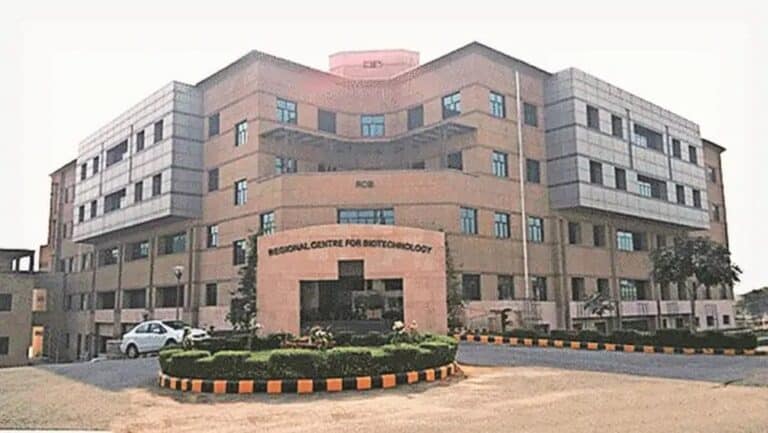
About Indian Biological Data Bank:
- The government has for the first time set up a digitised repository where Indian researchers will store biological data from publicly funded research, reducing their dependency on American and European data banks.
- The digitised data will be stored on a four-petabyte supercomputer called ‘Brahm’.
- A petabyte equals 10,00,000 gigabytes (gb).
- The government has mandated that data from all publicly funded research should be stored in this central repository.
- So it will not only provide a platform to researchers to securely store their data within the country, it will also provide access to a large database of indigenous sequences for analyses.
- At present, most Indian researchers depend on the European Molecular Biology Laboratory (EMBL) and National Center for Biotechnology Information databases for storing the biological data.
- There are other smaller datasets available with some institutes, but those are not accessible to all. This will be the first national data repository, where the data will not only be submitted from across India but can be accessed by researchers from across India.
Database:
- The bio-bank, which cost about Rs 85 crore to set up, currently accepts neucleotide sequences — the digitised genetic makeup of humans, plants, animals, and microbes.
- There are now 200 billion base pair data in the bio-bank, including 200 human genomes sequenced under the ‘1,000 Genome Project’, which is an international effort to map the genetic variations in people.
- The database also contains most of the 2.6 lakh Sars-Cov-2 genomes sequenced by the Indian Sars-CoV-2 Genomic Consortium (INSACOG).
- The database will also store the 25,000 sequences of mycobacterium tuberculosis.
- The database currently also stores the genomic sequences of crops such as rice, onion, tomatoes and mustard, among others.
- The database currently offers two mechanisms for data submission to researchers.
- One, open access where the data uploaded can be immediately used by other researchers from across the country and
- two, controlled access where the data will not be openly shared for a number of years before being opened up to all.
- The biobank also has a backup data ‘Disaster Recovery’ site at National Informatics Centre (NIC)-Bhubaneshwar.
Source : Indian Express






 Last updated on March, 2026
→ UPSC Final Result 2025 is now out.
→ UPSC has released UPSC Toppers List 2025 with the Civil Services final result on its official website.
→ Anuj Agnihotri secured AIR 1 in the UPSC Civil Services Examination 2025.
→ UPSC Marksheet 2025 is now out.
→ UPSC Notification 2026 & UPSC IFoS Notification 2026 is now out on the official website at upsconline.nic.in.
→ UPSC Calendar 2026 has been released.
→ Check out the latest UPSC Syllabus 2026 here.
→ UPSC Prelims 2026 will be conducted on 24th May, 2026 & UPSC Mains 2026 will be conducted on 21st August 2026.
→ The UPSC Selection Process is of 3 stages-Prelims, Mains and Interview.
→ Prepare effectively with Vajiram & Ravi’s UPSC Prelims Test Series 2026 featuring full-length mock tests, detailed solutions, and performance analysis.
→ Enroll in Vajiram & Ravi’s UPSC Mains Test Series 2026 for structured answer writing practice, expert evaluation, and exam-oriented feedback.
→ Join Vajiram & Ravi’s Best UPSC Mentorship Program for personalized guidance, strategy planning, and one-to-one support from experienced mentors.
→ Shakti Dubey secures AIR 1 in UPSC CSE Exam 2024.
→ Also check Best UPSC Coaching in India