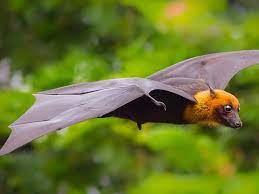
About Indian Flying Fox bat:
- It is a species of flying fox native to the Indian subcontinent.
- It is one of the largest bats in the world.
- The nectar and fruit-eating flying fox (Pteropus giganteus) is generally considered a vermin as they raid orchards.
- It is a keystone species causing seed dispersals of many plants in tropical systems.
- Appearance
- The Indian flying fox is so called due to its unique, fox-like appearance: reddish-brown coat, characteristically long snout as well as large eyes. And indeed, this animal resembles a little fox with wings.
- Distribution: These bats are endemic to South Central Asia, found from Pakistan and China to the Maldive Islands.
- Habits and Lifestyle
- It is highly social creatures, forming large roosts of several hundred animals.
- These bats live in a ‘vertical’, male-dominated hierarchy system, where higher-ranked individuals occupy higher spots of the tree, while lower-ranked individuals remain on lower spots.
- Diet: They maintain a frugivorous diet, supplementing it with insects as well as flowers, containing juice and nectar.
- Threat: Being external roosters, the flying fox is exposed to predators and disturbances apart from environmental indicators such as heat and light.
- Conservation status
- IUCN:Least concern
- The Wildlife (Protection) Act of 1972:Schedule II
Q1) What is the keystone species?
A keystone species is a species that has a disproportionately large impact on its ecosystem relative to its abundance or biomass. The term “keystone species” was first introduced by the American ecologist Robert T. Paine in 1969 to describe certain species that play a critical role in maintaining the structure, diversity, and function of an ecosystem.
Source: Flying fox bats for vigilance while day-roosting, finds study






 Last updated on March, 2026
→ UPSC Final Result 2025 is now out.
→ UPSC has released UPSC Toppers List 2025 with the Civil Services final result on its official website.
→ Anuj Agnihotri secured AIR 1 in the UPSC Civil Services Examination 2025.
→ UPSC Marksheet 2025 is now out.
→ UPSC Notification 2026 & UPSC IFoS Notification 2026 is now out on the official website at upsconline.nic.in.
→ UPSC Calendar 2026 has been released.
→ Check out the latest UPSC Syllabus 2026 here.
→ UPSC Prelims 2026 will be conducted on 24th May, 2026 & UPSC Mains 2026 will be conducted on 21st August 2026.
→ The UPSC Selection Process is of 3 stages-Prelims, Mains and Interview.
→ Prepare effectively with Vajiram & Ravi’s UPSC Prelims Test Series 2026 featuring full-length mock tests, detailed solutions, and performance analysis.
→ Enroll in Vajiram & Ravi’s UPSC Mains Test Series 2026 for structured answer writing practice, expert evaluation, and exam-oriented feedback.
→ Join Vajiram & Ravi’s Best UPSC Mentorship Program for personalized guidance, strategy planning, and one-to-one support from experienced mentors.
→ Shakti Dubey secures AIR 1 in UPSC CSE Exam 2024.
→ Also check Best UPSC Coaching in India