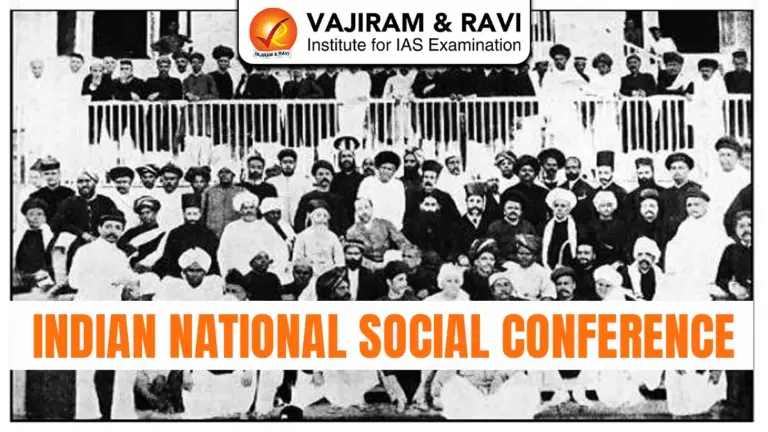
The Indian National Social Conference (INSC) was established in 1887 by M.G. Ranade and Raghunath Rao to promote social reform in colonial India. It was created when the Indian National Congress chose to focus mainly on political issues and avoid sensitive social matters. The Indian National Social Conference acted as a parallel platform to address social evils while remaining closely associated with the Congress.
Indian National Social Conference Background
The Indian National Social Conference was founded in 1887 by M.G. Ranade and Raghunath Rao to promote social reforms after the Indian National Congress decided to focus mainly on political issues.
- The Indian National Congress, formed in 1885, was initially expected to work on political as well as social reforms.
- Many leaders, including Ranade, believed that India’s progress required the elimination of social evils like child marriage, caste discrimination, and polygamy.
- However, a strong section within Congress argued that social reforms were controversial and divisive and could weaken political unity.
- Due to this difference of opinion, social issues were excluded from the Congress agenda.
- To fill this gap, M.G. Ranade and Raghunath Rao founded the Indian National Social Conference in 1887.
- Its first session was held in Madras alongside the Congress session.
- From then onwards, it met every year at the same venue and time as the Congress, making it a social reform wing of the national movement.
- The Conference aimed to bring together reformers, intellectuals, and progressive leaders to fight social backwardness in India.
Major Social Reforms Promoted by Indian National Social Conference
The Indian National Social Conference worked actively to remove social evils and promote progressive values in Indian society. It aimed to create a modern, just, and inclusive social order alongside the national movement.
- Opposition to Child Marriage: The Conference strongly criticized early marriages and promoted the Pledge Movement to encourage people to vow against child marriage.
- Support for Inter-Caste Marriages: It encouraged marriages across caste boundaries to reduce caste discrimination and promote social equality.
- Condemnation of Polygamy: The Conference opposed the practice of having multiple wives, especially highlighting its negative impact on women.
- Fight Against Kulinism: It condemned the kulin system in Bengal, which allowed upper-caste men to have several wives for social prestige.
- Promotion of Women’s Rights: It supported women’s education, widow remarriage, and better social status for women.
- Social Awareness Campaigns: The Conference organized discussions, speeches, and resolutions to spread awareness against social evils across India.





Indian National Social Conference Decline
- The Indian National Social Conference gradually lost importance after 1900 as political nationalism became the main focus of the freedom movement.
- The rise of extremist leaders in the Indian National Congress shifted attention away from social reform to direct political struggle against British rule.
- Many Congress leaders began to believe that political freedom should come before social reform, reducing support for the Conference.
- The Conference depended heavily on the Indian National Congress, and as Congress priorities changed, the Social Conference weakened.
- The death of M.G. Ranade in 1901 was a major setback, as he was the main driving force behind the movement.
- Social reform activities started being taken over by regional and community-based organizations, reducing the national role of the Conference.
- Growing religious and communal politics also made unified social reform more difficult.
- By the early 20th century, the Indian National Social Conference had lost its influence and relevance in national public life.

 Last updated on March, 2026
→ UPSC Final Result 2025 is now out.
→ UPSC has released UPSC Toppers List 2025 with the Civil Services final result on its official website.
→ Anuj Agnihotri secured AIR 1 in the UPSC Civil Services Examination 2025.
→ UPSC Marksheet 2025 is now out.
→ UPSC Notification 2026 & UPSC IFoS Notification 2026 is now out on the official website at upsconline.nic.in.
→ UPSC Calendar 2026 has been released.
→ Check out the latest UPSC Syllabus 2026 here.
→ UPSC Prelims 2026 will be conducted on 24th May, 2026 & UPSC Mains 2026 will be conducted on 21st August 2026.
→ The UPSC Selection Process is of 3 stages-Prelims, Mains and Interview.
→ Prepare effectively with Vajiram & Ravi’s UPSC Prelims Test Series 2026 featuring full-length mock tests, detailed solutions, and performance analysis.
→ Enroll in Vajiram & Ravi’s UPSC Mains Test Series 2026 for structured answer writing practice, expert evaluation, and exam-oriented feedback.
→ Join Vajiram & Ravi’s Best UPSC Mentorship Program for personalized guidance, strategy planning, and one-to-one support from experienced mentors.
→ Shakti Dubey secures AIR 1 in UPSC CSE Exam 2024.
→ Also check Best UPSC Coaching in India
Indian National Social Conference FAQs
Q1. What was the Indian National Social Conference?+
Q2. Who founded the Indian National Social Conference?+
Q3. Why was the Indian National Social Conference formed?+
Q4. Where was the first session of the Indian National Social Conference held?+
Q5. What were the main objectives of the Indian National Social Conference?+
Tags: indian national social conference