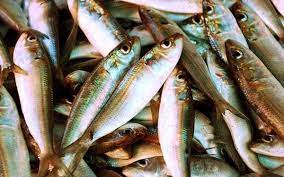
About Indian oil sardine:
- It is a very important pelagic fish species.
- It contributes to about 15% of the total marine fish production in India.
- Local names of oil sardine are, Mathi, Nalla mathi, Nei chala (Malayalam); Bhutai (Kannada); Tarli (Marathi and Hindi).
- Distribution
- It is distributed on the entire west coast from Gujarat to Kerala and also on the Tamil Nadu, Andhra Pradesh and Orissa coasts in the east.
- Highest abundance and large scale shoaling are observed off Kerala and Karnataka coasts.
- Significance
- The sardines are an ecologically important part of the marine ecosystem as they form an intermediate link in the food web and serve as prey for larger predators.
- The genome assembly of the sardines is a valuable tool for studying how fish adapt to climate change.
- Indian oil sardine is a vital fisheries resource in the Indian subcontinent, contributing substantially, approximately 10%, to the total marine fisheries industry in India.
- One of the findings of the study is that Indian oil sardines exist in two highly distinct stocks, one in the Indian waters and another in the Gulf of Oman.
- The researchers have identified the genes involved in the biosynthesis of polyunsaturated fatty acids (PUFA) of the oil sardine, offering insights into the genomic mechanisms behind the high nutritional quality of the fish.
Q1) What are Saturated fatty acids?
Saturated fatty acids are a type of fatty acid molecule in which the carbon atoms are bonded to as many hydrogen atoms as possible, resulting in a structure where all carbon-carbon bonds are single bonds. This saturated arrangement of hydrogen atoms on the carbon chain makes the fatty acid “saturated” with hydrogen atoms.
Source: Scientists unravel genome secrets of Indian oil sardine





 Last updated on March, 2026
→ UPSC Final Result 2025 is now out.
→ UPSC has released UPSC Toppers List 2025 with the Civil Services final result on its official website.
→ Anuj Agnihotri secured AIR 1 in the UPSC Civil Services Examination 2025.
→ UPSC Marksheet 2025 is now out.
→ UPSC Notification 2026 & UPSC IFoS Notification 2026 is now out on the official website at upsconline.nic.in.
→ UPSC Calendar 2026 has been released.
→ Check out the latest UPSC Syllabus 2026 here.
→ UPSC Prelims 2026 will be conducted on 24th May, 2026 & UPSC Mains 2026 will be conducted on 21st August 2026.
→ The UPSC Selection Process is of 3 stages-Prelims, Mains and Interview.
→ Prepare effectively with Vajiram & Ravi’s UPSC Prelims Test Series 2026 featuring full-length mock tests, detailed solutions, and performance analysis.
→ Enroll in Vajiram & Ravi’s UPSC Mains Test Series 2026 for structured answer writing practice, expert evaluation, and exam-oriented feedback.
→ Join Vajiram & Ravi’s Best UPSC Mentorship Program for personalized guidance, strategy planning, and one-to-one support from experienced mentors.
→ Shakti Dubey secures AIR 1 in UPSC CSE Exam 2024.
→ Also check Best UPSC Coaching in India