Indian Railways Latest News
- 2025 marked a landmark year for Indian Railways, as it completed rail connectivity to Kashmir Valley and Aizawl (Mizoram), bridged major geographic frontiers, advanced freight corridors and technology.
- At the same time, the Railways faced challenges in safety, crowd management, and financial sustainability.
From Kashmir to Mizoram: Railways Reach India’s Final Frontiers
- In 2025, Indian Railways achieved historic milestones by extending the rail grid to: Kashmir Valley in the North; Aizawl in the East.
- These connections brought the country’s last major unlinked regions into the national railway network, symbolising territorial integration and strategic connectivity.
Kashmir Rail Link: A Century-Old Dream Realised
- The idea of a railway line to the Kashmir Valley dates back to 1898, when Maharaja Pratap Singh first conceived it.
- However, after Partition, the Jammu–Sialkot rail link went to Pakistan, cutting off Jammu and Kashmir from India’s rail grid.
- While Jammu was connected by rail in 1972, the Valley remained unlinked.
- The long-cherished dream was realised in June 2025, when PM Modi inaugurated the final 63-km Katra–Sangaldan section of the 272-km Udhampur–Srinagar–Baramulla Rail Link (USBRL).
- A Vande Bharat train began services between Katra and Srinagar.
- The project’s most challenging stretch was the 111-km Katra–Banihal section, featuring:
- T-50, India’s longest operational transport tunnel (12.77 km)
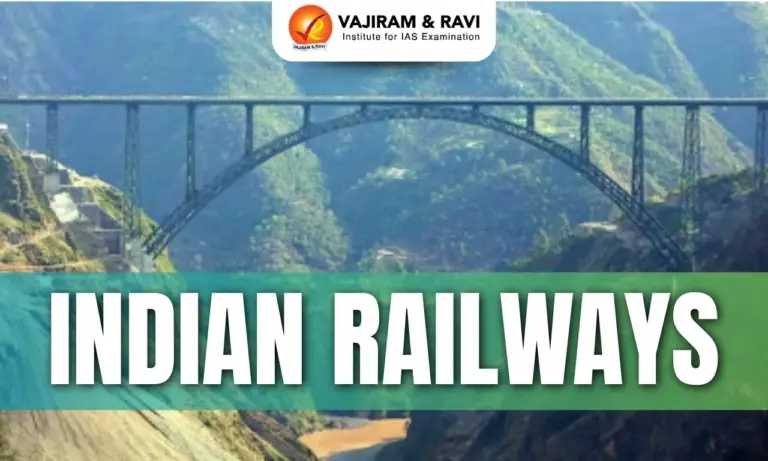
- Chenab Bridge, the world’s highest railway arch bridge (359 metres above the riverbed)
- Anji Bridge, Indian Railways’ first cable-stayed bridge
Mizoram: Railways Overcome Geography
- Mizoram’s late rail arrival was largely due to its difficult terrain and landlocked location—bordering Myanmar, Bangladesh, and northeastern states.
- Until recently, the state depended almost entirely on roads for passenger and freight movement.
- The breakthrough came with the inauguration of the Bairabi–Sairang line in September 2025, linking Bairabi to Sairang, near Aizawl.
- This marked the first-ever rail connectivity to the Mizoram capital.
- With this, Aizawl became the fourth northeastern capital—after Guwahati (Dispur), Agartala, and Itanagar—to be linked to the Indian Railways network.
Pamban Bridge: Reconnecting South India’s Maritime Edge
- Another landmark in 2025 was the inauguration of the 2.08-km new Pamban Bridge, replacing the 110-year-old cantilever bridge.
- It is India’s first vertical-lift railway sea bridge. It connects Rameswaram to the mainland across the Palk Strait.
Western Dedicated Freight Corridor (WDFC)
- First rail car ran on the 102-km Vaitarna–Jawaharlal Nehru Port (JNPT) section.
- Marks progress in India’s high-capacity, freight-only rail infrastructure.
Strategic Himalayan Connectivity
- Rishikesh–Karnaprayag Line
-
- 125 km line with strategic and pilgrimage significance
- Includes India’s longest transportation tunnel (14.57 km) (yet to be operational)
- Serves as a gateway to the China border and boosts Char Dham Yatra connectivity
- Bhanupalli–Bilaspur–Beri Line
-
- Connects Punjab to Himachal Pradesh
- Proposed extension up to Ladakh
- Progress delayed due to financial disputes between the state government and Railways





A Year Shadowed by Safety Concerns
- The year began with tragedy:
- Stampede at New Delhi Railway Station (February 15, 2025)
- 18 deaths, 15 injuries, during rush for Prayagraj-bound Mahakumbh trains
- Railways’ Response
-
- Launch of a nationwide project to create holding areas on high-passenger platforms
- Renewed emphasis on crowd management and passenger safety
Challenges in Freight Loading: Railways’ Revenue Backbone Under Strain
- Freight transport is the financial backbone of Indian Railways, contributing nearly 65% of its total earnings.
- However, despite its importance, the system faces persistent challenges, especially in last-mile delivery and competitiveness with road transport.
High Dependence on Bulk Commodities
- Indian Railways remains predominantly a bulk commodity transporter.
- Coal alone accounts for nearly 50% of total freight loading.
- Seven major commodities—coal, pig iron and steel, iron ore, cement, fertilisers, petroleum, oil and lubricants (POL), and containers—together accounted for 87.3% of total freight loading (in FY 25)
- Such heavy reliance exposes Railways to demand fluctuations in a few sectors.
Concerns Raised by the Standing Committee on Railways
- The Standing Committee on Railways has flagged structural risks in the freight basket:
- Called for diversification into automobiles, FMCG, and e-commerce to cushion demand volatility.
- Noted that year-on-year revenue growth from coal and iron ore is slowing, raising sustainability concerns.
Need to Raise Rail’s Modal Share
- Railways’ modal share in freight transport stands at about 27%, significantly lower than road transport.
- Enhancing this share is critical for revenue growth and environmental gains.
Operational Focus Areas in 2025
- Indian Railways prioritised:
- Removal of traffic bottlenecks
- Track expansion and capacity augmentation
- Passenger amenities under the Amrit Bharat Station Scheme
- Safety upgrades across high-density routes
Ambitious Traffic and Freight Targets
- With expanded infrastructure, Railways aims to achieve by 2030:
- 3 billion tonnes of freight loading – Up from 1.6 billion tonnes in FY25
- 10 billion passengers annually – A 42% increase from nearly 7 billion passengers in FY25
- These targets reflect Railways’ central role in India’s logistics and mobility strategy.
Technological Advancements
- Commissioning of Kavach 4.0 (advanced Automatic Train Protection system)
- Deployed over 738 route kilometres on two high-density corridors
- Rollout of: 13 Amrit Bharat trains for migrant workers; 2 Namo Bharat Rapid Rail Services for intercity commuters.
- Trials of Vande Bharat sleeper trains, signalling next-generation long-distance travel.
Financial Stress vs Green Promise
- Persistent Challenges – High revenue expenditure; Low earnings per route, affecting long-term financial health
- Green Mobility Advantage
- Despite financial strain, Railways remains one of India’s cleanest transport modes:
- Accounts for only ~1% of transport emissions
- Near-100% electrification of broad-gauge network
- Hydrogen-powered trains under development
- 2,626 solar-powered stations
- 898 MW of solar power used nationwide
- ~70% used for traction
- Despite financial strain, Railways remains one of India’s cleanest transport modes:

 Last updated on March, 2026
→ UPSC Final Result 2025 is now out.
→ UPSC has released UPSC Toppers List 2025 with the Civil Services final result on its official website.
→ Anuj Agnihotri secured AIR 1 in the UPSC Civil Services Examination 2025.
→ UPSC Marksheet 2025 is now out.
→ UPSC Notification 2026 & UPSC IFoS Notification 2026 is now out on the official website at upsconline.nic.in.
→ UPSC Calendar 2026 has been released.
→ Check out the latest UPSC Syllabus 2026 here.
→ UPSC Prelims 2026 will be conducted on 24th May, 2026 & UPSC Mains 2026 will be conducted on 21st August 2026.
→ The UPSC Selection Process is of 3 stages-Prelims, Mains and Interview.
→ Prepare effectively with Vajiram & Ravi’s UPSC Prelims Test Series 2026 featuring full-length mock tests, detailed solutions, and performance analysis.
→ Enroll in Vajiram & Ravi’s UPSC Mains Test Series 2026 for structured answer writing practice, expert evaluation, and exam-oriented feedback.
→ Join Vajiram & Ravi’s Best UPSC Mentorship Program for personalized guidance, strategy planning, and one-to-one support from experienced mentors.
→ Shakti Dubey secures AIR 1 in UPSC CSE Exam 2024.
→ Also check Best UPSC Coaching in India
Indian Railways FAQs
Q1. Why was 2025 a landmark year for Indian Railways?+
Q2. What were the major infrastructure achievements in 2025?+
Q3. What safety challenges did Railways face in 2025?+
Q4. Why is freight loading a challenge for Indian Railways?+
Q5. How is Indian Railways contributing to green mobility?+
Tags: Indian Railways mains articles upsc current affairs upsc mains current affair