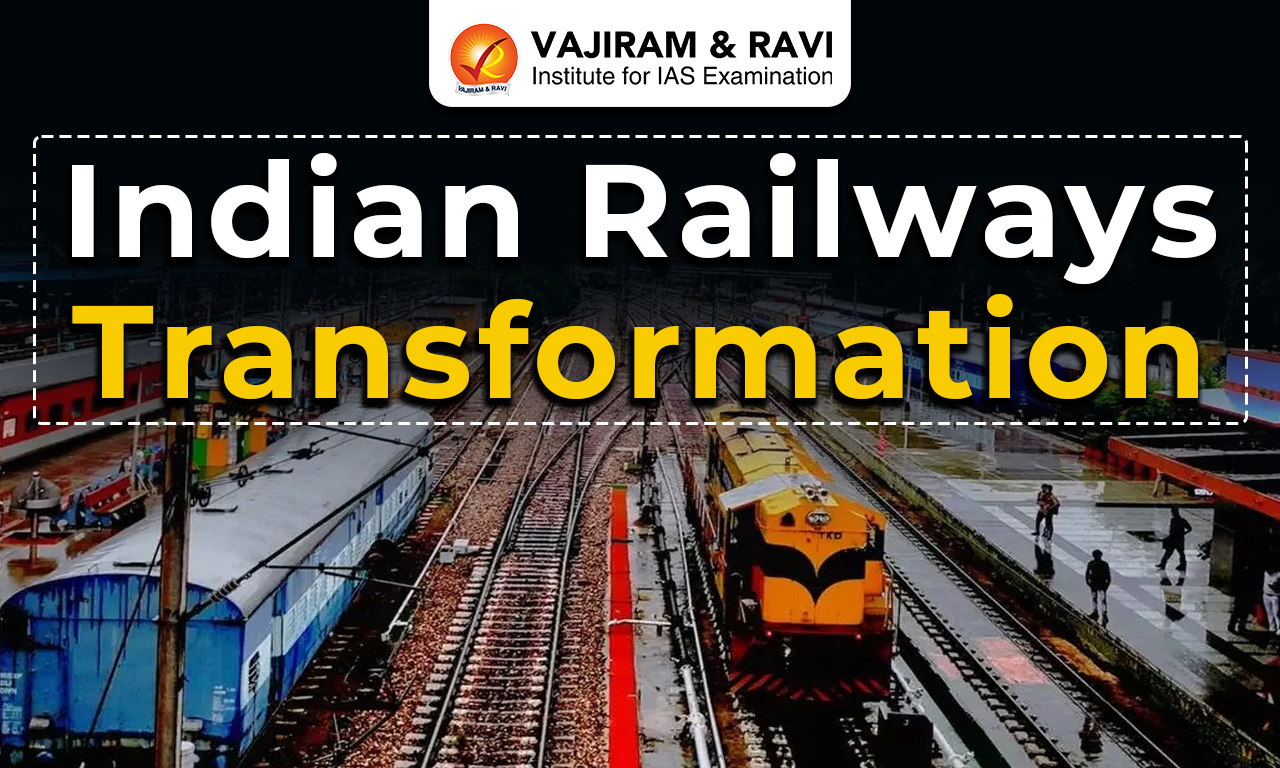
Indian Railways, carrying over 20 million passengers daily across more than 25,000 trains, operates on a vast track network that forms the backbone of the system. Over the past decade, this backbone has undergone significant modernisation, with large-scale track renewal, mechanised maintenance, and advanced inspection technologies improving safety, speed, and reliability across the network.
Key Factors Driving Indian Railways Transformation
Indian Railways’ growth in recent years has been driven by targeted structural reforms, technological upgrades and sustained public investment, transforming it into a faster, safer and more efficient transport system.
Key Factors Driving Indian Railways Transformation are:
Infrastructure Upgradation and Track Modernisation: A major driver of transformation is large-scale track infrastructure renewal and strengthening.
- Around 55,000 km of track has been renewed since 2014 under modernisation programmes.
- Introduction of long rail panels (260 metres) has reduced rail joints, improving ride quality and track continuity.
- Wider adoption of 60-kg rails has enhanced load-bearing capacity and speed potential of the network.
Preventive Maintenance and Predictive Asset Management: Indian Railways has transitioned from reactive maintenance to condition-based and predictive maintenance systems.
- Extensive use of Ultrasonic Flaw Detection (USFD) for identifying internal rail defects.
- Advanced inspection techniques such as phased-array testing and magnetic particle inspection.
- Significant reduction in rail and weld failures due to early fault detection.
Mechanisation of Track Maintenance Operations: A key structural reform has been the rapid expansion of track mechanisation. Mechanisation has improved productivity, precision, and maintenance efficiency.
- The track machine fleet has increased from 748 units (2014) to 1,785 units (2026).
- Machines are deployed for tamping, ballast cleaning, and rail grinding operations.
- Large-scale mechanised deep screening of ballast has improved track stability and drainage efficiency.
Strengthening of Track Components and Safety Infrastructure: Focus on track safety engineering and structural reinforcement has improved operational reliability.
- Installation of extensive safety fencing to prevent trespassing and cattle run-over incidents.
- Deployment of thick-web switches, weldable CMS crossings, and heavy-duty sleepers.
- Use of H-beam sleepers and long welded rails for enhanced track stability and thermal resilience.
Capacity Enhancement and Higher Speeds: Better tracks have directly increased train speed and capacity.
- Tracks capable of 130 kmph and above have increased significantly.
- Nearly 80% of the network now supports speeds of 110 kmph and above.
- This has reduced travel time and improved service efficiency.
Safety Enhancement and Accident Reduction: Train safety has improved sharply due to infrastructure and technological upgrades.
- Consequential train accidents have declined significantly over the last decade.
- Accident rate per million train kilometres has improved by nearly 90 per cent.
- Introduction of Kavach automatic train protection system has further strengthened safety by reducing the risk of signal passing at danger (SPAD) and collision in high-density routes.
Digitalisation and Integrated Asset Monitoring Systems: Indian Railways is increasingly relying on digital infrastructure and data-driven decision systems.
- Implementation of Track Management Systems (TMS) integrating multiple inspection datasets.
- GPS-enabled monitoring systems for ride quality analysis and defect localisation.
- Centralised data platforms for maintenance planning and prioritisation.
Challenges in Indian Railways Transformation
Despite significant modernisation, Indian Railways continues to face deep structural and operational challenges that constrain its efficiency and long term sustainability.
- Financial Fragility and High Operating Ratio: With an operating ratio of 98.43 percent, nearly all earnings are consumed by expenses, leaving minimal surplus for reinvestment and reinforcing dependence on government support.
- Premiumisation versus Inclusivity: The growing focus on premium trains with higher fares risks marginalising low income passengers, while shortages in general and sleeper coaches lead to overcrowding and safety concerns.
- Limited Coverage of Safety Systems: Indigenous safety technology like Kavach remains deployed on only about 1452 route kilometres, keeping a large part of the network dependent on human intervention.
- Declining Freight Share: The freight share of railways has declined sharply from 85 percent in 1951 to 27 percent in 2022 due to cross subsidisation that makes freight tariffs less competitive.
- Rising Debt Burden: Increasing borrowings through Indian Railway Finance Corporation including about 70000 crore rupees for financial year 2027 are adding to long term fiscal stress and repayment obligations.
- Project Delays and Cost Overruns: Land acquisition issues and administrative bottlenecks continue to delay project completion, leading to capital lock in and rising costs.
- Commodity Dependence in Freight: Heavy reliance on coal which contributes around 48 percent of freight revenue exposes the railways to risks arising from energy transition and declining fossil fuel demand.


Way Forward
To ensure sustainable and balanced transformation, Indian Railways requires a multi-dimensional strategy.
- Expansion of Safety Systems Nationwide: Accelerate large-scale deployment of Kavach and other automatic train protection systems across high-density and high-speed routes to minimise human error-based accidents.
- Financial Sustainability and Cost Efficiency: Improve operating ratio through energy efficiency, asset monetisation, better freight pricing strategy, and reduction in operational inefficiencies.
- Freight Sector Competitiveness: Rebalance freight policy by improving pricing efficiency, expanding containerisation, and building dedicated freight corridors to regain modal share from road transport.
- Balanced Passenger Service Development: Ensure equitable focus between premium and non-premium segments by increasing availability of general and sleeper coaches to avoid overcrowding and maintain inclusivity.
- Diversification of Freight Basket: Reduce overdependence on coal by expanding high-value freight segments such as agri-logistics, industrial goods, automobiles, and container traffic.
- Faster Project Execution: Streamline land acquisition processes, improve inter-agency coordination, and adopt time-bound project monitoring to reduce delays and cost overruns.
- Deepening Digital and AI Integration: Expand use of AI-based predictive maintenance, IoT-enabled sensors, and integrated digital control systems for real-time monitoring and decision-making.

 Last updated on Oct, 2026
→ UPSC 2027 Notification will be released on 13 January 2027 at upsconline.nic.in.
→ Check Nobel Prize 2026 Winners List here.
→ Download PIB PRiSM Monthly Magazine 2026 here.
→ Check UPSC Monthly Current Affairs Magazine The Recitals here.
→ Check out the latest UPSC Syllabus here.
→ Download UPSC Model Answers for Mains 2026
→ UPSC Mains Question Paper 2026 is out now for Essay & GS Paper 1, 2, 3 & 4.
→ UPSC Calendar 2027 has been released.
→ Enroll in Vajiram & Ravi’s UPSC Mains Test Series 2027 for structured answer writing practice, expert evaluation, and exam-oriented feedback.
→ Join Vajiram & Ravi’s UPSC Mentorship Program 2027 for personalized guidance, strategy planning, and one-to-one support from experienced mentors.
→ Go through the UPSC Mains Previous Year Papers to enhance your preparation.
→ UPSC has released UPSC Toppers List 2025 with the Civil Services final result on its official website.
→ Also check Best UPSC Coaching in India
Indian Railways Transformation FAQs
Q1. What is driving the transformation of Indian Railways?+
Q2. How has safety improved in Indian Railways?+
Q3. What is the role of technology in this transformation?+
Q4. Why is mechanisation important in railway maintenance?+
Q5. What are the key challenges for Indian Railways?+
Tags: indian railways transformation