Indian Star Tortoise Latest News
A slow-moving star-shelled tortoise was rescued and safely relocated to another part of the forest while escaping a fast-spreading ground fire in the Amrabad Tiger Reserve.
About Indian Star Tortoise
- It is a medium-sized terrestrial tortoise.
- Scientific Name: Geochelone elegans.
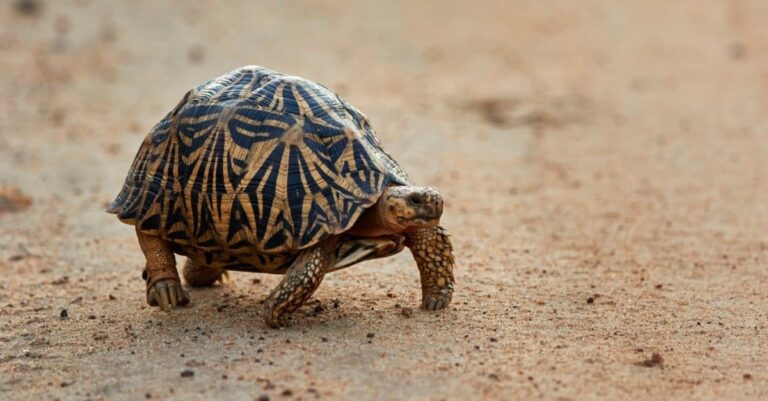
- Their name comes from the star-like pattern on their shell.
- These patterns act as camouflage by helping to break up the shell outline so that it more easily blends into its surroundings.
- Distribution: It is native to India, Pakistan and Sri Lanka where it inhabits dry areas and scrub forest.




Indian Star Tortoise Features
- It can grow to 10 inches long. Females are considerably larger than their male counterparts.
- The upper shell or carapace is coloured in dark brown or black with light brown or yellow lines radiating out from the centre of each scale to provide the star pattern.
- The pattern itself varies greatly from a simple pale ‘X’ shape in some tortoises to an intricate and complex array of stripes spreading from the central hub of each scale.
- It has a lifespan of 35 to 80 years in the wild.
- These solitary animals do not hibernate, but when it is very dry and hot, or very cold, they stay inactive.
Indian Star Tortoise Conservation Status
It is classified as ‘Vulnerable‘ under the IUCN Red List.
Key Facts about Amrabad Tiger Reserve
- It is located in the Nallamala hills of the Eastern Ghats in Telangana state.
- Spread over 2611.4 sq.km., it is one of the largest tiger reserves in India.
- It was originally part of the larger Nagarjunasagar-Srisailam Tiger Reserve before the bifurcation of Andhra Pradesh and Telangana in 2014.
- The reserve is renowned for its rugged terrain, deep valleys, and dense forests.
- Within the reserve lies the historic Nagalapuram fort.
- The Krishna River and its perennial streams originating within the reserve contribute to the water supply of major reservoirs such as the Srishailam Dam and Nagarjunsagar Dam.
- The Chenchu tribe is one of the major tribal communities that live in the ATR.
- Flora:
- It is characterized by dry deciduous forests, primarily made up of sal, teak, bamboo, and acacia trees.
- The forest is rich in medicinal plants and shrubs, which have long been used by local tribes for traditional remedies.
- Fauna:
- Apart from tigers, the reserve supports a range of other big cats, such as leopards and wild cats, along with herbivores like sambar deer, chital (spotted deer), nilgai (blue bull), wild boar, and the Indian bison (gaur).
- Over 303 bird species have been identified in this region. Some important groups include Eagles, Pigeons, Doves, Cuckoos, Woodpeckers, Drongos, etc.
Source: DC

 Last updated on March, 2026
→ UPSC Final Result 2025 is now out.
→ UPSC has released UPSC Toppers List 2025 with the Civil Services final result on its official website.
→ Anuj Agnihotri secured AIR 1 in the UPSC Civil Services Examination 2025.
→ UPSC Marksheet 2025 is now out.
→ UPSC Notification 2026 & UPSC IFoS Notification 2026 is now out on the official website at upsconline.nic.in.
→ UPSC Calendar 2026 has been released.
→ Check out the latest UPSC Syllabus 2026 here.
→ UPSC Prelims 2026 will be conducted on 24th May, 2026 & UPSC Mains 2026 will be conducted on 21st August 2026.
→ The UPSC Selection Process is of 3 stages-Prelims, Mains and Interview.
→ Prepare effectively with Vajiram & Ravi’s UPSC Prelims Test Series 2026 featuring full-length mock tests, detailed solutions, and performance analysis.
→ Enroll in Vajiram & Ravi’s UPSC Mains Test Series 2026 for structured answer writing practice, expert evaluation, and exam-oriented feedback.
→ Join Vajiram & Ravi’s Best UPSC Mentorship Program for personalized guidance, strategy planning, and one-to-one support from experienced mentors.
→ Shakti Dubey secures AIR 1 in UPSC CSE Exam 2024.
→ Also check Best UPSC Coaching in India
Indian Star Tortoise FAQs
Q1. What is the scientific name of the Indian Star Tortoise?+
Q2. In which countries is the Indian Star Tortoise naturally found?+
Q3. What type of habitat does the Indian Star Tortoise prefer?+
Q4. What is the IUCN conservation status of the Indian Star Tortoise?+
Tags: indian star tortoise prelims pointers upsc current affairs upsc prelims current affairs