About Indian Tectonic Plate
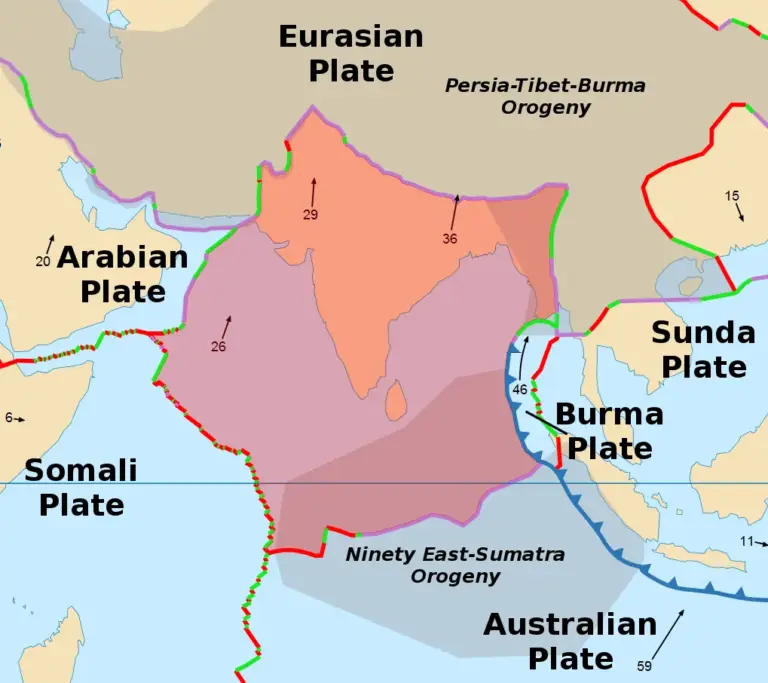
- It is a minor tectonic plate located in the north east hemisphere.
- It is bound by four major tectonic plates. North of the Indian plate is the Eurasian plate; to the south east is the Australian plate; to the south-west is the African plate; and to the west is the Arabian plate.
- As the Indian plate is moves northward relative to the Eurasian plate and collides with it, a convergent boundary is created.
- On the opposite side, the Indo-African boundary is divergent.
- The western Indo-Arabian boundary is lateral relative to each other, giving rise to a transform boundary.
- It was previously thought that the Indian and Australian plates formed one single plate as there is no clear type of boundary but recent seismologic evidence suggests that the two plates will have a transform boundary, as the drift velocities of these two plates are different even if the general direction of motion of the two plates is similar.
- The collision of the Indian plate with the Eurasian plate about 50 million years ago resulted in the erection of the Himalayan Mountains.
- As the Indian plate is still active today and drifts at a velocity of about 5 cm per year, earthquakes occur in the northern part of the plate.
- Because of the low-grade metamorphism that resulted in the collision of the Indian plate with the Eurasian plate, many micaceous minerals are mined in the northern part of the country; in fact, India is the greatest producer of mica blocks and splitting.
Q1) What is Plate Tectonics?
Plate tectonics is the theory that Earth’s outer shell is divided into large slabs of solid rock, called “plates,” that glide over Earth’s mantle, the rocky inner layer above Earth’s core. Earth’s solid outer layer, which includes the crust and the uppermost mantle, is called the lithosphere. Below the lithosphere is the asthenosphere — a viscous layer kept malleable by heat deep within the Earth. It lubricates the undersides of Earth’s tectonic plates, allowing the lithosphere to move around.
Source: Indian tectonic plate is breaking into two. It’s happening beneath Tibet






 Last updated on March, 2026
→ UPSC Final Result 2025 is now out.
→ UPSC has released UPSC Toppers List 2025 with the Civil Services final result on its official website.
→ Anuj Agnihotri secured AIR 1 in the UPSC Civil Services Examination 2025.
→ UPSC Marksheet 2025 is now out.
→ UPSC Notification 2026 & UPSC IFoS Notification 2026 is now out on the official website at upsconline.nic.in.
→ UPSC Calendar 2026 has been released.
→ Check out the latest UPSC Syllabus 2026 here.
→ UPSC Prelims 2026 will be conducted on 24th May, 2026 & UPSC Mains 2026 will be conducted on 21st August 2026.
→ The UPSC Selection Process is of 3 stages-Prelims, Mains and Interview.
→ Prepare effectively with Vajiram & Ravi’s UPSC Prelims Test Series 2026 featuring full-length mock tests, detailed solutions, and performance analysis.
→ Enroll in Vajiram & Ravi’s UPSC Mains Test Series 2026 for structured answer writing practice, expert evaluation, and exam-oriented feedback.
→ Join Vajiram & Ravi’s Best UPSC Mentorship Program for personalized guidance, strategy planning, and one-to-one support from experienced mentors.
→ Shakti Dubey secures AIR 1 in UPSC CSE Exam 2024.
→ Also check Best UPSC Coaching in India