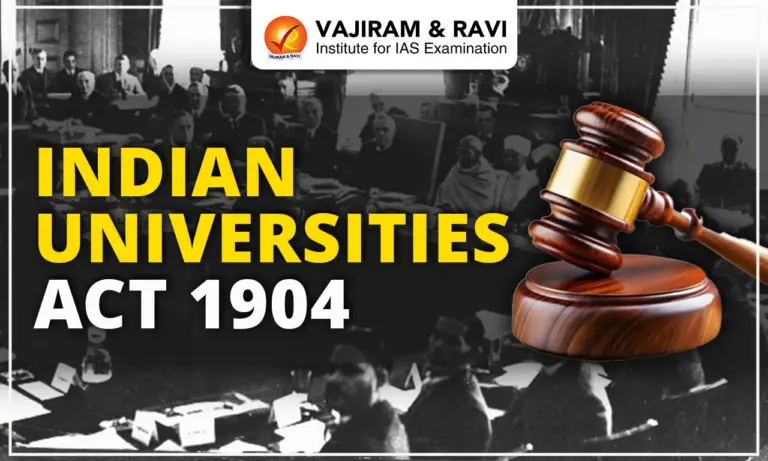
In 1904, the British Viceroy, Lord Curzon, introduced the Indian Universities Act 1904 based on the recommendations of the Raleigh Commission. The Act tightened government control over Indian universities, reflecting Curzon’s broader aim of curbing the growing wave of nationalism in the country. Earlier, the Hunter Commission had suggested reforms for a stronger education system, but its proposals were never fully implemented. When Curzon became Governor-General, he took it upon himself to push reforms across various spheres of administration, and education became one of his main targets.
Indian Universities Act 1904 Background
The early twentieth century in India was marked by growing political unrest. The colonial government claimed that education under private management had deteriorated and that universities were turning into breeding grounds for political revolutionaries. Nationalists, while acknowledging a decline in quality, blamed the government for failing to tackle widespread illiteracy.
In this context, the Raleigh Commission was set up in 1902 to examine the functioning of Indian universities and suggest reforms for their constitution and administration. Notably, the commission was restricted from reviewing primary or secondary education. Drawing on its recommendations, the British government introduced the Indian Universities Act in 1904.
Indian Universities Act 1904 Provisions
- Reconstitution of Governing Bodies: University Senates were restructured and reduced in size (50-100 members). Each member had a six-year term.
- Elected Fellows: Limited to 50 in Bombay, Calcutta, and Madras universities, and 15 in the other universities.
- Government Control: Majority of fellows to be appointed by the government, increasing state influence in university administration.
- Governor-General’s Authority: Empowered to fix the territorial limits of universities and regulate affiliation of colleges.
- Control Over Universities: Universities and affiliated colleges were placed directly under government supervision.
- Financial Grant: Annual grant of ₹5 lakh for five years introduced to promote higher education and research, marking the beginning of university grants in India





Indian Universities Act 1904 Recommendation
- Stronger Government Control: The Act placed universities firmly under colonial supervision, reducing their autonomy.
- Suppression of Nationalism: By limiting the role of Indians in university governance and tightening rules for private colleges, the Act sought to curb nationalist activities on campuses.
- Improved Research & Funding: The five-year grant of ₹5 lakh did promote some improvements in higher education and research facilities, marking the start of state-sponsored university grants.
- Criticism from Nationalists: National leaders and students viewed the Act as an attack on educational freedom and a deliberate attempt to stifle political awakening among youth.
Legacy: While it improved administrative efficiency and research, its controlling provisions created resentment and further fueled the nationalist movement.
| Also Check Other Posts | |
| Adi Shankaracharya | Bhakti Movements in North India |
| Ramanujacharya | Bhakti Movements in South India |
| Vallabhacharya | Guru Nanak |
| Lingayats and Veerashaivas | Basavanna |

 Last updated on March, 2026
→ UPSC Final Result 2025 is now out.
→ UPSC has released UPSC Toppers List 2025 with the Civil Services final result on its official website.
→ Anuj Agnihotri secured AIR 1 in the UPSC Civil Services Examination 2025.
→ UPSC Marksheet 2025 is now out.
→ UPSC Notification 2026 & UPSC IFoS Notification 2026 is now out on the official website at upsconline.nic.in.
→ UPSC Calendar 2026 has been released.
→ Check out the latest UPSC Syllabus 2026 here.
→ UPSC Prelims 2026 will be conducted on 24th May, 2026 & UPSC Mains 2026 will be conducted on 21st August 2026.
→ The UPSC Selection Process is of 3 stages-Prelims, Mains and Interview.
→ Prepare effectively with Vajiram & Ravi’s UPSC Prelims Test Series 2026 featuring full-length mock tests, detailed solutions, and performance analysis.
→ Enroll in Vajiram & Ravi’s UPSC Mains Test Series 2026 for structured answer writing practice, expert evaluation, and exam-oriented feedback.
→ Join Vajiram & Ravi’s Best UPSC Mentorship Program for personalized guidance, strategy planning, and one-to-one support from experienced mentors.
→ Shakti Dubey secures AIR 1 in UPSC CSE Exam 2024.
→ Also check Best UPSC Coaching in India
Indian Universities Act 1904 FAQs
Q1. Which act was passed in 1904?+
Q2. What is the Indian Act 1904?+
Q3. Who was the Viceroy of the Indian University Act 1904?+
Q4. What is the Indian Education Policy 1904?+
Q5. What are the features of 1904 Act?+
Tags: indian universities act 1904