About Indian Wild Ass:
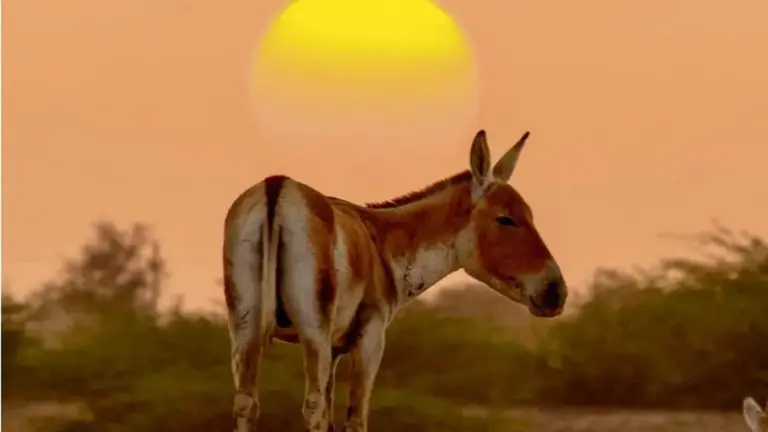
- It is a sub-species of Asian Wild Ass (Equus hemionus).
- It is locally called as khur in Gujarat region.
- It possesses remarkable characteristics, such as its ability to survive in the extreme conditions of Gujarat’s Wild Ass Sanctuary.
- The primary food source for these animals is the grass that grows on the islands in the desert.
- Appearance: It is characterized by distinctive white markings on the anterior part of the rump and on the posterior part of the shoulder and a stripe down the back that is bordered by white.
- Distribution: The khur was formerly widespread in the arid zone of northwestern India and Pakistan, westwards through much of central Asia. It is now limited to the Little Rann of Kutch in Gujarat.
- Habitat: Desert and grassland ecosystems.
- Conservation Status:
- IUCN: Near threatened.
- CITES: Appendix II
- Wildlife Protection Act (1972): Schedule-I
- Ecological Significance: It is helpful in seed dispersal in the area which helps in promoting vegetation growth and diversity. Besides, it is helpful in habitat creation for other species as it clears pathways by consuming grasses.
- Threats: Increased human presence, both for salt farming and agriculture, extensive cattle grazing, poses a major threat to the delicate ecosystem and its wildlife.
- Irrigation canals that bring water to the southern rim of the Little Rann can also add salinity to the soil.
Q1: Where is Rann of Kutch located ?
The Rann of Kachchh is a salt marshy land in the Thar Desert in the Kachchh district of western Gujarat. It lies between Gujarat in India and the Sindh province in Pakistan. It comprises around 30,000 sq. km of land which includes The Great Rann of Kachchh, The Little Rann of Kachchh and Banni grassland.
Source: Population of wild asses, an ‘endangered species’, has been rising since 1976 in Gujarat: State govt






 Last updated on March, 2026
→ UPSC Final Result 2025 is now out.
→ UPSC has released UPSC Toppers List 2025 with the Civil Services final result on its official website.
→ Anuj Agnihotri secured AIR 1 in the UPSC Civil Services Examination 2025.
→ UPSC Marksheet 2025 is now out.
→ UPSC Notification 2026 & UPSC IFoS Notification 2026 is now out on the official website at upsconline.nic.in.
→ UPSC Calendar 2026 has been released.
→ Check out the latest UPSC Syllabus 2026 here.
→ UPSC Prelims 2026 will be conducted on 24th May, 2026 & UPSC Mains 2026 will be conducted on 21st August 2026.
→ The UPSC Selection Process is of 3 stages-Prelims, Mains and Interview.
→ Prepare effectively with Vajiram & Ravi’s UPSC Prelims Test Series 2026 featuring full-length mock tests, detailed solutions, and performance analysis.
→ Enroll in Vajiram & Ravi’s UPSC Mains Test Series 2026 for structured answer writing practice, expert evaluation, and exam-oriented feedback.
→ Join Vajiram & Ravi’s Best UPSC Mentorship Program for personalized guidance, strategy planning, and one-to-one support from experienced mentors.
→ Shakti Dubey secures AIR 1 in UPSC CSE Exam 2024.
→ Also check Best UPSC Coaching in India