4G Stack Latest News
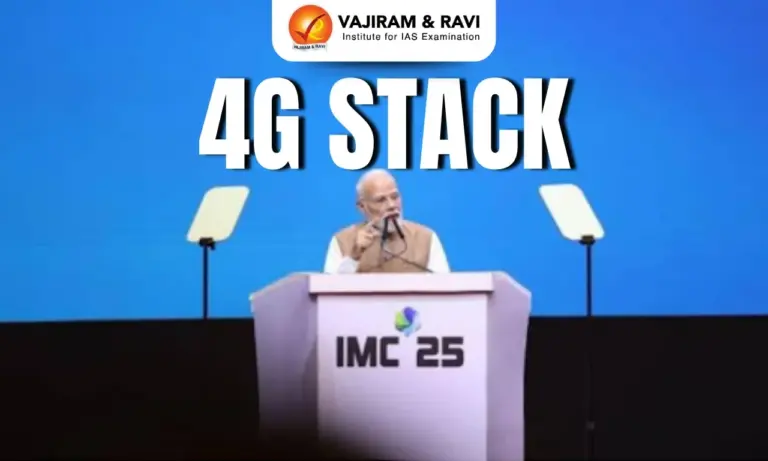
- PM Modi, at the India Mobile Congress 2025, announced that India’s indigenously developed 4G stack would not only enhance connectivity and internet access within the country but also be exported globally.
- The 4G stack, comprising both telecom hardware and software, is part of India’s strategy to challenge China’s dominance in building telecom infrastructure across the developing world, especially in Africa.
- Though less advanced than Chinese systems from Huawei and ZTE, India aims to expand its footprint through affordable, secure, and locally developed solutions.
- Additionally, New Delhi plans to export its ‘India Stack’ — a set of digital public infrastructure tools for identity, data management, and payments — positioning itself as a key player in digital transformation for developing nations.
About 4G
- 4G (fourth-generation wireless) represents the broadband mobile communication standard that succeeded 3G and paved the way for 5G.
- It delivers high-speed internet, enabling HD video streaming and wireless broadband connectivity without wired ISP networks.
- Technologies such as LTE, MIMO, and OFDM power 4G networks, offering higher bandwidth, lower latency, and improved efficiency.





India’s Indigenous 4G Technology Stack: A Step Toward Telecom Self-Reliance
- India has achieved a landmark milestone by launching its first indigenously developed 4G network, featuring 98,000 Swadeshi 4G towers powered entirely by homegrown technology.
- The initiative — led by C-DOT (core network), Tejas Networks (radio access), and TCS (system integration) — marks a major stride towards Aatmanirbhar Bharat and digital self-reliance.
- Previously reliant on foreign technology for 2G, 3G, and 4G, India built this stack from scratch during the Covid-19 pandemic, demonstrating resilience, innovation, and supply-chain independence.
- The BSNL 4G stack, designed to be cloud-native and 5G-ready, provides seamless connectivity and ensures easy future upgrades.
- Complementary initiatives such as the Bharat 6G Alliance, Telecom Technology Development Fund, and 100 5G/6G labs are accelerating India’s journey toward Viksit Bharat 2047 and global digital leadership.
Key Features of India’s 4G Stack
- End-to-End Indigenous Stack: Combines Tejas Networks’ Radio Access Network, C-DOT’s Core Network, and TCS integration, cutting reliance on foreign vendors.
- Cloud-Native Software Architecture: Enables scalability, rapid upgrades, and smooth migration to 5G.
- Future-Proof Design: The network is 5G-ready, allowing upgrades without replacing existing infrastructure.
- Nationwide Reach: Deployed across 92,000+ sites, bringing connectivity to 22 million citizens, including tribal and remote areas.
Benefits and Impact of the Indigenous 4G Stack
- Strategic Autonomy and Digital Sovereignty – Empowers India to control its telecom infrastructure, ensuring security, independence, and reduced dependence on global tech providers.
- Digital Inclusion: Enhances access to education, healthcare, and agriculture services through reliable internet in remote regions.
- Secure Connectivity for Armed Forces: Strengthens national security and ensures secure communications for defense personnel.
- Employment and Supply-Chain Development – Boosts domestic manufacturing, generates jobs, and nurtures a skilled workforce, reinforcing India’s telecom ecosystem.
- Global Export Potential – The indigenous 4G stack meets domestic needs while holding export potential, with interest from multiple developing nations.
- Rapid Indigenous Development – Developed in just 22 months, the project highlights India’s engineering capability and agility in telecom innovation.
- Swadeshi Principle in Action – Reflects the Swadeshi ethos, promoting domestic production, local skills, and community enterprise, driving inclusive growth.
India’s 4G Export Plan as a Response to China’s Digital Silk Road
- For years, China’s telecom giants like Huawei and ZTE have dominated developing markets by offering low-cost telecom infrastructure, backed by state funding and easy loans.
- According to the Organisation for Research on China and Asia, this strategy forms part of China’s Digital Silk Road (DSR) — a key component of the Belt and Road Initiative aimed at expanding digital connectivity across the developing world.
- The DSR promotes Chinese technology, goods, and services, including cellular networks, mobile apps, and payment platforms, while cementing China’s role as the global supplier of digital infrastructure.
- It represents a state–industry alliance, supported by policy banks and political backing, to strengthen China’s technological and geopolitical influence.

 Last updated on March, 2026
→ UPSC Final Result 2025 is now out.
→ UPSC has released UPSC Toppers List 2025 with the Civil Services final result on its official website.
→ Anuj Agnihotri secured AIR 1 in the UPSC Civil Services Examination 2025.
→ UPSC Marksheet 2025 is now out.
→ UPSC Notification 2026 & UPSC IFoS Notification 2026 is now out on the official website at upsconline.nic.in.
→ UPSC Calendar 2026 has been released.
→ Check out the latest UPSC Syllabus 2026 here.
→ UPSC Prelims 2026 will be conducted on 24th May, 2026 & UPSC Mains 2026 will be conducted on 21st August 2026.
→ The UPSC Selection Process is of 3 stages-Prelims, Mains and Interview.
→ Prepare effectively with Vajiram & Ravi’s UPSC Prelims Test Series 2026 featuring full-length mock tests, detailed solutions, and performance analysis.
→ Enroll in Vajiram & Ravi’s UPSC Mains Test Series 2026 for structured answer writing practice, expert evaluation, and exam-oriented feedback.
→ Join Vajiram & Ravi’s Best UPSC Mentorship Program for personalized guidance, strategy planning, and one-to-one support from experienced mentors.
→ Shakti Dubey secures AIR 1 in UPSC CSE Exam 2024.
→ Also check Best UPSC Coaching in India
4G Stack FAQs
Q1. What is India’s 4G stack?+
Q2. Why is the 4G stack important for India?+
Q3. How does the 4G stack challenge China’s Digital Silk Road?+
Q4. What are the key features of India’s 4G stack?+
Q5. What impact will this have globally?+
Tags: 4G stack mains articles upsc current affairs upsc mains current affairs