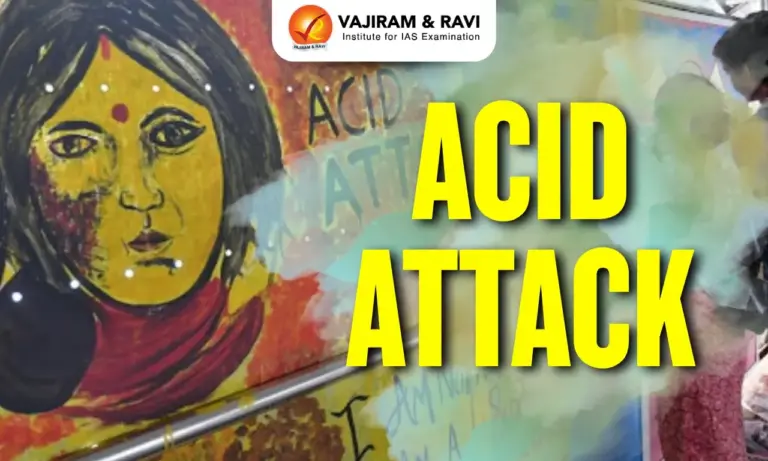
Acid Attack Latest News
- The recent acquittal of the three main accused in a 2009 acid attack case by a Delhi court marked a crushing setback for survivor and social activist Shaheen Malik, who fought a 16-year legal battle.
- The case underscores broader concerns in India’s legal response to acid attacks.
- Official data shows that of 703 acid attack cases pending in courts in 2023, there were only 16 convictions against 27 acquittals, highlighting low conviction rates and prolonged judicial processes that continue to challenge survivors’ access to justice.
Acid Attacks
- An acid attack involves throwing a corrosive substance—most commonly sulphuric, hydrochloric, or nitric acid—on a person with the intent to cause harm.
- Such attacks can melt skin and flesh, expose or dissolve bones, and result in severe burns, blindness, disfigurement, permanent disability, or even a vegetative state.
- Beyond physical injuries, survivors suffer deep psychological trauma and long-term socio-economic harm.
- Acid attacks remain a grave, underreported crime in India, rooted in gendered violence, easy access to corrosives, and systemic enforcement gaps, with devastating consequences for survivors’ lives and livelihoods.
Who Are the Victims and Why Do Attacks Occur
- Acid attacks in India predominantly target women and young girls, with perpetrators almost always men, making it a form of gender-based violence.
- Children may also be harmed when present near the intended victim.
- A 2024 analysis of 55 Indian cases by Acid Survivors Trust International found that in cases involving women, three-fourths were driven by personal relationship issues—often revenge for rejecting romantic or sexual advances.
- Other motives include dowry disputes, suspicions of infidelity, and domestic abuse.
- For male victims, property disputes, professional jealousy, and political rivalry were more common.
How Often Do Acid Attacks Occur
- According to the National Crime Records Bureau, 207 acid attacks were reported in 2023, up from 202 in 2022 and 176 in 2021, alongside 65 attempted attacks.
- Experts note significant underreporting due to stigma, family pressure, and fear of retaliation; ASTI estimates around 1,000 attacks annually in India.
Geographical Hotspots and Contributing Factors
- In 2023, the highest reported cases were in West Bengal (57), Uttar Pradesh (31), and Gujarat (15).
- Researchers link prevalence not only to patriarchal attitudes and weak enforcement, but also to easy availability of acids near industrial clusters (e.g., textiles and rubber), which lowers barriers to access.





Legal Framework Against Acid Attacks in India
- Following the Supreme Court of India’s landmark judgment in Laxmi vs Union of India, acid attacks were recognised as a distinct criminal offence, separate from general injury provisions.
Current Law and Punishments
- With the replacement of the IPC by the Bharatiya Nyaya Sanhita, acid attacks are covered under Section 124:
- Acid attack: Minimum 10 years’ imprisonment, extendable to life imprisonment, plus a “just and reasonable” fine to cover medical expenses
- Attempt to acid attack: 5–7 years’ imprisonment
- All public and private hospitals are legally required to provide free first aid and medical treatment to acid attack victims. Failure to comply is punishable with up to one year imprisonment and/or a fine.
Regulation of Acid Sale
- The Supreme Court also directed strict regulation of acid sales:
- Buyers must produce photo identification
- Sellers must maintain a register of acid purchases
- However, these rules are poorly enforced in most States.
Gaps in Implementation: Survivor’s Experience
- Acid attack survivor and activist Shaheen Malik highlighted serious systemic failures:
- 16-year delay in trial despite cases meant to be fast-tracked
- Shoddy police investigation, ignored evidence, and judicial insensitivity
- Pressure from police to settle out of court
- Compensation of ₹3 lakh received nine years after the attack
- She noted that none of the 300 survivors supported by her foundation have secured convictions, though many were offered monetary settlements.
Judicial Outcomes and NCRB Data
- According to the National Crime Records Bureau (NCRB) for 2023:
- 113 cases under investigation, plus 53 pending from previous year
- 86 cases chargesheeted and sent for trial
- 649 cases pending trial overall
- Only 16 convictions, while 27 cases ended in acquittal
Ending Acid Attacks: What More Needs to Be Done
- Survivors call for a comprehensive ban or far stricter control over acid sales, alongside rigorous enforcement of existing rules.
- Accountability of local authorities is crucial, with penalties for illegal sales to deter misuse.
- Ensure Timely Compensation and Care– Compensation must be disbursed within months, enabling prompt medical treatment and rehabilitation. Delays undermine recovery and access to justice.
- Implement Comprehensive Rehabilitation – The Justice J S Verma Committee recommended a national fund to cover survivors’ lifelong medical, psychological, educational, and skilling needs.
Learning from Bangladesh’s Experience
- Bangladesh enacted stringent laws against acid sale and attacks in 2002, backed by sustained public awareness campaigns.
- According to the Acid Survivors Foundation of Bangladesh, reported attacks fell sharply—from 494 in 2002 to 13 in 2024, declining 15–20% annually.
Strengthen the Justice Delivery System
- Improving convictions requires:
- Sensitisation of police, prosecutors, and judges
- Fast-track courts for acid attack cases
- Legal aid and counselling for survivors
- Penalising judicial delays to ensure timely trials
Source: TH

 Last updated on March, 2026
→ UPSC Final Result 2025 is now out.
→ UPSC has released UPSC Toppers List 2025 with the Civil Services final result on its official website.
→ Anuj Agnihotri secured AIR 1 in the UPSC Civil Services Examination 2025.
→ UPSC Marksheet 2025 is now out.
→ UPSC Notification 2026 & UPSC IFoS Notification 2026 is now out on the official website at upsconline.nic.in.
→ UPSC Calendar 2026 has been released.
→ Check out the latest UPSC Syllabus 2026 here.
→ UPSC Prelims 2026 will be conducted on 24th May, 2026 & UPSC Mains 2026 will be conducted on 21st August 2026.
→ The UPSC Selection Process is of 3 stages-Prelims, Mains and Interview.
→ Prepare effectively with Vajiram & Ravi’s UPSC Prelims Test Series 2026 featuring full-length mock tests, detailed solutions, and performance analysis.
→ Enroll in Vajiram & Ravi’s UPSC Mains Test Series 2026 for structured answer writing practice, expert evaluation, and exam-oriented feedback.
→ Join Vajiram & Ravi’s Best UPSC Mentorship Program for personalized guidance, strategy planning, and one-to-one support from experienced mentors.
→ Shakti Dubey secures AIR 1 in UPSC CSE Exam 2024.
→ Also check Best UPSC Coaching in India
Acid Attack FAQs
Q1. What are the current legal punishments for acid attacks in India?+
Q2. What does the data say about acid attack conviction rates?+
Q3. What are the primary motives behind these attacks in India?+
Q4. What regulations exist regarding the sale of acid?+
Q5. What steps are suggested to improve the situation for survivors?+
Tags: acid attack mains articles upsc current affairs upsc mains current affairs