Aviation Sector Latest News
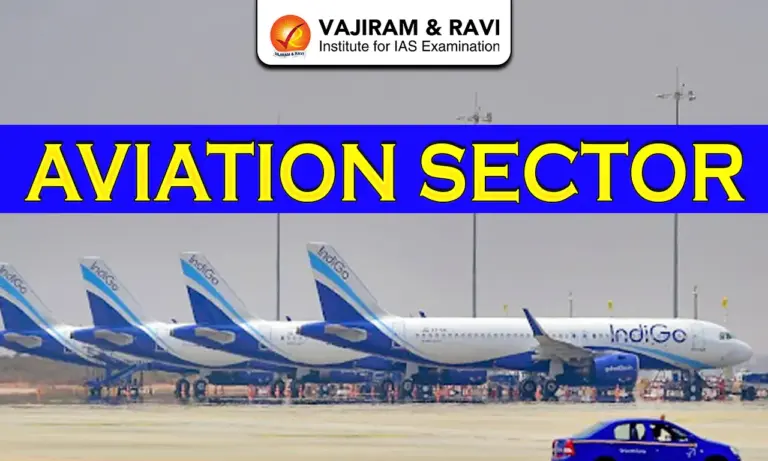
- India’s aviation sector is under scrutiny following repeated operational disruptions, safety incidents, and declining service reliability among major airlines.
Overview of India’s Aviation Sector
- India has emerged as the world’s third-largest domestic aviation market, operating over 840 aircraft and carrying more than 350 million passengers annually.
- Rapid growth in air travel demand has been driven by rising incomes, regional connectivity initiatives, and fleet expansion by private carriers.
- However, this expansion has increasingly exposed structural weaknesses related to manpower, regulation, and market concentration.
- While the sector contributes significantly to economic integration and mobility, its current growth trajectory appears overstretched, raising concerns about sustainability, safety, and passenger welfare.





Operational Disruptions and Safety Concerns
- The past year witnessed multiple operational failures, including mass flight cancellations, prolonged delays, and safety-related incidents.
- A major disruption in December involving IndiGo acted as a failed “stress test” for the system, revealing vulnerabilities that go beyond a single airline.
- These incidents were not isolated but indicative of system-wide constraints, with airlines operating close to their maximum capacity.
- The rising frequency of safety notices issued by the aviation regulator points to deeper compliance and oversight challenges.
Pilot Shortage and Flight Duty Time Constraints
- One of the most critical structural challenges is the acute shortage of trained pilots. India’s aviation expansion has outpaced its training capacity.
- New Flight Duty Time Limitation (FDTL) norms, which mandate longer rest periods and reduced night operations, have made existing airline schedules difficult to sustain.
- Major airlines operate with a pilot-to-aircraft ratio significantly below global benchmarks, increasing fatigue risks and operational fragility.
- While India may require 25,000-30,000 pilots over the next decade, licensing and training bottlenecks have constrained supply, forcing airlines to rely on costly and limited foreign pilots as stopgap measures.
Regulatory Capacity and Oversight Gaps
- Regulatory stress has compounded operational issues.
- The aviation regulator faces significant staff shortages, with a large proportion of technical positions vacant despite rapid sectoral growth.
- In practice, disruptions have often been managed through ad hoc exemptions rather than strict enforcement of safety norms.
- This approach reflects a shift toward crisis management instead of preventive regulation, weakening long-term institutional capacity and undermining confidence in oversight mechanisms.
Market Concentration and the Aviation Duopoly
- India’s domestic aviation market is highly concentrated, with two airline groups controlling nearly 90% of passenger traffic.
- This level of concentration transforms dominant carriers into systemically important entities whose failures directly impact national connectivity.
- On a majority of domestic routes, only one airline operates. Consequently, disruptions do not result in passenger redistribution but in the complete loss of connectivity, particularly affecting smaller cities and time-sensitive travel.
Entry of New Regional Airlines
- To address concentration and improve connectivity, the government has approved new regional airlines aimed at serving underserved routes.
- These entrants align with the objectives of the UDAN scheme, which has expanded regional air access across multiple States.
- However, past failures of regional airlines highlight persistent challenges such as high fuel costs, weak demand, infrastructure gaps, and intense price competition.
- Without sustained policy support, such as assured subsidies, better airport infrastructure, and relief from fuel price volatility, new entrants risk inheriting the same fragilities.
Structural Challenges and Fuel Price Volatility
- Aviation Turbine Fuel (ATF) remains one of the biggest cost drivers for Indian airlines.
- Prices are linked to global oil markets and currency fluctuations, exposing carriers to external shocks.
- Combined with thin profit margins, this volatility has historically contributed to airline failures.
- Globally, airlines maintain spare crew and capacity buffers to absorb shocks. Indian carriers, by contrast, operate at near-total utilisation, allowing minor disruptions to cascade across networks.
Source: TH

 Last updated on March, 2026
→ UPSC Final Result 2025 is now out.
→ UPSC has released UPSC Toppers List 2025 with the Civil Services final result on its official website.
→ Anuj Agnihotri secured AIR 1 in the UPSC Civil Services Examination 2025.
→ UPSC Marksheet 2025 is now out.
→ UPSC Notification 2026 & UPSC IFoS Notification 2026 is now out on the official website at upsconline.nic.in.
→ UPSC Calendar 2026 has been released.
→ Check out the latest UPSC Syllabus 2026 here.
→ UPSC Prelims 2026 will be conducted on 24th May, 2026 & UPSC Mains 2026 will be conducted on 21st August 2026.
→ The UPSC Selection Process is of 3 stages-Prelims, Mains and Interview.
→ Prepare effectively with Vajiram & Ravi’s UPSC Prelims Test Series 2026 featuring full-length mock tests, detailed solutions, and performance analysis.
→ Enroll in Vajiram & Ravi’s UPSC Mains Test Series 2026 for structured answer writing practice, expert evaluation, and exam-oriented feedback.
→ Join Vajiram & Ravi’s Best UPSC Mentorship Program for personalized guidance, strategy planning, and one-to-one support from experienced mentors.
→ Shakti Dubey secures AIR 1 in UPSC CSE Exam 2024.
→ Also check Best UPSC Coaching in India
Aviation Sector FAQs
Q1. Why is India’s aviation sector facing repeated disruptions?+
Q2. What role do Flight Duty Time norms play in recent disruptions?+
Q3. Why is market concentration a concern in Indian aviation?+
Q4. Can new regional airlines solve India’s aviation challenges?+
Q5. What is the long-term risk if reforms are delayed?+
Tags: aviation sector mains articles upsc current affairs upsc mains current affairs