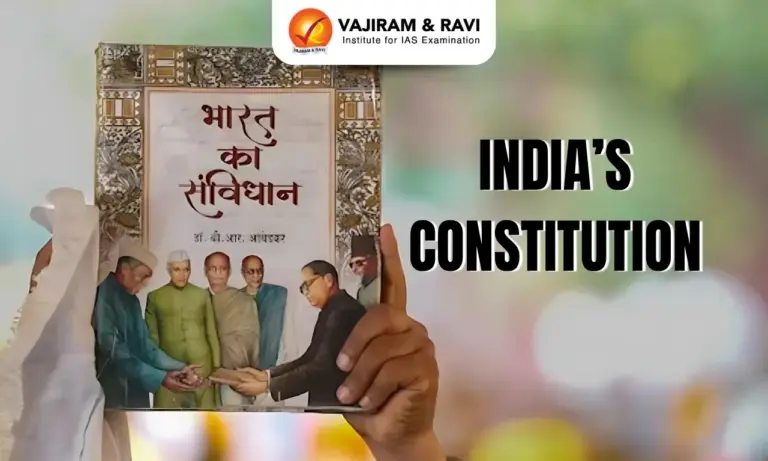
India’s Constitution Latest News
- Vice President Jagdeep Dhankhar has criticized the Emergency-era inclusion of the words “socialist” and “secular” in the Constitution’s Preamble, calling it a “sacrilege to the spirit of Sanatan”.
- These terms were added via the 42nd Constitutional Amendment, which made sweeping changes to the Constitution during the Emergency.
- Although many of those changes were reversed by the 44th Amendment in 1978, the additions to the Preamble remain intact.
Preamble The Vision of the Constitution
- Described by the Supreme Court in In Re: The Berubari Union (1961) as “a key to open the mind of the makers”.
- Serves as the vision statement of the Constitution, outlining its core values and purpose.
- Original Preamble (1950)
-
- Described India as a “Sovereign Democratic Republic”.
- Guaranteed Justice, Equality, Liberty, and Fraternity to all citizens.





Changes Introduced by the 42nd Amendment (1976)
- Inserted the words: “Socialist” and “Secular”, making India a “Sovereign Socialist Secular Democratic Republic”.
- Added the word “integrity” to the phrase on fraternity, which now reads: “assuring the dignity of the individual and the unity and integrity of the Nation…”
Other Key Provisions of the 42nd Amendment
- Introduced a new chapter on Fundamental Duties of citizens.
- Added several new Directive Principles of State Policy.
- Diluted judicial review by curbing the powers of the courts.
- Froze delimitation of constituencies, affecting electoral boundaries.
Reasons Behind the Changes Introduced by the 42nd Amendment
- Political Context: The Emergency Rule
-
-
- The 42nd Amendment was enacted during the Emergency (1975–77) when Prime Minister Indira Gandhi ruled by decree.
- Experts feel she wanted to reshape the Constitution to align with her ideological and political agenda.
-
- Parliament vs Judiciary: The Land Reform Debate
-
- Since the 1950s, a conflict between Parliament and the judiciary centered on land reform and the right to property.
- Courts often upheld fundamental rights over collective socioeconomic goals, which frustrated the political class.
Why “Socialist” Was Added
- The them PM Indira Gandhi had taken a clear leftward shift with moves like:
- Bank nationalization (1969)
- Abolition of privy purses (1971)
- Campaigning with “Garibi Hatao” (End Poverty)
- Adding “socialist” to the Preamble signaled alignment with her economic vision.
- The Statement of Objects and Reasons for the amendment said this addition was meant to prioritize Directive Principles over Fundamental Rights, which were seen as hindrances to socioeconomic reform.
Why “Secular” Was Added
- The move wasn’t directly explained, but analysts feel it occurred due to political rise of Bhartiya Jan Sangh.
- Indira Gandhi defended the addition by claiming the founding fathers intended India to be secular and socialist, and the amendment merely made it explicit.
Why “Integrity” Was Included
- Indira Gandhi’s Emergency-era rhetoric focused on national unity and the threat of divisive forces.
- The word “integrity” was added to reinforce the idea of an indivisible nation.
- Then Law Minister H. R. Gokhale emphasized that integrity meant maintaining the territorial and social indivisibility of the country.
Significance of These Changes
- The addition of “socialist” and “secular” to the Preamble through the 42nd Amendment was largely symbolic.
- As per the Supreme Court’s Berubari Union (1960) ruling, the Preamble is not a source of substantive power and not considered part of the Constitution’s enforceable text.
Secularism Already Ingrained in the Constitution
- Secularism is embedded in key constitutional provisions:
- Article 14 – Right to equality before the law.
- Article 15 – Prohibition of discrimination based on religion, caste, sex, etc.
- Article 16 – Equality of opportunity in public employment.
- These articles reflect the inherent secular nature of the Constitution even before 1976.
Judicial Endorsement of Secularism
- In Kesavananda Bharati (1973), a 13-judge bench held that secularism is a basic feature of the Constitution and cannot be removed or diluted.
- In S. R. Bommai (1994), the Supreme Court reaffirmed secularism as a cornerstone of Centre-State relations and constitutional governance.
Socialism and Directive Principles
- In Minerva Mills v Union of India (1980), the SC upheld that socialism is a constitutional ideal, rooted in Part IV: Directive Principles of State Policy.
- The Court noted that framing a Socialist State aimed to ensure social, economic, and political justice.
Recent Judicial Endorsement (2024)
- In November 2024, a two-judge Bench led by then CJI Sanjiv Khanna dismissed petitions challenging the inclusion of “secular” and “socialist” in the Preamble.
- The Court ruled that:
- These additions did not restrict legislation or governance.
- They did not infringe on fundamental rights or alter the basic structure of the Constitution.
Conclusion
- While added during the Emergency, the terms “secular” and “socialist” reflect values already embedded in the Constitution.
- The Supreme Court has consistently upheld these principles as basic features, immune to dilution or removal.

 Last updated on March, 2026
→ UPSC Final Result 2025 is now out.
→ UPSC has released UPSC Toppers List 2025 with the Civil Services final result on its official website.
→ Anuj Agnihotri secured AIR 1 in the UPSC Civil Services Examination 2025.
→ UPSC Marksheet 2025 is now out.
→ UPSC Notification 2026 & UPSC IFoS Notification 2026 is now out on the official website at upsconline.nic.in.
→ UPSC Calendar 2026 has been released.
→ Check out the latest UPSC Syllabus 2026 here.
→ UPSC Prelims 2026 will be conducted on 24th May, 2026 & UPSC Mains 2026 will be conducted on 21st August 2026.
→ The UPSC Selection Process is of 3 stages-Prelims, Mains and Interview.
→ Prepare effectively with Vajiram & Ravi’s UPSC Prelims Test Series 2026 featuring full-length mock tests, detailed solutions, and performance analysis.
→ Enroll in Vajiram & Ravi’s UPSC Mains Test Series 2026 for structured answer writing practice, expert evaluation, and exam-oriented feedback.
→ Join Vajiram & Ravi’s Best UPSC Mentorship Program for personalized guidance, strategy planning, and one-to-one support from experienced mentors.
→ Shakti Dubey secures AIR 1 in UPSC CSE Exam 2024.
→ Also check Best UPSC Coaching in India
India’s Constitution FAQs
Q1. What is the Preamble’s role in India’s Constitution? +
Q2. When were 'secular' and 'socialist' added to the Preamble? +
Q3. Why was 'socialist' added to India’s Constitution? +
Q4. Is secularism enforceable through India’s Constitution? +
Q5. What did the Supreme Court say about secularism? +
Tags: indias constitution mains article upsc mains current affairs