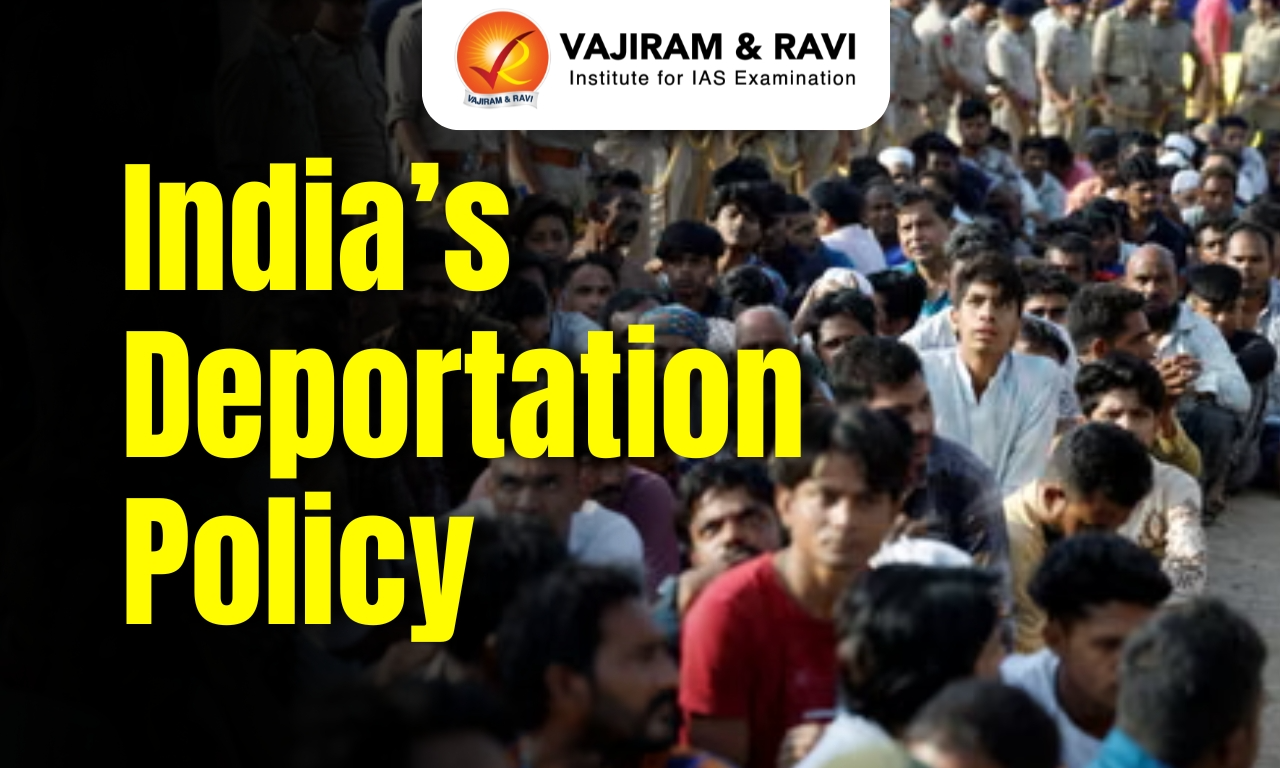
The Union Ministry of Home Affairs has introduced a new deportation policy to speed up the process of identifying and removing illegal migrants, especially from Bangladesh and Myanmar.
Deportation Meaning
Deportation is the formal legal process through which a foreign national is removed from a country for entering illegally or staying without valid documents. It involves proper identification, verification of nationality, and sending the person back to their home country through legal procedures.
To make this process more effective and streamlined, the Government of India has introduced a new deportation policy. The policy aims to ensure faster identification and removal of illegal migrants, particularly from Bangladesh and Myanmar, by creating a structured system at the district and state levels.
Key Features of the New Deportation Policy
The new policy introduces several administrative and operational measures to improve enforcement on the ground.
District-Level Special Task Forces: The policy directs every State and Union Territory to establish a district-level task force to detect, identify and deport illegal migrants from Bangladesh and Myanmar.
- States must submit a monthly report to the Union Ministry of Home Affairs on missing foreigners and those overstaying their visas to ensure continuous monitoring.
Time-Bound Verification Process: The policy emphasizes faster verification of suspected migrants to avoid delays.
- An upper limit of 90 days has been fixed to verify the antecedents of suspected Bangladeshi or Myanmarese nationals.
- This is especially important in cases where the person claims to be living in another state, so that authorities can check their details properly without unnecessary delay.
Establishment of Holding Centres: States must set up holding centres or camps with strong security arrangements.
- Private buildings could also be hired to run as holding centres, if government land was not available.
- These centres should have a 10-feet-high boundary wall with barbed wire fencing to restrict movement.
- They are not meant to function as prisons but as temporary facilities for migrants awaiting deportation.
Facilities in Holding Centres: To ensure basic dignity, certain minimum facilities must be provided
- Holding centres should not be run from jails, States may also consider the engagement of language interpreters, mobile medical dispensaries, and 24×7 ambulances, and special attention may be given to women/nursing mothers, transgender inmates, children, etc.
- It also suggested creche facilities for children, and educational facilities for child inmates, by admitting them in local schools nearby.
- The holding centre should have separate enclosures for men and women, and should be equipped with all amenities, including an LPG connection in the kitchen, fire safety system, strict access control measures and adequate security personnel for round-the-clock security
- Apart from the basic facilities to be provided like living area, toilets and bathrooms, kitchen, dining hall etc., other facilities like covered lobby outside rooms, open area, library, recreational facilities, space for indoor games, space for yoga and meditation and open space for outdoor games etc. may be provided depending upon availability of space.
Application to Foreigners’ Tribunals: The policy extends beyond newly identified migrants.
- The guidelines for holding centres also apply to individuals declared as foreigners by Foreigners’ Tribunals, particularly in Assam.
Document Cancellation and Blacklisting: To prevent misuse of identity systems, the policy includes strict measures on documentation.
- Documents obtained illegally, such as Aadhaar cards, PAN cards, and driving licenses, must be uploaded on a designated portal for cancellation.
- Deported individuals will be blacklisted by the Bureau of Immigration, preventing their re-entry into India.
Foreigners Identification Portal (FIP): A specialised digital platform has been introduced to record the biometric details, such as fingerprints and facial images, along with basic personal information of illegal foreign nationals who are intercepted.
Deportation Process: Migrants intercepted at land or maritime borders are to be returned to their country of origin after recording their biometric details.
- In cases where individuals are found to have crossed the border unintentionally and are not involved in any unlawful activity, they may be handed over to the border guarding authorities of the concerned country instead of being detained.


New Deportation Policy Need
The introduction of this policy is driven by multiple long-standing concerns.
- Historical and Ongoing Migration: Illegal migration into India has deep historical roots, beginning with the Partition of 1947 and increasing during the 1971 Bangladesh Liberation War. Even today, migration continues due to economic inequality, environmental stress, and political instability in neighbouring regions. Estimates suggest that India may have anywhere between 12 million to 20 million illegal migrants, although exact numbers remain uncertain due to lack of reliable data.
- Internal Security Concerns: Undocumented migrants may pose risks related to security, illegal activities, and identity fraud, making monitoring necessary. In several instances, authorities have found undocumented migrants using forged identity documents and being linked to smuggling networks or illegal activities.
- Pressure on Resources: Large-scale and unregulated migration places pressure on public services such as housing, healthcare, and employment, particularly in border states.
- Demographic and Social Impact: Migration has also influenced the demographic composition of certain regions, especially in states like Assam, and sometimes resulting in social tensions.
Challenges in Implementation of New Deportation Policy
While the New Deportation Policy is comprehensive, its implementation faces several practical difficulties.
- Identification Challenges: Many people lack proper documents, making it difficult to clearly distinguish between illegal migrants and Indian citizens, especially among poor and marginalized groups.
- Diplomatic Issues: Deportation requires the cooperation of the migrant’s home country. If the country refuses to accept them, migrants may remain in holding centres for long periods.
- Human Rights Concerns: Long detention periods can affect mental and physical well-being. There are concerns about living conditions and treatment in holding centres.
- Administrative Constraints: Local authorities may face shortage of manpower, training, and resources, making implementation difficult.
Way Forward
To make the policy more effective and balanced, certain steps are necessary.
- Transparent and Fair Verification: The identification process must be accurate and fair to avoid wrongful detention of citizens.
- Better Diplomatic Coordination: India should work with neighbouring countries to ensure smooth and timely acceptance of deported individuals.
- Ensure Humane Conditions: Holding centres must provide decent living conditions and basic rights, especially for women and children.
- Strengthen Border Management: Improving surveillance and infrastructure at borders can reduce illegal entry at the source.
- Improve Documentation Systems: Better identity systems and stricter verification can prevent misuse of documents.

 Last updated on Oct, 2026
→ UPSC 2027 Notification will be released on 13 January 2027 at upsconline.nic.in.
→ Check Nobel Prize 2026 Winners List here.
→ Download PIB PRiSM Monthly Magazine 2026 here.
→ Check UPSC Monthly Current Affairs Magazine The Recitals here.
→ Check out the latest UPSC Syllabus here.
→ Download UPSC Model Answers for Mains 2026
→ UPSC Mains Question Paper 2026 is out now for Essay & GS Paper 1, 2, 3 & 4.
→ UPSC Calendar 2027 has been released.
→ Enroll in Vajiram & Ravi’s UPSC Mains Test Series 2027 for structured answer writing practice, expert evaluation, and exam-oriented feedback.
→ Join Vajiram & Ravi’s UPSC Mentorship Program 2027 for personalized guidance, strategy planning, and one-to-one support from experienced mentors.
→ Go through the UPSC Mains Previous Year Papers to enhance your preparation.
→ UPSC has released UPSC Toppers List 2025 with the Civil Services final result on its official website.
→ Also check Best UPSC Coaching in India
India’s Deportation Policy FAQs
Q1. What is meant by deportation in India?+
Q2. Why has India introduced a new deportation policy?+
Q3. Which countries are mainly targeted under the policy?+
Q4. What is the time limit for verification under the policy?+
Q5. What is the role of district-level task forces in the deportation policy?+
Q6. What is the role of the Foreigners Identification Portal (FIP)?+
Tags: indias deportation policy