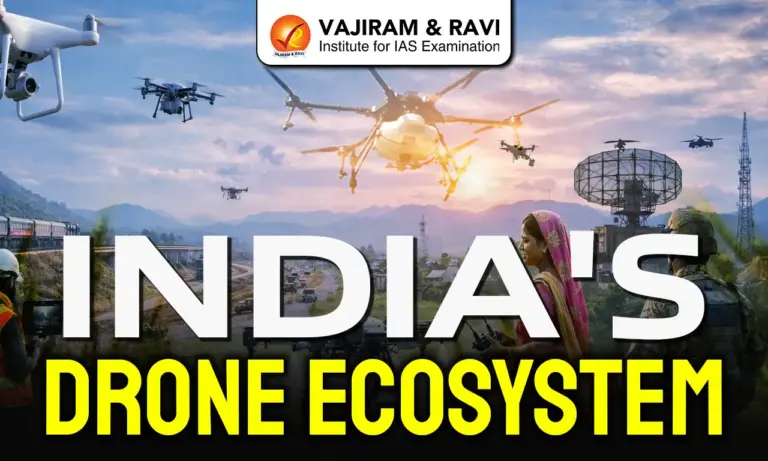
Over the past two decades, drone technology has moved from a specialised military tool to a widely used platform for governance and development across the world. India, too, has begun to harness its potential in a systematic manner.
In India, drones are used for land and property surveys, precision agriculture, infrastructure inspection, disaster management, railway and highway monitoring, and defence applications etc
As of February 2026, India has over 38,500 registered drones, nearly 40,000 certified remote pilots, and 244 approved training organisations, reflecting the expanding scale of India’s drone ecosystem.
India’s Drone Ecosystem Reforms
The transformation in India’s Drone Ecosystem is the result of deliberate policy reforms, simplified regulations, targeted financial incentives, and capacity-building initiatives. Key Reforms include:
Liberalised Drone Rules
- The Drone Rules, 2021, and their amendments in 2022 and 2023, have significantly liberalized the sector.
- Regulatory procedures were simplified, with forms reduced from 25 to 5 and approvals from 72 to just 4.
- Civilian drones weighing up to 500 kg can now operate across 90% of Indian airspace declared as Green Zones.
- Traditional pilot licenses have been replaced with DGCA-issued Remote Pilot Certificates, and government-issued IDs suffice for drone registration and operation.
Manufacturing Support
- The Production Linked Incentive (PLI) scheme for drones and components, with an approved outlay of ₹120 crore, encourages domestic manufacturing and supports start-ups and MSMEs.
Tax Incentive
- GST on drones was reduced to 5%, replacing earlier higher tax slabs. This move has reduced costs for commercial users and training institutions, encouraging wider adoption.
Digital Platforms
- Digital platforms like Digital Sky and eGCA have enabled single-window registration, pilot certification, airspace approvals, and flight planning, making compliance efficient and transparent.
- By February 2026, India had registered 38,575 drones and issued 39,890 Remote Pilot Certificates, while 244 DGCA-approved training organizations were operational nationwide, strengthening the pool of trained personnel.
Capacity Building
- Capacity-building programs such as SwaYaan and the National Innovation Challenge for Drone Application and Research (NIDAR) have promoted skill development, research, and start-up incubation.
- Platforms like Bharat Drone Shakti and the Bharat Drone Mahotsav provide visibility to innovations and foster collaboration between industry, start-ups, and research institutions.
Drone Applications in India
Drone technology has become a key enabler of efficient and responsive public service delivery in India. It has been integrated into flagship government schemes such as Survey of Villages and Mapping with Improvised Technology in Village Areas (SVAMITVA) and Pradhan Mantri Fasal Bima Yojana (PMFBY).
Agriculture and Farmer Empowerment
Namo Drone Didi Scheme
- The government launched the Namo Drone Didi Scheme in November 2023.
- It provides drones to women-led Self Help Groups (SHGs) to promote modern and efficient farming practices.
- The scheme aims to increase crop productivity, reduce input costs, and create sustainable livelihood opportunities for women.
- Since its inception, over 1,094 drones have been distributed, with more than 500 allocated under this initiative alone.
Land Mapping and Property Surveys
SVAMITVA Scheme
- The government launched the SVAMITVA Scheme (Survey of Villages and Mapping with Improvised Technology in Village Areas) in April 2020.
- SVAMITVA Scheme is a Central Sector Scheme launched by the Ministry of Panchayati Raj.
- It uses drone technology to map rural residential land, providing official “Record of Rights” and property cards to homeowners to enable financial loans, reduce disputes, and improve rural planning.
- By December 2025, surveys had been completed in approximately 3.28 lakh villages, and 2.76 crore property cards had been issued across 1.82 lakh villages in 31 states and Union Territories. The scheme has brought legal clarity, reduced disputes, and enhanced financial inclusion in rural areas.
Infrastructure Monitoring
- The National Highways Authority of India (NHAI) requires monthly drone recordings for highway projects. These recordings allow for precise monitoring of project progress, digital reporting, and permanent records for dispute resolution.
- Similarly, Indian Railways deploy drones to inspect tracks, bridges, and yards, especially in hard-to-reach areas.
- The Railway Protection Force (RPF) uses drones for real-time surveillance, crowd management, and anti-trespass operations, improving both security and operational efficiency.
Disaster Management and Emergency Response
Drones are playing a crucial role in disaster preparedness and response.
- The North East Centre for Technology Application and Reach (NECTAR) has developed specialised drones capable of carrying heavy payloads and providing live visuals during floods and landslides.
- Drones enable faster damage assessment, better coordination of rescue teams and improved situational awareness. This enhances resilience in disaster-prone regions.
Defence and National Security
- Drones are increasingly used by the Indian armed forces for border surveillance, intelligence gathering, and precision strikes.
- During Operation SINDOOR, drones and loitering munitions were employed to neutralize enemy targets safely and accurately.
- By integrating with radar systems, air defense networks, and command centers, drones enhance India’s ability to protect critical infrastructure and respond swiftly to security threats.





Socio-Economic Impact of India’s Drone Ecosystem
The expansion of drone applications across sectors is creating visible socio-economic changes. India’s drone ecosystem is not only improving efficiency in governance but also generating new livelihoods, empowering communities, and strengthening public service delivery.
Economic Impacts
- India’s drone ecosystem is creating new employment avenues for remote pilots, technicians, maintenance staff, and data analysts.
- It is encouraging the growth of start-ups and MSMEs in manufacturing, software, mapping, and drone services.
- The rise of Drone-as-a-Service models is lowering operational costs for farmers, infrastructure firms, and government departments.
- Precision agriculture through drones is helping farmers reduce input costs, improve crop health monitoring, and increase productivity.
Social Impacts
- Women-led initiatives such as SHG-based drone services are providing new income opportunities and enhancing financial independence.
- Drone-based land surveys are improving property ownership clarity in rural areas, reducing disputes and enabling easier access to bank credit.
- During floods, landslides, and other disasters, drones are enabling quicker assessment and more effective rescue operations, helping save lives.
- The spread of drone training programmes is opening up modern technical career paths for youth, especially in semi-urban and rural regions.
Governance Impacts
- Drone-based monitoring of highways, railways, and urban infrastructure is improving transparency and reducing delays and cost overruns.
- Real-time aerial data is enabling more accurate, evidence-based decision-making by government agencies.
- Drones are strengthening the monitoring of public schemes in agriculture, land management, and disaster response.
- Overall, India’s drone ecosystem is helping shift governance towards faster, more transparent, and technology-driven service delivery.
Challenges in India’s Drone Ecosystem
Despite rapid growth, India’s drone ecosystem still faces a few key challenges that need timely attention.
- Dependence on imports: Many critical components like sensors, chips, and batteries are still sourced from abroad, making the sector vulnerable to supply disruptions.
- Limited indigenous R&D: Advanced technologies such as autonomous systems and high-end defence drones still rely heavily on foreign know-how.
- Training quality concerns: While training centres are increasing, maintaining uniform standards of pilot training and certification remains a challenge.
- Cybersecurity and data risks: Drones collect sensitive aerial data, raising concerns about privacy, hacking, and data protection.
- Urban airspace integration: Growing drone use in cities requires robust traffic management systems to ensure safety and avoid congestion.
Addressing these issues will be essential for the sustainable and secure growth of India’s drone ecosystem.
Way Forward
To unlock the full potential of India’s drone ecosystem, the focus should now shift from early adoption to long-term capacity building and global competitiveness.
- Strengthen domestic manufacturing: Build local supply chains for key components to reduce import dependence and support self-reliance.
- Promote R&D and innovation: Invest in AI-enabled, autonomous, and high-end drone technologies through industry–academia collaboration.
- Expand skill development: Increase training institutes and integrate drone skills into vocational and technical education.
- Develop urban airspace systems: Establish drone traffic management frameworks to ensure safety, privacy, and efficient operations in cities.
- Encourage exports: Support export-oriented manufacturing to position India as a global hub for affordable and reliable drones.
A coordinated push in manufacturing, innovation, skills, and regulation will help India’s drone ecosystem grow into a globally competitive and future-ready sector.

 Last updated on March, 2026
→ UPSC Final Result 2025 is now out.
→ UPSC has released UPSC Toppers List 2025 with the Civil Services final result on its official website.
→ Anuj Agnihotri secured AIR 1 in the UPSC Civil Services Examination 2025.
→ UPSC Marksheet 2025 is now out.
→ UPSC Notification 2026 & UPSC IFoS Notification 2026 is now out on the official website at upsconline.nic.in.
→ UPSC Calendar 2026 has been released.
→ Check out the latest UPSC Syllabus 2026 here.
→ UPSC Prelims 2026 will be conducted on 24th May, 2026 & UPSC Mains 2026 will be conducted on 21st August 2026.
→ The UPSC Selection Process is of 3 stages-Prelims, Mains and Interview.
→ Prepare effectively with Vajiram & Ravi’s UPSC Prelims Test Series 2026 featuring full-length mock tests, detailed solutions, and performance analysis.
→ Enroll in Vajiram & Ravi’s UPSC Mains Test Series 2026 for structured answer writing practice, expert evaluation, and exam-oriented feedback.
→ Join Vajiram & Ravi’s Best UPSC Mentorship Program for personalized guidance, strategy planning, and one-to-one support from experienced mentors.
→ Shakti Dubey secures AIR 1 in UPSC CSE Exam 2024.
→ Also check Best UPSC Coaching in India
India’s Drone Ecosystem FAQs
Q1. What reforms have accelerated drone adoption in India?+
Q2. How are drones improving agriculture in India?+
Q3. What is the significance of drones in land governance?+
Q4. What is the main objective of the Namo Drone Didi Scheme?+
Q5. What are the key challenges facing India’s drone ecosystem?+
Tags: indias drone ecosystem science & technology science & technology notes