India’s Goldilocks Economy Challenges Latest News
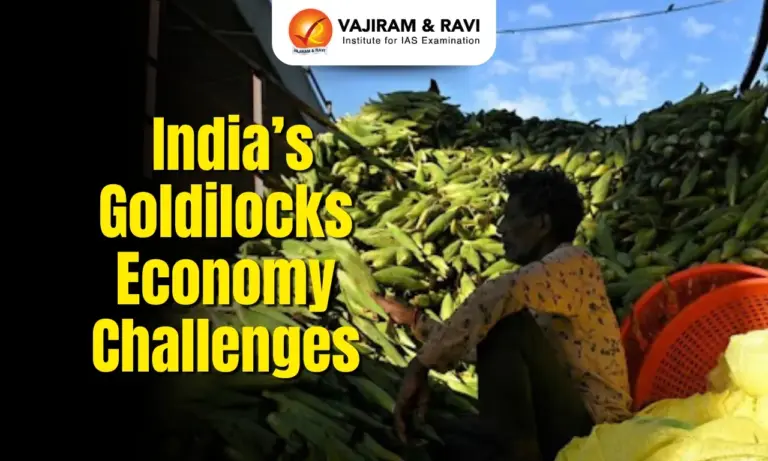
- India’s Finance Ministry recently hailed the economy’s “Goldilocks situation” — moderate growth, low inflation, and favourable monetary conditions — with analysts noting strong 7.6% GDP growth, peak interest rates, and steady corporate earnings.
- The country ended FY2024 as a $3.6 trillion economy, signalling optimism for 2025.
- However, seasoned economists caution that this rosy picture masks deeper structural imbalances, making the golden equilibrium more fragile than it appears.
Inflation and Stagnant Wage Growth: The Cracks in the “Goldilocks” Narrative
- While headline CPI inflation eased from 4.8% in May 2024 to 2.82% by May 2025, food inflation told a harsher story.
- The Consumer Food Price Index (CFPI) often outpaced general inflation, peaking at 10.87% in October 2024 against CPI’s 6.21%.
- Even in moderate months, the gap persisted, disproportionately hurting lower-income households, for whom food constitutes nearly half the consumption basket.
- This volatility, driven by weather disruptions, supply chain issues, and global commodity swings, eroded real incomes and destabilised household budgets, undermining the perception of price stability.
Erosion of Real Wages
- The wage data further challenges the “Goldilocks” image. In 2023, an average nominal salary hike of 9.2% translated to only 2.5% real wage growth.
- In 2020, real wages even turned negative (-0.4%) despite nominal growth of 4.4%.
- For 2025, projected real wage growth of 4% against an 8.8% nominal rise means inflation still halves the gain.
- This persistent erosion squeezes household savings, curtails discretionary spending, and increases debt dependence — particularly in sectors with modest pay hikes like IT services, manufacturing, engineering, and consumer industries.
The Silent Squeeze on Households
- A salary hike loses its promise when inflation eats away its value — a 9% raise feels like just 2% in purchasing power if prices rise 7%.
- For many families, this silent squeeze means compromising on quality of life, reducing essential and discretionary consumption, and struggling with financial uncertainty, exposing the fragility beneath India’s supposed macroeconomic equilibrium.





Income Inequality and Fiscal Pressures: Questioning the “Goldilocks” Claim
- India’s headline GDP growth masks deep-seated structural issues of inequality and fiscal strain.
- While the Gini coefficient for taxable income has declined from 0.489 in AY13 to a projected 0.402 in AY23, this improvement is limited to the formal sector and excludes the vast informal workforce.
- The post-pandemic recovery has been K-shaped, benefiting affluent segments and specific industries, while real wages for low-income groups have stagnated.
- This persistent disparity risks weakening social cohesion, restricting access to quality education and healthcare, and constraining long-term inclusive growth.
- On the fiscal front, the government is committed to reducing the fiscal deficit from 6.4% in 2022-23 to 4.4% in 2025-26, with similar declines in revenue and primary deficits.
- However, these deficits remain high, necessitating large-scale borrowing that could crowd out private investment, slow job creation, and curb economic expansion.
- With public debt-to-GDP at around 81%—well above the FRBM target of 60%—a significant share of future revenues will be consumed by debt servicing, limiting funds for social sector spending and potentially leading to higher taxes.
- Together, entrenched inequality and fiscal vulnerabilities challenge the sustainability of India’s so-called “Goldilocks” economy.
Beyond the “Goldilocks” Illusion: India’s Underlying Economic Fragilities
- India’s so-called “Goldilocks” economy—marked by strong GDP growth, low inflation, and stable macro indicators—conceals deeper structural weaknesses.
- Volatile food inflation, stagnant real wages, persistent income inequality, and constrained fiscal space undermine the perception of a universally shared macroeconomic sweet spot.
- While headline numbers project stability, the benefits of growth remain concentrated among a select few, leaving large sections of the population struggling with eroded purchasing power and limited economic opportunity.
- True equilibrium lies not in surface-level metrics but in inclusive growth that boosts real incomes, narrows inequality, and strengthens fiscal resilience.
- Without addressing these systemic challenges, the notion of a “just right” economy risks remaining an illusion for millions of Indians.
Source: TH

 Last updated on March, 2026
→ UPSC Final Result 2025 is now out.
→ UPSC has released UPSC Toppers List 2025 with the Civil Services final result on its official website.
→ Anuj Agnihotri secured AIR 1 in the UPSC Civil Services Examination 2025.
→ UPSC Marksheet 2025 is now out.
→ UPSC Notification 2026 & UPSC IFoS Notification 2026 is now out on the official website at upsconline.nic.in.
→ UPSC Calendar 2026 has been released.
→ Check out the latest UPSC Syllabus 2026 here.
→ UPSC Prelims 2026 will be conducted on 24th May, 2026 & UPSC Mains 2026 will be conducted on 21st August 2026.
→ The UPSC Selection Process is of 3 stages-Prelims, Mains and Interview.
→ Prepare effectively with Vajiram & Ravi’s UPSC Prelims Test Series 2026 featuring full-length mock tests, detailed solutions, and performance analysis.
→ Enroll in Vajiram & Ravi’s UPSC Mains Test Series 2026 for structured answer writing practice, expert evaluation, and exam-oriented feedback.
→ Join Vajiram & Ravi’s Best UPSC Mentorship Program for personalized guidance, strategy planning, and one-to-one support from experienced mentors.
→ Shakti Dubey secures AIR 1 in UPSC CSE Exam 2024.
→ Also check Best UPSC Coaching in India
India’s Goldilocks Economy Challenges FAQs
Q1. What is India’s “Goldilocks” economy?+
Q2. Why is food inflation a concern?+
Q3. How are wages impacting growth?+
Q4. What role does inequality play?+
Q5. Why is fiscal pressure a threat?+
Tags: India’s Goldilocks economy challenges mains articles upsc current affairs upsc mains current affairs