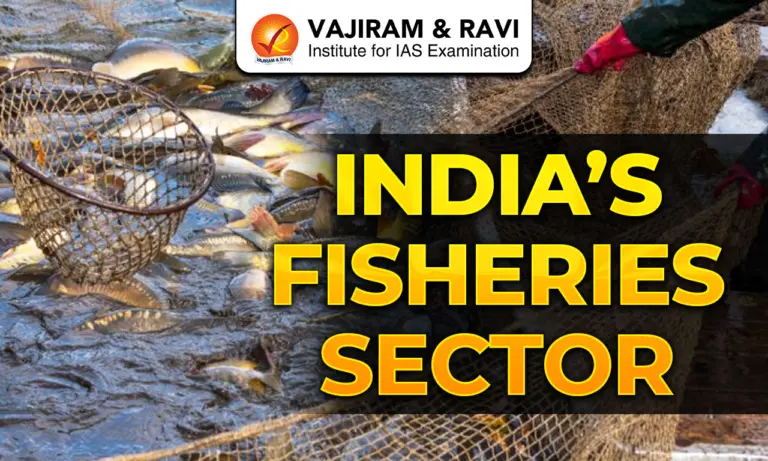
The fisheries sector in India encompasses all activities related to the production, processing, and marketing of fish and other aquatic resources. It includes marine fisheries, which involve fishing in the seas and oceans, including coastal and deep-sea fishing, and inland fisheries, which cover rivers, lakes, reservoirs, and ponds, including both wild capture and freshwater aquaculture.
Aquaculture, or fish farming, forms a major part of the sector, with techniques like pond, tank, and cage culture, often integrated with crops or livestock. The sector also includes shrimp and crustacean farming, fish processing and value addition such as freezing, canning, and packaging, and supporting infrastructure like cold storage, harbors, landing centers, and fishing vessels.
Overall, the fisheries sector covers the entire chain from capture and cultivation to processing, marketing, and allied services, making it a critical component of India’s food security, livelihood generation, and economy.
India’s Fisheries Sector Status
- India is the second-largest fish-producing nation in the world, contributing about 8% of global fish output.
- Fisheries provide employment to nearly three crore people, particularly in coastal and rural communities.
- It contributes 7.43% to Agricultural GVA, the highest among agriculture and allied sectors.
Significance of India’s Fisheries Sector
The fisheries sector is a vital pillar of India’s economy, contributing to food security, employment generation, export earnings, and livelihoods for millions of fishers, particularly in coastal and rural regions.
- Food and Nutritional Security: Provides high-quality protein, essential fatty acids, vitamins, and minerals, contributing significantly to the nutritional needs of rural and coastal populations.
- Employment Generation: Supports the livelihoods of around 3 crore people, including fishers, aquaculture farmers, processors, transporters, and market workers, especially in coastal and inland regions.
- Economic Contribution: Accounts for 7.43% of Agricultural Gross Value Added, the highest among allied sectors, underlining its importance in the rural economy.
- Export Earnings: India is a major exporter of shrimp and marine products, earning ₹62,408 crore in FY 2024-25, enhancing foreign exchange inflows and global competitiveness.
- Rural and Inclusive Development: Promotes livelihoods in marginalised coastal and inland communities, including women-led collectives and Fish Farmer Producer Organizations (FFPOs), supporting inclusive growth and entrepreneurship.
- Sustainable Development: Aligns with SDG 14 – Life Below Water, by promoting responsible fisheries, aquaculture sustainability, and ecosystem conservation.





India’s Fisheries Sector Government Initiatives
Total fish production increased from 95.79 lakh tonnes in FY 2013-14 to 197.75 lakh tonnes in FY 2024–25, representing a 106% growth over a decade. This was made possible through several government policies and programs aimed at boosting production, modernising aquaculture, supporting fishers, and improving exports.
Blue Revolution:
- The Blue Revolution, launched in 2015, seeks to increase fish production and strengthen the fisheries value chain across inland and marine sectors by enhancing productivity, expanding infrastructure, and promoting modern practices.
- To build on these efforts and further advance post-harvest management, traceability, fisher welfare, and market linkages, the Government launched the Pradhan Mantri Matsya Sampada Yojana(PMMSY) in 2020 to accelerate the sector’s transformation.
National Policy on Marine Fisheries (NPMF):
- The National Policy on Marine Fisheries (NPMF), 2017 provides a comprehensive framework for sustainable development, management, and conservation of India’s marine fisheries.
- Its key objectives include promoting responsible fishing practices, conserving resources, and safeguarding ecosystems in the Exclusive Economic Zone (EEZ) and along the coastline.
- The policy emphasizes fisher welfare, ensuring safety at sea, insurance, housing, and health facilities, alongside improving infrastructure such as landing centres, fishing harbours, cold chains, and processing units.
- It encourages scientific research, technology adoption, modern fishing methods, and capacity building to enhance productivity and sustainability.
- Additionally, NPMF supports market development, value addition, and export competitiveness, while establishing a robust regulatory and institutional framework for monitoring and compliance.
Pradhan Mantri Matsya Sampada Yojana (PMMSY):
- The Pradhan Mantri Matsya Sampada Yojana (PMMSY), with a budget of ₹2,500 crore for 2026-27, focuses on the entire fisheries value chain, including ponds, reservoirs, fish transport, cold storage, processing units, and retail markets.
- It also promotes modern technologies such as Recirculatory Aquaculture Systems (RAS), which recycle water and allow high-density fish farming, and Bio-floc technology, which converts waste into feed and improves water quality.
- As of March 2026, 12,081 RAS units and 4,205 Bio-floc units have been approved, along with over 23,000 hectares of pond area, 52,000 reservoir cages, and 6,896 retail markets, showing strong progress in sustainable and technology-driven fisheries development.
Pradhan Mantri Matsya Kisan Samridhi Sah-Yojana (PM-MKSSY):
- The Pradhan Mantri Matsya Kisan Samridhi Sah-Yojana (PM-MKSSY) is a Central Sector sub-scheme under the PMMSY, operational across all States and Union Territories from 2023–24 to 2026–27 with a total outlay of ₹6,000 crore.
- The scheme aims to transform the fisheries sector by promoting formalisation, insurance coverage, access to institutional finance, and quality assurance across the fisheries value chain.
- It also strengthens traceability, market integration, and risk mitigation, helping fishers, aquaculture farmers, and allied stakeholders become part of a more organised, transparent, and sustainable sector.
Kisan Credit Card (KCC) scheme:
- The Kisan Credit Card (KCC) scheme has been an important tool for financial inclusion in India’s agrarian economy.
- Since 2019, its coverage has been expanded to include fisheries, animal husbandry, and dairy, enabling timely and affordable access to working capital for fishers and allied stakeholders.
- The government has increased the lending limit from ₹2 lakh to ₹5 lakh, improving access to credit for fishers, farmers, processors, and others.
- As per the Economic Survey 2024-25, the scheme has benefited 4.39 lakh fishers, provided insurance to 3.3 million people, and supported an average of 7.44 lakh fisher families during lean periods, highlighting its role in stabilising incomes, enhancing resilience, and integrating fishers into organised markets.
Fisheries and Aquaculture Infrastructure Development Fund (FIDF):
- The Fisheries and Aquaculture Infrastructure Development Fund (FIDF), launched in 2018-19 and extended until March 2026, aims to strengthen infrastructure in marine and inland fisheries and promote sustainable growth.
- The scheme provides a credit guarantee of up to ₹12.50 crore and an interest subvention of up to 3%, enabling fishers and entrepreneurs to access low-cost loans at a minimum rate of 5% per year.
- As of January 2026, FIDF has approved 225 projects worth ₹6,685.78 crore, including fishing harbours, landing centres, and processing units, mobilising ₹754.50 crore from private investment.
- Completed projects have created safe landing and berthing facilities for over 8,100 fishing vessels, increased fish landings by 1.09 lakh tonnes, benefited around 3.3 lakh fishers, and generated nearly 2.5 lakh direct and indirect employment opportunities, reflecting significant progress in building modern fisheries infrastructure.
National Fisheries Digital Platform (NFDP):
- The National Fisheries Digital Platform (NFDP), launched in September 2024 under PM-MKSSY, aims to promote digital governance and formalisation in the fisheries and aquaculture sector.
- It provides digital identities for fishers, fish farmers, cooperatives, enterprises, and other value chain stakeholders, while building a centralized database to improve transparency, streamline service delivery, and support data-driven policymaking.
- The platform functions as a single-window system, enabling access to institutional credit, aquaculture insurance, traceability, and performance-linked incentives, while also supporting the strengthening of fisheries cooperatives and training initiatives.
- As of March 2026, NFDP has registered over 30.60 lakh stakeholders, integrated 12 banks, and facilitated 217 loan disbursements, advancing formalisation, financial inclusion, and efficiency across India’s fisheries sector.
National Marine Fisheries Census (MFC) 2025:
- The National Marine Fisheries Census (MFC) 2025, launched on 31st October 2025, marks a major step toward fully digital and georeferenced data collection in India’s fisheries sector.
- Using custom mobile applications like VyAS-NAV, VyAS-BHARAT, and VyAS-SUTRA, the Census enabled real-time, geo-tagged enumeration, immediate data verification, and continuous field monitoring.
- For the first time, it has generated detailed socio-economic profiles of fisher households, covering aspects such as income, insurance status, access to credit, and participation in government schemes, providing a strong foundation for evidence-based planning and policy-making in fisheries development.
Mission-Driven Reservoir Development and Fisheries Value Chain Expansion:
- India has one of the world’s largest inland reservoir networks, covering approximately 31.5 lakh hectares, providing significant potential to expand inland fisheries.
- Under Mission Amrit Sarovar, the government has developed 68,827 water bodies, including 1,222 integrated with fisheries activities, promoting fish culture, livelihood diversification, and aquatic ecosystem enhancement as of February 2026.
- Future plans include the development of 500 more reservoirs and Amrit Sarovars to strengthen the fisheries value chain across coastal and inland regions.
- These initiatives aim to enhance market linkages and value addition by involving startups, women-led collectives, and Fish Farmer Producer Organizations (FFPOs), fostering inclusive growth, entrepreneurship, and sustainable fisheries-based livelihoods.
Sustainable Governance of Marine Fisheries and EEZ Resources:
India’s extensive coastline of over 11,099 km and an Exclusive Economic Zone (EEZ) of around 24 lakh sq km support the livelihoods of more than 50 lakh fishers across 13 maritime States and Union Territories. Marine fisheries form a key part of the blue economy, contributing to both export earnings and national nutritional security.
- To ensure sustainable use of aquatic resources, the government notified the Rules and Guidelines for Sustainable Harnessing of Fisheries in the EEZ and High Seas (2025), creating a regulatory framework aligned with sustainability and international standards.
- Policy measures such as duty-free status for catch landed abroad and treated as exports aim to improve price realisation and global competitiveness, while traceability and compliance safeguards prevent misuse.
- The Marine Products Export Development Authority (MPEDA) further supports sustainable growth through quality assurance, market facilitation, capacity building, and ecological stewardship, strengthening long-term resource security and fisher livelihoods.
Further, the Union Budget 2026–27 has proposed the highest-ever annual allocation of ₹2,761.80 crore for the fisheries sector, highlighting its growing policy priority. Of this total outlay, ₹2,530 crore is earmarked for implementation through targeted schemes, including financial assistance, capital subsidies, insurance coverage, capacity-building initiatives, infrastructure development, and welfare support mechanisms designed to directly benefit fishers and fish farmers.
Challenges in India’s Fisheries Sector
India’s fisheries sector, despite significant growth and policy support, faces multiple challenges that limit productivity, sustainability, and the welfare of fishers. Addressing these issues is critical to ensure long-term resilience, inclusive growth, and global competitiveness.
- Illegal, Unreported, and Unregulated (IUU) Fishing: Exacerbates overfishing and undermines sustainability.
- Inadequate Infrastructure and Technology: Outdated vessels, gear, and limited cold storage reduce productivity.
- Climate Change and Environmental Degradation: Rising temperatures, ocean acidification, and pollution impact fish stocks.
- Socio-Economic Issues: Low incomes, limited credit/insurance, and gender disparities increase fisher vulnerability.
- Market Access and Value Chain Inefficiencies: Weak post-harvest handling and poor market linkages reduce profitability.
Way Forward for India’s Fisheries Sector
To sustain growth and improve resilience, India’s fisheries sector requires targeted interventions in technology, infrastructure, governance, and socio-economic empowerment. These measures will strengthen productivity, market access, and sustainability across marine and inland fisheries.
- Strengthen Infrastructure: Expand cold chains, ice plants, landing centres, and processing facilities to reduce post-harvest losses.
- Promote Modern Aquaculture Technology: Encourage adoption of Recirculatory Aquaculture Systems (RAS), Bio-floc, and sustainable fishing practices.
- Enhance Financial Inclusion: Improve access to credit, insurance, and risk-mitigation schemes for fishers and aquaculture farmers.
- Sustainable Resource Management: Implement EEZ and inland water regulations to prevent overfishing and conserve ecosystems.
- Digital Governance and Traceability: Expand platforms like NFDP for transparency, efficient service delivery, and market integration.
- Capacity Building and Skill Development: Train fishers, promote entrepreneurship, and empower women and marginalized communities.
- Strengthen Market Linkages and Export Competitiveness: Promote value addition, quality standards, and compliance with international trade norms.

 Last updated on April, 2026
→ UPSC Final Result 2025 is now out.
→ UPSC has released UPSC Toppers List 2025 with the Civil Services final result on its official website.
→ Anuj Agnihotri secured AIR 1 in the UPSC Civil Services Examination 2025.
→ UPSC Marksheet 2025 is now out.
→ UPSC Notification 2026 & UPSC IFoS Notification 2026 is now out on the official website at upsconline.nic.in.
→ UPSC Calendar 2026 has been released.
→ Check out the latest UPSC Syllabus 2026 here.
→ UPSC Prelims 2026 will be conducted on 24th May, 2026 & UPSC Mains 2026 will be conducted on 21st August 2026.
→ The UPSC Selection Process is of 3 stages-Prelims, Mains and Interview.
→ Prepare effectively with Vajiram & Ravi’s UPSC Prelims Test Series 2026 featuring full-length mock tests, detailed solutions, and performance analysis.
→ Enroll in Vajiram & Ravi’s UPSC Mains Test Series 2026 for structured answer writing practice, expert evaluation, and exam-oriented feedback.
→ Join Vajiram & Ravi’s Best UPSC Mentorship Program for personalized guidance, strategy planning, and one-to-one support from experienced mentors.
→ Shakti Dubey secures AIR 1 in UPSC CSE Exam 2024.
→ Also check Best UPSC Coaching in India
India’s Fisheries Sector FAQs
Q1. What is the current status of India’s fisheries sector?+
Q2. What are the key government initiatives in fisheries?+
Q3. Why is the fisheries sector significant for India?+
Q4. What are the major challenges in India’s fisheries sector?+
Q5. What is the way forward for India’s fisheries sector?+
Tags: indias fisheries sector