India’s Largest Circular Stone Labyrinth Latest News
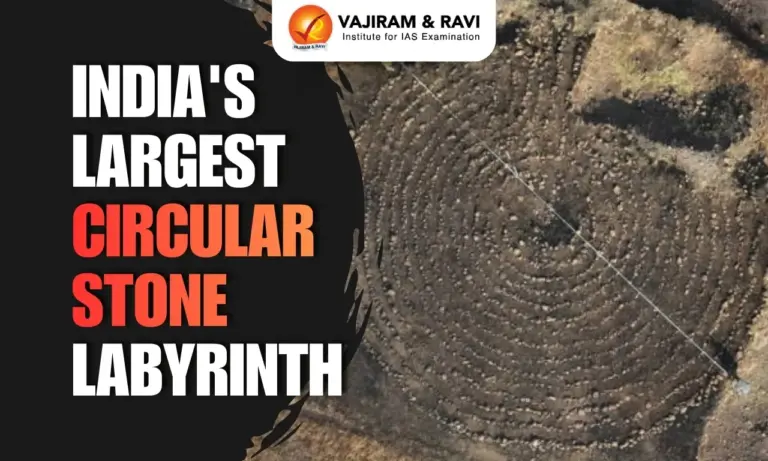
Archaeologists recently discovered a remarkable circular stone labyrinth in the Boramani grasslands of Solapur, Maharashtra, identified as the largest of its kind ever recorded in India.
About India’s Largest Circular Stone Labyrinth
- It was discovered in the Boramani grasslands of Solapur, Maharashtra.
- It is approximately 50 feet by 50 feet in size and has 15 concentric circles formed from small stone blocks.
- The rings guide movement inward toward a tightly coiled spiral at the center, creating a design that reflects both precision and symbolic intent.
- This structure dates back to nearly 2,000 years ago and is linked to Indo-Roman trade during the Satavahana dynasty period.
- The presence of soil accumulation between the stone rings shows that this structure has remained untouched for several centuries.
- Its design resembles classical labyrinth forms found in Mediterranean cultures, including motifs seen on Roman-era coins, while also incorporating a central spiral associated in India with the concept of the Chakravyuh.
- The Chakravyūha is a complex military formation described in the Hindu epic Mahabharata, designed to encircle and overwhelm enemies through multiple defensive layers.
- Before this discovery, the largest known circular labyrinth in India had 11 circuits, making the Solapur example unprecedented in terms of circular complexity.
- Although there is a larger square labyrinth in Gedimedu in Tamil Nadu, this newly documented site is the largest circular stone labyrinth identified in the country to date.





Mazes vs. Labyrinths
- Labyrinths and mazes are not the same; however both are patterns for a path from the entrance to the centre.
- Though the terms are often used interchangeably, they mean different things.
- Mazes are a kind of puzzle with multiple paths and decision points, and sometimes high walls.
- Labyrinths, by contrast, are unicursal: a single path twisting and turning through several concentric circles or circuits to arrive at a central goal, without walls or other obstructions to visibility.
- There are no “wrong turns” in a labyrinth.
- Labyrinths and/or labyrinth carvings in rock and stone date back more than 4,000 years.
- There are labyrinths etched in Roman mosaics, in caves, cliffs, and tombs, on stone floors of medieval churches, and cut into turf.
Source: IT

 Last updated on April, 2026
→ UPSC Final Result 2025 is now out.
→ UPSC has released UPSC Toppers List 2025 with the Civil Services final result on its official website.
→ Anuj Agnihotri secured AIR 1 in the UPSC Civil Services Examination 2025.
→ UPSC Marksheet 2025 is now out.
→ UPSC Notification 2026 & UPSC IFoS Notification 2026 is now out on the official website at upsconline.nic.in.
→ UPSC Calendar 2026 has been released.
→ Check out the latest UPSC Syllabus 2026 here.
→ UPSC Prelims 2026 will be conducted on 24th May, 2026 & UPSC Mains 2026 will be conducted on 21st August 2026.
→ The UPSC Selection Process is of 3 stages-Prelims, Mains and Interview.
→ Prepare effectively with Vajiram & Ravi’s UPSC Prelims Test Series 2026 featuring full-length mock tests, detailed solutions, and performance analysis.
→ Enroll in Vajiram & Ravi’s UPSC Mains Test Series 2026 for structured answer writing practice, expert evaluation, and exam-oriented feedback.
→ Join Vajiram & Ravi’s Best UPSC Mentorship Program for personalized guidance, strategy planning, and one-to-one support from experienced mentors.
→ Shakti Dubey secures AIR 1 in UPSC CSE Exam 2024.
→ Also check Best UPSC Coaching in India
India's Largest Circular Stone Labyrinth FAQs
Q1. Where was India’s largest circular stone labyrinth discovered?+
Q2. How many concentric circles does India’s largest circular stone labyrinth contain?+
Q3. India's Largest Circular Stone Labyrinth dates back to which historical period?+
Tags: india's largest circulars stone labyrinth