
India Geothermal Energy Policy Latest News
- According to the govt, India’s new national geothermal energy policy aims to test the technology’s commercial viability, with firms from the US, Iceland, and Norway exploring R&D and pilot projects in the Gulf of Cambay, Arunachal Pradesh, and Uttarakhand.
About Geothermal Energy
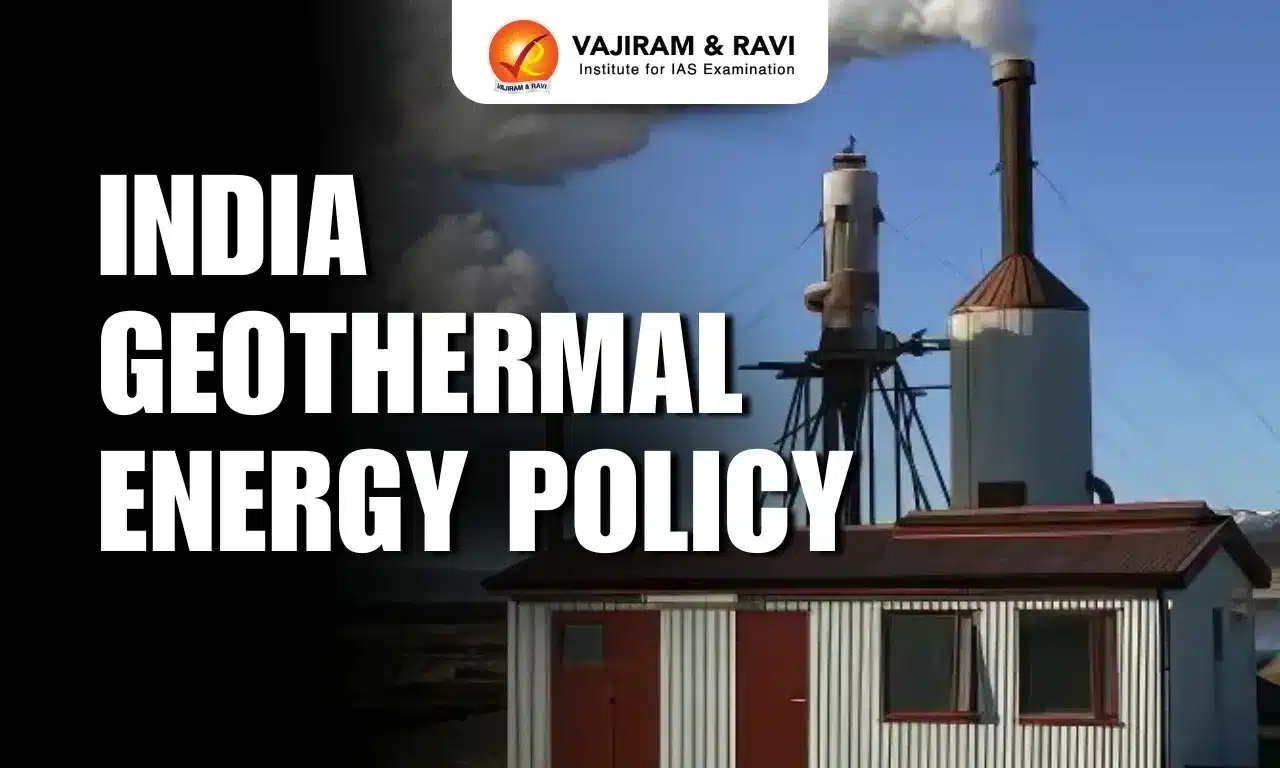
- Geothermal energy harnesses the Earth’s heat from hot springs or underground reservoirs, using steam to generate electricity.
- It can also provide heating, cooling, greenhouse support, and aquaculture benefits.
- The Geological Survey of India (GSI) has identified 381 hot springs with surface temperatures of 35°C to 89°C.
How it Works: The Process
- The process of harnessing geothermal energy typically involves drilling wells to access underground reservoirs of hot water and steam, known as hydrothermal resources.
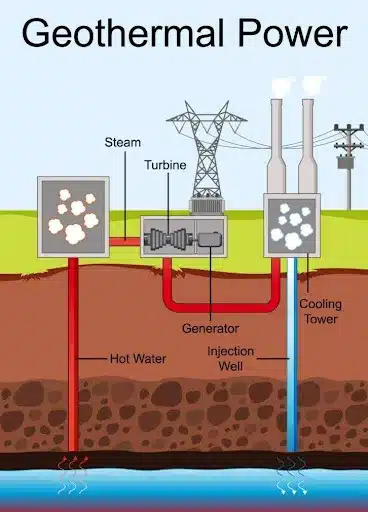
- The most common method for generating electricity from these resources involves a few key steps:
- Extraction: Wells are drilled deep into the Earth to tap into geothermal reservoirs.
- Conversion: The hot water or steam is brought to the surface. In a dry steam plant, the steam is used directly to spin a turbine. In a flash steam plant, high-pressure hot water is converted to steam in a “flash tank” before it turns the turbine.
- Electricity Generation: The spinning turbine is connected to a generator, which converts the mechanical energy into electricity.
- Reinjection: The cooled water or condensed steam is then pumped back into the geothermal reservoir, a crucial step for maintaining the pressure and sustainability of the resource.




India’s Geothermal Potential
- India’s estimated geothermal potential is 10.6 GW, with major sites in the Himalayan Geothermal Province (Uttarakhand, Himachal Pradesh, Ladakh, Jammu and Kashmir, Arunachal Pradesh), the Cambay Graben in Gujarat, and the Andaman and Nicobar Islands.
- Abandoned oil wells in Cambay and Gandhar (ONGC, Gujarat) are being considered for geothermal use.
Global Geothermal Capacity
- Globally, geothermal capacity is less than 17 GW, dominated by the US, Indonesia, and the Philippines, while Iceland and Norway lead in technology innovation.
- The US International Trade Administration identified Ladakh’s Puga and Chumathang fields as India’s most promising.
- According to the International Energy Agency (IEA), China, the US, and India account for 75% of next-generation geothermal potential, with India’s capacity projected to reach 4.2 GW by 2035 and nearly 100 GW by 2045.
India’s Geothermal Energy Push
- The Ministry of New and Renewable Energy (MNRE) launched its geothermal energy policy, to promote exploration and development.
- Companies from Norway and Iceland have begun pilot studies in the Gulf of Cambay, Arunachal Pradesh, and Uttarakhand.
- Collaborations with the US and Indonesia are also being explored, especially for enhanced geothermal systems suited for large-scale power plants.
Potential Benefits in Remote Areas
- According to the policy, geothermal energy can transform energy access in remote regions.
- In the Andaman and Nicobar Islands, where electricity costs ₹30–32 per unit, geothermal could reduce costs to ₹10–11 per unit.
- In Ladakh, it could supply both heating and electricity during extreme winters.
Repurposing Oil Wells
- India has thousands of abandoned oil wells, particularly in the Gulf of Cambay, which can be repurposed for geothermal use.
- Oil and gas firms are showing interest: IIT Madras is piloting a 450 kWh project in Barmer, Rajasthan, with support from MNRE and Vedanta’s Cairn Oil & Gas.
- Reliance Industries also plans to expand into geothermal through its oil and gas business.
Challenges and Policy Support
- Geothermal projects face high upfront costs and exploration risks, with an estimated ₹36 crore required per megawatt of capacity.
- To address this, the National Policy on Geothermal Energy will support R&D, pilot projects, and coordination across stakeholders, including the Ministry of Petroleum and Natural Gas and state governments.
- A viability gap funding (VGF) scheme is also being considered.
Ongoing Initiatives
- MNRE has already sanctioned five projects, including one backed by Vedanta.
- With the new policy, it expects to expand this list.
- The policy follows the creation of an MNRE task force on geothermal energy (formed in August 2024) and aims to demonstrate commercial feasibility while building technical and financial frameworks for scaling up.
Last updated on February, 2026
→ UPSC Notification 2026 is now out on the official website at upsconline.nic.in.
→ UPSC IFoS Notification 2026 is now out on the official website at upsconline.nic.in.
→ UPSC Calendar 2026 has been released.
→ UPSC Final Result 2025 is expected to be released in the second week of April 2026.
→ Check out the latest UPSC Syllabus 2026 here.
→ Join Vajiram & Ravi’s Interview Guidance Programme for expert help to crack your final UPSC stage.
→ UPSC Mains Result 2025 is now out.
→ UPSC Prelims 2026 will be conducted on 24th May, 2026 & UPSC Mains 2026 will be conducted on 21st August 2026.
→ The UPSC Selection Process is of 3 stages-Prelims, Mains and Interview.
→ Prepare effectively with Vajiram & Ravi’s UPSC Prelims Test Series 2026 featuring full-length mock tests, detailed solutions, and performance analysis.
→ Enroll in Vajiram & Ravi’s UPSC Mains Test Series 2026 for structured answer writing practice, expert evaluation, and exam-oriented feedback.
→ Join Vajiram & Ravi’s Best UPSC Mentorship Program for personalized guidance, strategy planning, and one-to-one support from experienced mentors.
→ Check UPSC Marksheet 2024 Here.
→ UPSC Toppers List 2024 is released now. Shakti Dubey is UPSC AIR 1 2024 Topper.
→ Also check Best UPSC Coaching in India
India Geothermal Energy Policy FAQs
Q1. What is geothermal energy and how is it used?+
Q2. What is India’s geothermal potential?+
Q3. How does the new policy support geothermal development?+
Q4. What benefits can geothermal bring to remote areas?+
Q5. What challenges does geothermal face in India?+
Tags: India geothermal energy policy mains articles upsc current affairs upsc mains current affairs