India’s Organ Transplant Crisis Latest News
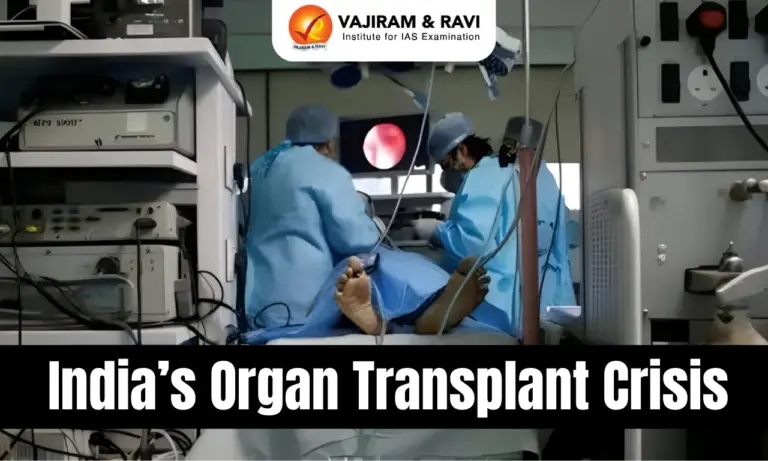
- Organ transplantation in India continues to face a severe gap between demand and supply.
- Recent data submitted by the Union Health Ministry in Parliament (2020–2024) highlights a growing crisis, marked by long waiting lists, state-level disparities, and the dominance of living-donor transplants over deceased organ donations.
Organ Donation in India
- Overview:
- While India ranks third globally in the total number of organ transplants (over 18,900 in 2024), the country’s organ donation rate remains critically low, particularly for deceased donations.
- Though India reports 1,60,000 road traffic deaths annually, only 1,000–1,200 deceased organ donations occur per year.
- This means, India is heavily reliant on living donors for most transplants, especially for kidneys (for which, overall 13,476 transplants performed in 2024) and liver (4,901 transplants).
- Statistics:
- Living vs. deceased donors: In 2024, India recorded just 1,128 deceased donors compared to over 15,000 living donors. Over 700 of these deceased donors came from just six southern states.
- Donor-per-million rate: India’s donation rate is less than 1 donor per million population, far behind developed countries like Spain (~48 per million) and the US (~36 per million).
- Supply-demand gap: With over 63,000 people needing a kidney transplant and 22,000 needing a liver, the demand for organs vastly outstrips the supply, and thousands die each year while waiting.





Magnitude of the Crisis
- Rising deaths while waiting: 2,805 deaths between 2020–2024 while waiting for organs. Delhi accounts for nearly half (1,425 deaths), despite being the state with the highest number of transplants. Maharashtra (297) and Tamil Nadu (233) follow.
- Large and growing waiting lists: Total patients awaiting transplants are 82,285 (as of December 2025). Out of this, the majority are kidney patients (60,590), followed by liver (18,724), heart (1,695), lungs (970), and pancreas (306).
State-wise Burden of Organ Demand
- High-burden states:
-
- Maharashtra: 20,553 total (13,045 kidney).
- Gujarat: 9,592 total (7,405 kidney; 2,019 liver).
- Tamil Nadu: 9,166 total (6,448 kidney; 2,020 liver).
- Delhi: 8,853 total (5,894 kidney; 2,835 liver).
- Why Delhi has the highest deaths: Though it conducts the most transplants, the majority are from living relatives, not deceased donors. Demand-surpass-supply dynamic leads to longer queues and higher mortality.
Organ Allocation Systems in India
- State-specific criteria (fragmented system):
-
- Different states follow distinct allocation methods: state-specific scoring systems (Telangana, Maharashtra, Gujarat); first-come, first-served (West Bengal, Karnataka, Rajasthan, Kerala) – allocation based on registration date.
- Zonal allocation (Tamil Nadu): Divided into three zones; organs circulated zone-wise, then statewide.
- Priority-based allocation (MP and Chhattisgarh): Priority to patients without a living donor or where a matched donor refuses in writing.
Challenges in India’s Organ Transplant Ecosystem
- Heavy reliance on living donors: Creates inequity for patients without eligible relatives.
- Fragmented allocation policies: Lack of a uniform national standard leads to inconsistency and regional disparities.
- Long waiting times: Waiting periods range from months to years, influenced by: blood type compatibility, body size, health status, and organ availability.
- State capacities vary widely: Some states have advanced transplant infrastructures; others remain underdeveloped.
- High mortality among waiting patients: Nearly 3,000 deaths in five years underline systemic gaps.
Government Steps to Boost Organ Donation in India
- Institutional reforms:
-
- The Indian government has taken several steps to improve organ donation rates through the National Organ and Tissue Transplant Organisation (NOTTO).
- These include establishing the National Organ Transplant Programme (NOTP) to provide financial support for infrastructure and setting up regional and state bodies (ROTTOs and SOTTOs).
- Legal reforms: In 2023, the government removed the upper age limit for deceased donor registration and the state domicile requirement.
- Digital initiatives: Include a unique NOTTO-ID system to monitor transplants.
Policy Response and Way Forward
- Move toward uniform allocation: The NOTTO is working on:
- A standardized national allocation model
- Essential and optional variables for registration
- Ensuring equitable and transparent organ distribution
- Reducing regional disparities and improving fairness
- Nationwide awareness campaigns: To strengthen deceased organ donation, streamline declaration of brain death, incentivize hospitals to improve organ retrieval rates.
- Expanding transplant infrastructure: Increasing dedicated transplant centres, enhancing human resource training, and ensuring last-mile cold-chain logistics for organ transport.
- Digital integration: Real-time, nationwide waitlist and organ availability system. Mandatory online reporting by all hospitals.
- Ethical safeguards: Monitoring to prevent organ trafficking. Oversight mechanisms for living donor consent.
Conclusion
- India’s organ transplant ecosystem is at a critical juncture, with over 82,000 patients waiting and nearly 3,000 deaths in the last five years.
- The need for systemic reform is urgent – to make the organ transplant system equitable, transparent, and efficient.
- Addressing these gaps is vital to fulfilling the constitutional mandate of the Right to Life (Article 21) and ensuring accessible, affordable healthcare for all.
Source: IE

 Last updated on March, 2026
→ UPSC Final Result 2025 is now out.
→ UPSC has released UPSC Toppers List 2025 with the Civil Services final result on its official website.
→ Anuj Agnihotri secured AIR 1 in the UPSC Civil Services Examination 2025.
→ UPSC Marksheet 2025 is now out.
→ UPSC Notification 2026 & UPSC IFoS Notification 2026 is now out on the official website at upsconline.nic.in.
→ UPSC Calendar 2026 has been released.
→ Check out the latest UPSC Syllabus 2026 here.
→ UPSC Prelims 2026 will be conducted on 24th May, 2026 & UPSC Mains 2026 will be conducted on 21st August 2026.
→ The UPSC Selection Process is of 3 stages-Prelims, Mains and Interview.
→ Prepare effectively with Vajiram & Ravi’s UPSC Prelims Test Series 2026 featuring full-length mock tests, detailed solutions, and performance analysis.
→ Enroll in Vajiram & Ravi’s UPSC Mains Test Series 2026 for structured answer writing practice, expert evaluation, and exam-oriented feedback.
→ Join Vajiram & Ravi’s Best UPSC Mentorship Program for personalized guidance, strategy planning, and one-to-one support from experienced mentors.
→ Shakti Dubey secures AIR 1 in UPSC CSE Exam 2024.
→ Also check Best UPSC Coaching in India
India’s Organ Transplant Crisis FAQs
Q1. What are the key reasons behind the rising deaths of patients awaiting organ transplants in India?+
Q2. What is the role of state-wise criteria in creating regional disparities in organ allocation in India?+
Q3. Why is the reliance on living donors considered a structural challenge for India’s transplant ecosystem?+
Q4. What is the significance of NOTTO’s initiative to create a uniform national allocation framework?+
Q5. What policy measures are needed to strengthen the deceased organ donation ecosystem in India?+
Tags: india’s organ transplant crisis