ULLAS Latest News
- India has set an ambitious target of achieving 100% literacy by 2030, in line with the National Education Policy (NEP) 2020 and UN Sustainable Development Goals (SDG-4: Quality Education).
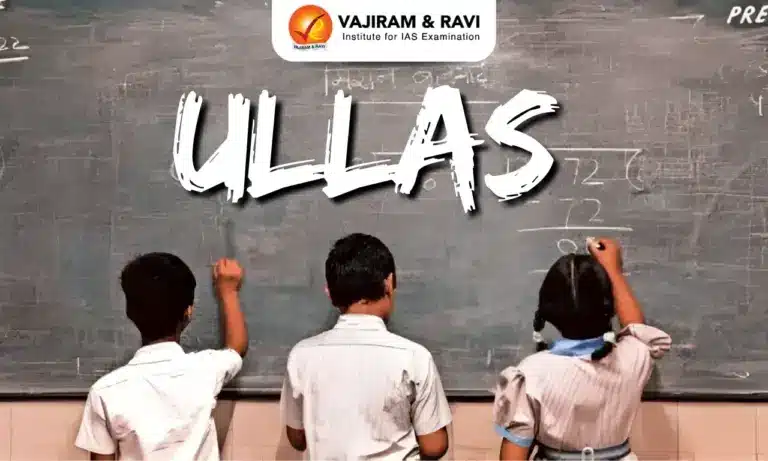
- To realise this, the Union Government launched the ULLAS – Understanding Lifelong Learning for All in Society.
- However, the non-participation of Bihar—one of India’s least literate states—has emerged as a major obstacle.
Overview of the ULLAS Scheme
- Launched: It was launched in 2022 by the Union Education Ministry in line with the NEP 2020.
- Target group: Non-literate persons above 15 years of age.
- Methodology to identify beneficiaries:
- Door-to-door identification of non-literates
- Training in basic literacy and numeracy (Class 3 level)
- Online/offline learning modes
- Mandatory assessment and certification
- Expanded definition of literacy (as per August 2024 guidelines):
- Reading, writing, and numeracy with comprehension
- Digital literacy, financial literacy, and life skills
- Benchmark: 95% literacy treated as equivalent to 100% literacy.





Progress so Far
- Declared fully literate States/UTs: Himachal Pradesh, Mizoram, Goa, Tripura, Ladakh.
- Likely to join soon: At least two southern states and one UT.
- Assessment of impact: Gains likely to reflect in upcoming Census data.
Bihar – A Major Concern
- Literacy statistics:
- PLFS 2023–24:
- Bihar literacy rate was 74.3% (2nd lowest after Andhra Pradesh – 72.6%), with male literacy of 82.3%, and female literacy of 66.1%.
- Non-literates (15–59 age group): Nearly 2 crore, including 1.32 crore women.
- Historical trend: Census 2011 literacy rate was 61.8% (lowest in India).
- PLFS 2023–24:
- Financial and administrative issues:
- Funds released under ULLAS (2023–24): A total amount of about Rs 35 crore was approved (Central share: ₹21 cr; State: ₹14 cr). The first instalment of 75% of the approved amount–Rs 16 crore–was released as the central share to Bihar in 2023.
- Issues flagged by Centre:
- Funds not transferred to Single Nodal Agency (SNA)
- No annual plan submitted
- Non-utilisation of funds
- 7% interest penalty applicable on delayed transfers (as per Department of Expenditure norms)
Bihar’s Stand – Akshar Anchal Scheme
- It is a State-run literacy programme in operation for about 15 years.
- Focus groups:
- Dalits, Mahadalits, minorities
- Extremely Backward Classes (EBCs)
- Women (15–45 age group)
- Features:
- Ensuring schooling for children in the 6-14 age group, and basic literacy and numeracy among women in the 15-45 age group.
- Women of the targeted groups take a test on basic literacy organised by the state every six months.
- State’s argument:
- The scheme attracts larger financial outlay than ULLAS.
- The existing institutional mechanism makes ULLAS redundant.
Key Challenges and Way Forward
- Centre–State coordination deficit: Union Education Minister urged Bihar CM to take immediate action, emphasised Bihar’s role in achieving national literacy goals, and directed Bihar to utilise released funds.
- Duplication vs integration of literacy schemes: Convergence of schemes – Align Akshar Anchal with ULLAS framework.
- Gender gap in literacy, especially in Bihar: Focus on female literacy as a multiplier for social development.
- Underutilisation of central funds: Incentivise participation through performance-linked funding.
- Political and administrative inertia: Strengthen cooperative federalism in education governance.
- Monitoring and outcome-based evaluation: Digital and community-based learning models to reach adult learners. Robust monitoring mechanism with third-party assessments.
Conclusion
- The success of India’s mission to achieve 100% literacy by 2030 critically depends on bringing laggard states like Bihar on board.
- A cooperative, flexible, and outcome-oriented approach—rooted in NEP 2020’s vision of lifelong learning—is essential to transform literacy from a statistical target into a social reality.
Source: IE

 Last updated on April, 2026
→ UPSC Final Result 2025 is now out.
→ UPSC has released UPSC Toppers List 2025 with the Civil Services final result on its official website.
→ Anuj Agnihotri secured AIR 1 in the UPSC Civil Services Examination 2025.
→ UPSC Marksheet 2025 is now out.
→ UPSC Notification 2026 & UPSC IFoS Notification 2026 is now out on the official website at upsconline.nic.in.
→ UPSC Calendar 2026 has been released.
→ Check out the latest UPSC Syllabus 2026 here.
→ UPSC Prelims 2026 will be conducted on 24th May, 2026 & UPSC Mains 2026 will be conducted on 21st August 2026.
→ The UPSC Selection Process is of 3 stages-Prelims, Mains and Interview.
→ Prepare effectively with Vajiram & Ravi’s UPSC Prelims Test Series 2026 featuring full-length mock tests, detailed solutions, and performance analysis.
→ Enroll in Vajiram & Ravi’s UPSC Mains Test Series 2026 for structured answer writing practice, expert evaluation, and exam-oriented feedback.
→ Join Vajiram & Ravi’s Best UPSC Mentorship Program for personalized guidance, strategy planning, and one-to-one support from experienced mentors.
→ Shakti Dubey secures AIR 1 in UPSC CSE Exam 2024.
→ Also check Best UPSC Coaching in India
ULLAS
Q1. How does the ULLAS scheme operationalise the goal of 100% literacy envisaged under the NEP 2020?+
Q2. Why is Bihar’s non-participation in the ULLAS scheme a major challenge to India’s literacy goals?+
Q3. What is the significance of redefining ‘literacy’ under the ULLAS programme?+
Q4. What are the Centre–State coordination issues highlighted by the implementation of the ULLAS scheme in Bihar?+
Q5. How is the ULLAS scheme linked to global development commitments?+
Tags: ullas