Road Safety Crisis Latest News
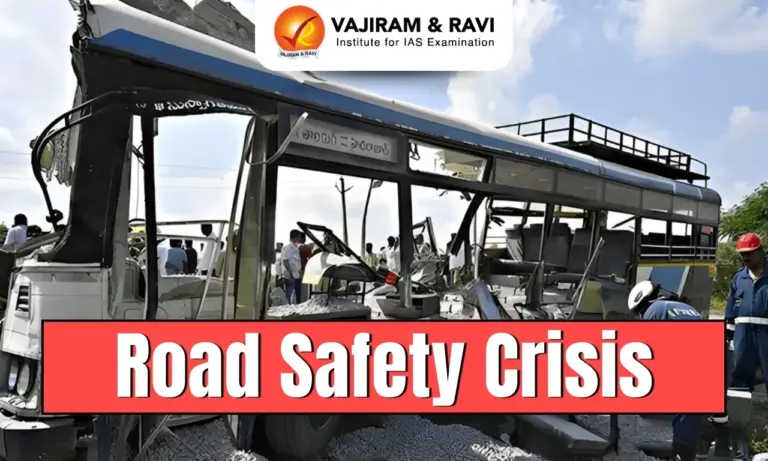
- A recent national report has identified India’s deadliest districts for road accidents, revealing that most fatalities are linked to infrastructure and systemic failures rather than traffic violations.
India’s Road Safety Scenario
- India records the highest number of road accident deaths globally, far exceeding other major countries.
- Despite having the world’s second-largest road network, road safety outcomes remain poor.
- According to recent estimates, nearly 3.5 lakh people died in road accidents during 2023-24, highlighting the scale of the crisis.
- Road safety in India has traditionally focused on driver behaviour, such as speeding or drunk driving.
- However, emerging evidence shows that this approach alone is insufficient, as deeper structural issues dominate accident causation.





Key Structural Factors Behind Road Fatalities
- The report underlines that 59% of road accident fatalities occurred without any traffic violation, clearly pointing to road engineering deficiencies as a primary cause of deaths. These include:
- Poor road design and alignment
- Absence or damage of crash barriers
- Inadequate signage and road markings
- Insufficient street lighting
- Unsafe junctions and pedestrian crossings
- Such defects convert routine travel into a high-risk activity, especially on rural roads and highways.
Geographic Concentration of Road Accidents
- Road fatalities in India are highly concentrated rather than evenly spread.
- The report identifies 100 districts accounting for more than 25% of total road deaths over two years. Among them:
- Nashik Rural and Pune Rural recorded the highest number of severe accidents.
- Other high-fatality districts include Patna, Ahmednagar, Purba Midnapur, and Belagavi.
- States such as Uttar Pradesh, Tamil Nadu, Maharashtra, Karnataka, and Rajasthan dominate the list.
- This concentration indicates that targeted interventions in specific districts can yield substantial reductions in fatalities.
Nature and Timing of Fatal Accidents
- The report highlights clear accident patterns:
- 53% of deaths occurred between 6 PM and midnight, reflecting poor visibility and fatigue-related risks.
- Rear-end, head-on, and pedestrian crashes accounted for 72% of fatalities.
- Speeding contributed to only 19% of deaths, while rash driving and dangerous overtaking together accounted for less than 10%.
- This challenges the perception that driver misconduct alone is responsible and shifts attention to road design and traffic management failures.
Emergency Response and Medical Gaps
- Post-accident response remains weak:
- Only about one-fifth of victims used the government 108 ambulance services.
- A majority were transported using private vehicles or private ambulances, delaying critical care.
- Hospital readiness and trauma care infrastructure vary widely across districts.
- Delayed medical response significantly increases mortality, making emergency preparedness a crucial pillar of road safety.
News Summary: Findings and Recommendations of the Report
- The joint report by the Ministry of Road Transport and Highways and SaveLIFE Foundation provides a clear roadmap for action:
- Focus on known crash-prone locations rather than spreading resources thinly.
- Conduct Road Safety Surveys on critical corridors by NHAI and state PWDs.
- Implement site-specific engineering corrections based on Indian Road Congress and MoRTH guidelines.
- Strengthen policing capacity at high-fatality police station jurisdictions.
- Improve emergency response by expanding effective coverage of 108 ambulance services.
- Use existing schemes more efficiently instead of launching new ones.
- The report stresses that reducing road deaths requires better coordination, clearer accountability, and sustained leadership, not additional laws or schemes.
Source: IE

 Last updated on April, 2026
→ UPSC Final Result 2025 is now out.
→ UPSC has released UPSC Toppers List 2025 with the Civil Services final result on its official website.
→ Anuj Agnihotri secured AIR 1 in the UPSC Civil Services Examination 2025.
→ UPSC Marksheet 2025 is now out.
→ UPSC Notification 2026 & UPSC IFoS Notification 2026 is now out on the official website at upsconline.nic.in.
→ UPSC Calendar 2026 has been released.
→ Check out the latest UPSC Syllabus 2026 here.
→ UPSC Prelims 2026 will be conducted on 24th May, 2026 & UPSC Mains 2026 will be conducted on 21st August 2026.
→ The UPSC Selection Process is of 3 stages-Prelims, Mains and Interview.
→ Prepare effectively with Vajiram & Ravi’s UPSC Prelims Test Series 2026 featuring full-length mock tests, detailed solutions, and performance analysis.
→ Enroll in Vajiram & Ravi’s UPSC Mains Test Series 2026 for structured answer writing practice, expert evaluation, and exam-oriented feedback.
→ Join Vajiram & Ravi’s Best UPSC Mentorship Program for personalized guidance, strategy planning, and one-to-one support from experienced mentors.
→ Shakti Dubey secures AIR 1 in UPSC CSE Exam 2024.
→ Also check Best UPSC Coaching in India
Road Safety Crisis FAQs
Q1. Why do most road accident deaths in India occur without traffic violations?+
Q2. Which districts are among India’s deadliest for road accidents?+
Q3. When do most fatal road accidents occur in India?+
Q4. What types of crashes cause most fatalities?+
Q5. What is the report’s key recommendation for reducing road deaths?+
Tags: mains articles road safety crisis upsc current affairs upsc mains current affairs