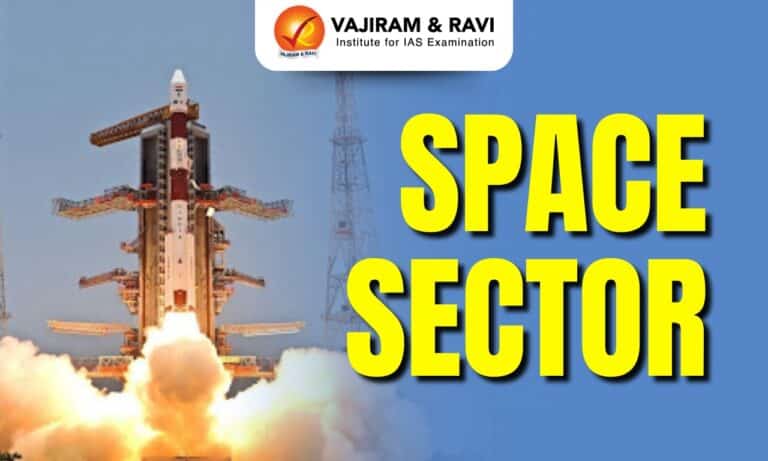
Space Sector Latest News
- The Economic Survey 2025-26 has assessed India’s space sector amid a flat budget trajectory and growing expectations from the private industry.
India’s Space Sector: Evolution and Policy Shift
- India’s space programme has undergone a significant transition over the past decade, moving from a state-dominated model to a more open and commercially oriented ecosystem.
- Landmark achievements such as successful lunar missions and a high launch success rate positioned India as a reliable spacefaring nation.
- A major policy shift occurred in 2020, when reforms opened the space sector to private participation.
- The creation of IN-SPACe as a regulatory and facilitative body and the encouragement of private launch vehicle and satellite start-ups marked the beginning of India’s “NewSpace” phase.
- However, this transition has coincided with operational and fiscal challenges within the Department of Space (DoS).





Budgetary Trends in the Space Sector
- The Economic Survey 2025-26 points out that the Department of Space has experienced near-stagnant budget growth over the last four years. When adjusted for inflation, the overall allocation has effectively declined.
- Capital expenditure, crucial for new launch infrastructure, spacecraft development, and R&D, has fallen steadily.
- In contrast, revenue expenditure, such as salaries and routine operational costs, has increased.
- This shift has resulted in a growing share of the budget being consumed by maintenance rather than innovation, raising concerns about long-term technological competitiveness.
- Additionally, the Department has repeatedly failed to fully utilise its allocated funds, leading to downward revisions during the Revised Estimates stage.
- This weak absorption capacity has further constrained the case for a substantial budgetary increase.
Export Performance and Structural Concerns
- Despite budgetary stress, the Survey highlights strong export performance.
- Between 2015 and 2024, India launched nearly 400 foreign satellites for over 30 countries, generating substantial commercial revenue.
- However, the Survey cautions that export earnings may be masking deeper structural issues.
- Recent launch failures and near-misses have exposed vulnerabilities in manufacturing quality and supply chains.
- The push for higher launch cadence, driven by commercial demand, has placed additional strain on an ecosystem still adapting from a protected state monopoly to a competitive market environment.
Role of NSIL in the Emerging Model
- NewSpace India Limited (NSIL), ISRO’s commercial arm, has emerged as a key pillar in the government’s evolving strategy.
- According to the Survey, NSIL’s revenues increased sharply within a few years, signalling the government’s intent to rely more on commercial income rather than tax-funded capital investment.
- The implicit policy shift is towards commerce-led growth, where NSIL monetises launch services, satellite missions, and downstream applications.
- However, this raises questions about whether commercial revenues can adequately substitute for sustained public investment in core R&D and critical infrastructure.
Industry Expectations and Policy Demands
- Industry associations have expressed dissatisfaction with current funding levels.
- They argue that India’s space budget remains a very small fraction of GDP compared to leading space powers.
- Proposals include scaling up allocations, expanding launch infrastructure, and introducing targeted production-linked incentives for space components.
- Private players have also advocated for a procurement-driven model, where the government acts as an anchor customer by purchasing services and data from domestic companies rather than owning all assets.
- This approach mirrors international practices and could provide predictable demand, encouraging private investment.
Challenges Highlighted by the Economic Survey
- The Survey underlines a widening gap between what the industry seeks and what the Department of Space can realistically deliver.
- While private firms demand rapid expansion and assured procurement, the Department faces constraints related to quality control, spending efficiency, and operational reliability.
- The Survey also notes that different space programmes, such as human spaceflight, satellite launches, and strategic missions, compete for limited resources, complicating prioritisation and long-term planning.
Way Forward
- The Economic Survey suggests a phased and balanced transition.
- Strengthening quality assurance systems, fixing supply-chain weaknesses, and improving fund utilisation are essential first steps.
- Large infrastructure projects, such as new spaceports, must progress without repeated delays.
- Equally important is a clear roadmap identifying which missions will gradually shift from government-built assets to industry-provided services.
- Enhancing institutional capacity to manage complex, long-term service contracts will be crucial for building investor confidence.
Source: TH

 Last updated on March, 2026
→ UPSC Final Result 2025 is now out.
→ UPSC has released UPSC Toppers List 2025 with the Civil Services final result on its official website.
→ Anuj Agnihotri secured AIR 1 in the UPSC Civil Services Examination 2025.
→ UPSC Marksheet 2025 is now out.
→ UPSC Notification 2026 & UPSC IFoS Notification 2026 is now out on the official website at upsconline.nic.in.
→ UPSC Calendar 2026 has been released.
→ Check out the latest UPSC Syllabus 2026 here.
→ UPSC Prelims 2026 will be conducted on 24th May, 2026 & UPSC Mains 2026 will be conducted on 21st August 2026.
→ The UPSC Selection Process is of 3 stages-Prelims, Mains and Interview.
→ Prepare effectively with Vajiram & Ravi’s UPSC Prelims Test Series 2026 featuring full-length mock tests, detailed solutions, and performance analysis.
→ Enroll in Vajiram & Ravi’s UPSC Mains Test Series 2026 for structured answer writing practice, expert evaluation, and exam-oriented feedback.
→ Join Vajiram & Ravi’s Best UPSC Mentorship Program for personalized guidance, strategy planning, and one-to-one support from experienced mentors.
→ Shakti Dubey secures AIR 1 in UPSC CSE Exam 2024.
→ Also check Best UPSC Coaching in India
Space Sector FAQs
Q1. What concern does the Economic Survey raise about India’s space budget?+
Q2. What role is NSIL expected to play in the space sector?+
Q3. Why is declining capital expenditure a concern?+
Q4. How has the private industry responded to current budget trends?+
Q5. What is the key challenge identified by the Survey?+
Tags: mains articles space sector upsc current affairs upsc mains current affairs