Transport Crisis Latest News
- India recently witnessed two major transport disruptions: severe overcrowding on Bihar-bound trains during October-November, and mass cancellation of Indigo flights in December.
- The events raise critical questions on pricing policies, regulatory oversight, monopolies, and the role of the state in ensuring accessible and efficient transport services.
Demand Pressures and the Strain on Public Transport
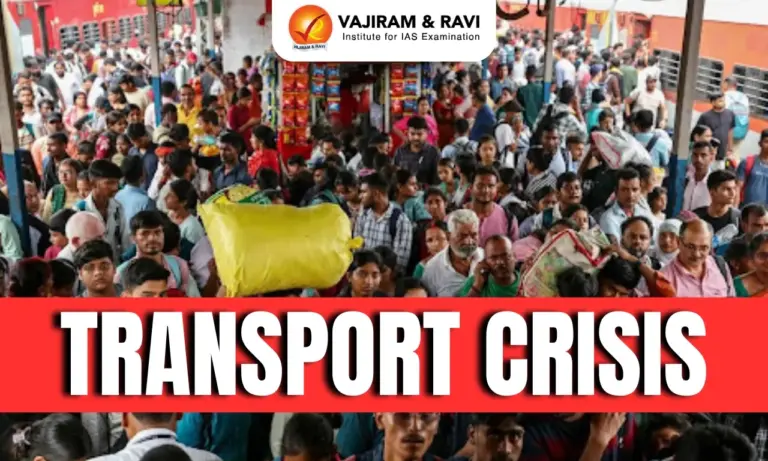
- During Chhath Puja and the Bihar elections, lakhs of migrants attempted to return home, producing a sharp, sudden demand shock for long-distance trains.
- With prices kept low for welfare purposes and limited train availability, passengers faced extreme overcrowding, unsafe travel conditions, and inhospitable unreserved compartments.
- Economic theory suggests that rising demand should push up prices to equilibrate the market.
- However, in essential public services like railways, artificially low prices are a welfare mandate.
- The resulting excess demand exposes the underinvestment in public transport infrastructure, rather than a pricing failure.
- Why Raising Prices Is Not the Solution
- Critics often argue that low fares create inefficiency. However, the core issue is inadequate supply, not affordability.
- For essential sectors, health, education, and public transport, low pricing is integral to welfare. What is missing is state-led expansion in capacity.





Constraints of a Neo-Liberal Fiscal Framework
- Fiscal Limits on Public Investment
- India’s fiscal rules constrain government spending, preventing large-scale expansion of railway capacity.
- Strict deficit targets limit the ability to build additional trains, add new routes, or expand infrastructure.
- Impact on Public Welfare
- Thus, the state is forced into a paradox:
- Keeping prices low to maintain welfare,
- But it lacks the fiscal bandwidth to expand services.
- This leads to systemic overcrowding, service degradation, and periodic crises.
Private Sector Vulnerabilities: The Indigo Flight Crisis
- In December, Indigo, India’s dominant private airline, cancelled a large number of flights due to regulatory issues, creating a supply shock. This triggered:
- Stranded passengers
- Sharp spike in airfares across airlines
- Market-wide disruption, despite the issue originating in one firm
- This is because Indigo holds a near-monopoly in several sectors of the Indian aviation market.
- In a competitive market, one airline’s supply cut would not cause such widespread chaos. The episode underscores the need for regulatory oversight to prevent monopolistic dominance.
Common Structural Thread Between the Crises
- At first glance, the train overcrowding and airline cancellations seem unrelated, one arising from public sector limitations, the other from private sector dominance. But both crises stem from a single underlying framework:
- Underinvestment in essential public services
- Public transport is priced low for welfare reasons, but cannot expand sufficiently under strict fiscal rules.
- Overreliance on deregulated private markets
- Private airlines operate with concentrated market power, enabling fare spikes and system-wide disruption when one firm fails.
- Together, these factors reflect the constraints of a neo-liberal policy model, where the state is discouraged from expanding welfare services and private monopolies grow unchecked.
- The result is recurring transport crises affecting millions.
Way Forward
- The lessons from recent events point to three clear policy needs:
- Expand public investment in railways and essential transport infrastructure.
- Strengthen regulatory oversight of private operators, especially monopolistic entities.
- Reassess fiscal rules to allow higher spending in welfare-critical sectors.
- Transport is not just an economic service; it is a public good.
- Ensuring reliability, affordability, and resilience requires a balanced model where both state capacity and market behaviour are aligned with public welfare.
Source: TH

 Last updated on March, 2026
→ UPSC Final Result 2025 is now out.
→ UPSC has released UPSC Toppers List 2025 with the Civil Services final result on its official website.
→ Anuj Agnihotri secured AIR 1 in the UPSC Civil Services Examination 2025.
→ UPSC Marksheet 2025 is now out.
→ UPSC Notification 2026 & UPSC IFoS Notification 2026 is now out on the official website at upsconline.nic.in.
→ UPSC Calendar 2026 has been released.
→ Check out the latest UPSC Syllabus 2026 here.
→ UPSC Prelims 2026 will be conducted on 24th May, 2026 & UPSC Mains 2026 will be conducted on 21st August 2026.
→ The UPSC Selection Process is of 3 stages-Prelims, Mains and Interview.
→ Prepare effectively with Vajiram & Ravi’s UPSC Prelims Test Series 2026 featuring full-length mock tests, detailed solutions, and performance analysis.
→ Enroll in Vajiram & Ravi’s UPSC Mains Test Series 2026 for structured answer writing practice, expert evaluation, and exam-oriented feedback.
→ Join Vajiram & Ravi’s Best UPSC Mentorship Program for personalized guidance, strategy planning, and one-to-one support from experienced mentors.
→ Shakti Dubey secures AIR 1 in UPSC CSE Exam 2024.
→ Also check Best UPSC Coaching in India
Transport Crisis FAQs
Q1. What caused overcrowding in Bihar-bound trains?+
Q2. Why didn’t railways raise fares to reduce demand?+
Q3. What led to mass Indigo flight cancellations?+
Q4. Why did airfares rise sharply after the cancellations?+
Q5. What common issue links both crises?+
Tags: mains articles transport crisis upsc current affairs upsc mains current affairs