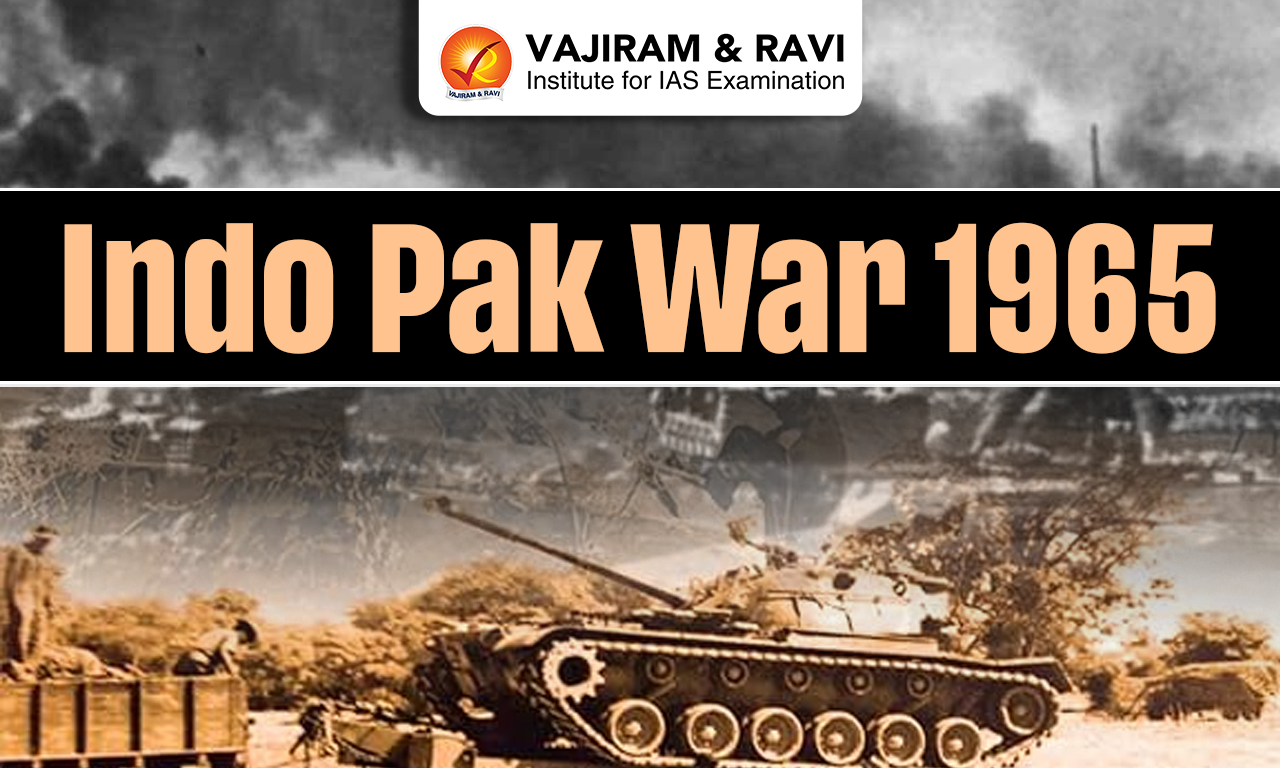
The Indo Pak War 1965 was the second major conflict between India and Pakistan over Kashmir. It lasted for about 17 days between August and September 1965 and involved large scale land, air and limited naval warfare. The war place extended across Jammu and Kashmir, Punjab, Rajasthan and international borders. Both sides claimed victory, but the result remained largely inconclusive despite heavy casualties and intense battles.
Indo Pak War 1965 Background
The background of Indo Pak War 1965 developed through earlier conflicts, border tensions and strategic miscalculations after 1947, eventually escalating into full scale war.
- Partition of 1947: After independence, princely states chose accession. Kashmir acceded to India under Maharaja Hari Singh, leading to the First Indo Pak War 1947-48 and creation of a ceasefire line dividing the region.
- Ceasefire and unresolved dispute: The 1949 United Nations brokered ceasefire left Kashmir divided. Pakistan controlled a part, while India administered the rest. The dispute remained unresolved, causing repeated tensions along the border.
- Post 1962 situation: After Sino Indian War in 1962, Pakistan assumed India was militarily weak. This perception became a major reason behind Pakistan’s aggressive posture in 1965.
- Rann of Kachchh clashes (Jan-June 1965): Skirmishes occurred in Gujarat’s Rann of Kachchh. Pakistan launched Operation Desert Hawk in April to test Indian response, capturing some positions before a UK brokered ceasefire in July.
- Operation Gibraltar (August 5, 1965): Pakistan infiltrated 7,000 to 30,000 troops into Jammu and Kashmir to incite rebellion. This marked the key escalation point in the Indo Pak War 1965 timeline.
- Capture of Haji Pir Pass (August 28, 1965): Indian forces captured this strategic infiltration route in Kashmir, strengthening their control and disrupting Pakistani plans significantly.
- Operation Grand Slam (September 1, 1965): Pakistan launched a major offensive targeting Akhnoor to cut Indian supply lines. Initial gains were made but later halted by Indian resistance.
- Expansion of war (September 6, 1965): India crossed the international border near Lahore, converting the conflict into a full scale war across multiple fronts in Punjab and Rajasthan.
Indo Pak War 1965 Reasons
The Indo Pak War 1965 was caused by strategic, political and military factors rooted in unresolved territorial disputes and misjudgments.
- Kashmir dispute: The primary reason was the unresolved status of Jammu and Kashmir. Both countries claimed the region, making it the central issue behind repeated conflicts including the Indo Pak War 1965.
- Pakistan’s strategic miscalculation: Pakistan believed India was weakened after the 1962 war with China and would not respond strongly to infiltration, leading to aggressive actions like Operation Gibraltar.
- Failure of diplomacy: Despite earlier UN intervention, no permanent solution was achieved. Continued border tensions and lack of political dialogue contributed to escalation.
- Military testing in Rann of Kachchh: Early clashes in 1965 gave Pakistan confidence that India would avoid large scale confrontation, encouraging further military operations.
- Desire to alter status quo: Pakistan aimed to change the existing control over Kashmir by triggering local uprising and capturing strategic locations.


Second Indo Pak War 1965 Course
The course of Indo Pak War 1965 saw rapid escalation from infiltration to full scale war involving tanks, air forces and major offensives across borders.
- Initial infiltration phase: The war began with covert infiltration under Operation Gibraltar, where Pakistani soldiers entered Kashmir disguised as locals to create insurgency.
- Indian counter offensive: India responded by clearing infiltrators and launching attacks across the ceasefire line, capturing strategic points like Haji Pir Pass.
- Expansion to international border: On September 6, India opened the western front in Punjab, attacking Lahore and Sialkot sectors to reduce pressure on Kashmir.
- Tank and air warfare: The conflict saw one of the largest tank battles since World War II, involving over 1,000 tanks, along with extensive aerial combat between both air forces.
- Stalemate phase: By mid September, both sides held captured territories, but neither could achieve decisive victory, leading to a stalemate situation.
- UN intervention: The United Nations Security Council passed Resolution 211, demanding an immediate ceasefire, which came into effect on September 22, 1965.
Indo Pak War 1965 Events
Major events of Indo Pak War 1965 occurred in a structured timeline with key battles, operations and declarations shaping the conflict.
- Operation Gibraltar (August 5, 1965): Pakistan infiltrated thousands of troops into Kashmir to trigger rebellion, but locals reported them, leading to failure of the operation.
- Battle of Haji Pir Pass (August 26-28, 1965): Indian forces captured the pass after intense fighting, cutting a major infiltration route used by Pakistani forces.
- Operation Grand Slam (September 1, 1965): Pakistan launched an offensive to capture Akhnoor, aiming to disrupt Indian logistics, but failed due to Indian resistance and counter attacks.
- Indian advance towards Lahore (September 6, 1965): India crossed the international border and advanced towards Lahore, marking a major escalation of the war.
- Battle of Asal Uttar (September 8-10, 1965): One of the largest tank battles where Indian forces destroyed around 97 Pakistani Patton tanks, halting their advance towards Amritsar.
- Battle of Phillora (September 10, 1965): Indian armoured division defeated Pakistani forces, destroying many tanks and gaining advantage in the Sialkot sector.
- Battle of Chawinda (September 14-19, 1965): A major tank battle where Pakistani forces stopped Indian advance, resulting in heavy losses on both sides.
- Air war engagements: Indian Air Force and Pakistan Air Force engaged in dogfights; Indian Folland Gnat earned the nickname “Sabre Slayer” for downing advanced F 86 Sabre jets.
- Operation Dwarka (September 7, 1965): Pakistan Navy bombarded Dwarka radar station in Gujarat, marking a limited naval operation during the war.
Indo Pak War 1965 Results
The Indo Pak War 1965 ended without a clear winner, though both countries claimed success, resulting in strategic and political consequences.
- Military result: The war result remained inconclusive. India performed better in several sectors, while Pakistan failed to achieve its primary objective of capturing Kashmir.
- Territorial changes: India captured about 1,840 sq km of Pakistani territory, while Pakistan held around 540 sq km of Indian land during the conflict.
- Casualties: India suffered approximately 3,000 military deaths, while Pakistan lost around 3,800 personnel, along with thousands of civilian casualties on both sides.
- Strategic outcome: Pakistan’s plan to incite rebellion in Kashmir failed completely, while India demonstrated its military capability after the 1962 setback.
- International impact: The war attracted global attention to the Kashmir Issue. The USA and UK imposed arms embargoes on both nations during the conflict.
- Military lessons: The war highlighted the importance of coordination, modern equipment and intelligence. It also led to future military reforms in both countries.
- Long term consequences: The Kashmir dispute remained unresolved and continued to be a flashpoint, leading to future conflicts like the Indo Pak War 1971 and Kargil War conflict.
Indo Pak War 1965 Tashkent Agreement
The Indo Pak War 1965 formally ended through diplomatic negotiations known as the Tashkent Declaration signed under Soviet mediation.
- Signing of agreement (January 10, 1966): The Prime Minister of India Lal Bahadur Shastri and Pakistani President Mohammad Ayub Khan signed the agreement in Tashkent, Uzbekistan, restoring peace.
- Restoration of status quo: Both countries agreed to withdraw troops and return to positions held before August 5, 1965, effectively reversing territorial gains made during the war.
- Non interference clause: The agreement emphasized non interference in each other’s internal affairs and commitment to peaceful coexistence.
- Diplomatic relations: Both sides agreed to restore diplomatic ties, including returning High Commissioners and normalizing communication channels.
- Economic and cultural cooperation: Provisions included efforts to improve trade, economic ties and cultural exchanges between the two nations.
- Implementation deadline: Armed forces were to withdraw by February 25, 1966, ensuring compliance with ceasefire terms and reducing tensions along borders.
- Death of Lal Bahadur Shastri: The Indian Prime Minister died of a heart attack on January 11, 1966, in Tashkent, shortly after signing the agreement, adding a tragic note to the event.

 Last updated on Oct, 2026
→ UPSC 2027 Notification will be released on 13 January 2027 at upsconline.nic.in.
→ Check Nobel Prize 2026 Winners List here.
→ Download PIB PRiSM Monthly Magazine 2026 here.
→ Check UPSC Monthly Current Affairs Magazine The Recitals here.
→ Check out the latest UPSC Syllabus here.
→ Download UPSC Model Answers for Mains 2026
→ UPSC Mains Question Paper 2026 is out now for Essay & GS Paper 1, 2, 3 & 4.
→ UPSC Calendar 2027 has been released.
→ Enroll in Vajiram & Ravi’s UPSC Mains Test Series 2027 for structured answer writing practice, expert evaluation, and exam-oriented feedback.
→ Join Vajiram & Ravi’s UPSC Mentorship Program 2027 for personalized guidance, strategy planning, and one-to-one support from experienced mentors.
→ Go through the UPSC Mains Previous Year Papers to enhance your preparation.
→ UPSC has released UPSC Toppers List 2025 with the Civil Services final result on its official website.
→ Also check Best UPSC Coaching in India
Indo Pak War 1965 FAQs
Q1. What was the Indo Pak War 1965?+
Q2. What was the main reason for the Indo Pak War 1965?+
Q3. Which operation started the Indo Pak War 1965?+
Q4. Who won the Indo Pak War 1965?+
Q5. Who was the Prime Minister of India during the Indo Pak War 1965?+
Tags: history history notes indo pak war 1965