Industrial Relations Code (Amendment) Bill 2026 Latest News
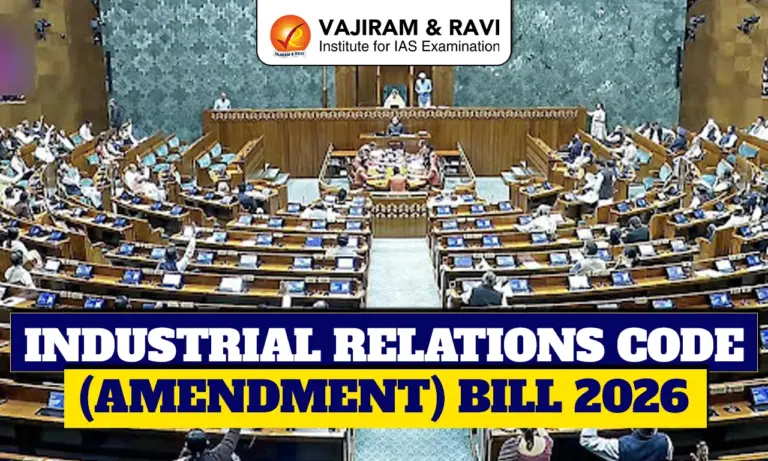
- Recently, the Lok Sabha passed the Industrial Relations Code (Amendment) Bill 2026, aimed at preventing potential legal confusion regarding the repeal of older labour laws replaced by the Industrial Relations Code, 2020.
- The amendment seeks to reinforce legal certainty around the repeal and continuity provisions embedded in the Code.
- The debate once again brought the larger issue of labour reforms vs. labour rights to the forefront — a recurring theme in contemporary Indian polity and governance.
Background
- The Industrial Relations Code, 2020 is one of the four Labour Codes enacted to consolidate and rationalise India’s labour laws.
- It subsumed three major legislations:
- The Trade Unions Act, 1926 (dealt with trade union recognition)
- The Industrial Employment (Standing Orders) Act, 1946 (conditions of employment)
- The Industrial Disputes Act, 1947 (industrial dispute resolution)
- The objective was to streamline labour regulations under a unified framework and promote ease of doing business (EoDB) while protecting worker rights.





Why the Amendment?
- Issue of repeal and legal clarity:
- Section 104 of the 2020 Code already provides for repeal of the above Acts. However, concerns emerged that there could be future legal challenges claiming that repeal power was improperly delegated to the executive.
- Confusion may arise over whether repeal occurred automatically or via government notification.
- The 2026 amendment:
- It clarifies that repeal occurred by operation of Section 104 itself.
- Reinforces savings provisions ensuring continuity of actions taken under old laws.
- Prevents “future unwarranted complications.”
- In essence: This is a legal housekeeping exercise, but one with constitutional implications relating to delegated legislation and legislative competence.
Government’s Position
- The Union Labour Minister defended the amendment and the broader labour codes as reforms for labour welfare.
- Key claims: These
- Guarantee of minimum wages
- Mandatory issuance of appointment letters
- Uniform wages irrespective of gender (equal pay for equal work)
- Greater transparency and formalisation of labour relations
- Commitment to balancing worker welfare and industrial growth
- The government framed the reform as a historic structural change aimed at protecting labourers while enhancing economic efficiency.
Opposition’s Criticism
- Opposition parties raised sharp concerns calling reforms as anti-labour.
- Major objections:
- The Code allegedly enables “ease of firing” without “ease of hiring.”
- This results in weakening of job security, potential increase in working hours, favouring corporates over workers.
- Retrospective amendment reflects complete failure of government, as this repealing of the old Act should have been done before the new law was passed.
- The Opposition also linked labour unrest and strike calls to dissatisfaction with the government’s approach.
Challenges and Way Forward
- Trust deficit: Persistent suspicion among trade unions and opposition parties. Structured dialogue with trade unions.
- Implementation gap: Ensuring uniform enforcement across states. Transparent rule-making at state level.
- Balancing act: Promoting investment while protecting labour rights. Clear communication on safeguards against arbitrary termination. Strengthening labour inspection and compliance systems.
- Judicial scrutiny: Possibility of constitutional challenges. Judiciary must balance labour rights and EoDB.
- Industrial unrest: Strikes and labour mobilisation. Periodic review mechanisms to assess impact on employment and industrial relations. A reform of this scale must be both economically rational and socially sensitive.
Conclusion
- The Industrial Relations Code (Amendment) Bill 2026 may appear technical, but it underscores a larger debate: How should India modernise its labour regime in a fast-changing economy?
- The amendment primarily seeks to eliminate legal ambiguity regarding repeal of older labour laws.
- However, the political contestation around it reveals deeper anxieties about worker protections, job security, and the balance between capital and labour.
- For a country aspiring to become a global manufacturing hub, labour reform is inevitable.
- The real test lies not in legislative consolidation alone, but in ensuring that reform translates into industrial harmony, social justice, and inclusive growth.

 Last updated on March, 2026
→ UPSC Final Result 2025 is now out.
→ UPSC has released UPSC Toppers List 2025 with the Civil Services final result on its official website.
→ Anuj Agnihotri secured AIR 1 in the UPSC Civil Services Examination 2025.
→ UPSC Marksheet 2025 is now out.
→ UPSC Notification 2026 & UPSC IFoS Notification 2026 is now out on the official website at upsconline.nic.in.
→ UPSC Calendar 2026 has been released.
→ Check out the latest UPSC Syllabus 2026 here.
→ UPSC Prelims 2026 will be conducted on 24th May, 2026 & UPSC Mains 2026 will be conducted on 21st August 2026.
→ The UPSC Selection Process is of 3 stages-Prelims, Mains and Interview.
→ Prepare effectively with Vajiram & Ravi’s UPSC Prelims Test Series 2026 featuring full-length mock tests, detailed solutions, and performance analysis.
→ Enroll in Vajiram & Ravi’s UPSC Mains Test Series 2026 for structured answer writing practice, expert evaluation, and exam-oriented feedback.
→ Join Vajiram & Ravi’s Best UPSC Mentorship Program for personalized guidance, strategy planning, and one-to-one support from experienced mentors.
→ Shakti Dubey secures AIR 1 in UPSC CSE Exam 2024.
→ Also check Best UPSC Coaching in India
Industrial Relations Code (Amendment) Bill 2026 FAQs
Q1. What is the need for the Industrial Relations Code (Amendment) Bill 2026?+
Q2. How the Industrial Relations Code, 2020 seeks to balance ease of doing business with labour welfare?+
Q3. Why has the Industrial Relations Code faced criticism from trade unions and opposition parties?+
Q4. What is the significance of savings clauses in legislative reforms such as the Industrial Relations Code?+
Q5. What are the broader economic and social implications of labour code reforms in India?+
Tags: industrial relations code (amendment) bill 2026