About Injunction
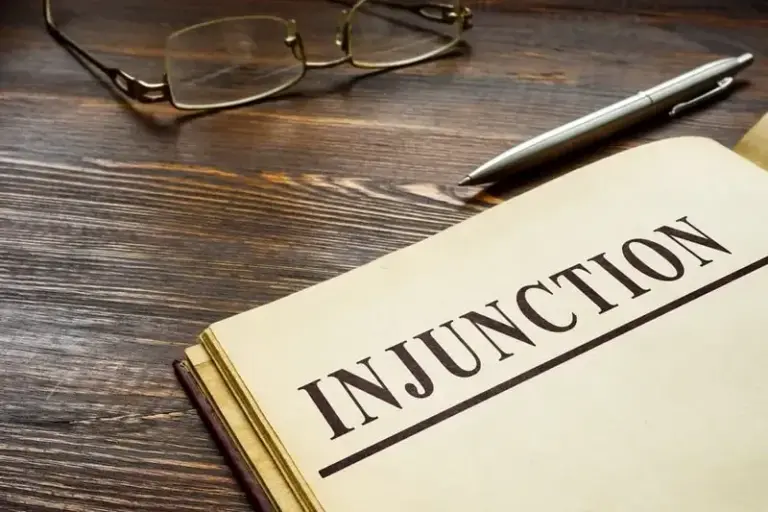
- In India, an injunction is a legal remedy available to parties who wish to prevent the other party from carrying out a certain action or behavior.
- Injunctions can be granted in a variety of situations, such as in cases of intellectual property infringement, breach of contract, or defamation.
- An injunction is a powerful legal tool that acts as a court order requiring a party to do or cease doing specific actions.
- It plays a crucial role in many legal battles, serving as a preventive measure to stop legal wrongs or as a remedy to enforce rights.
- Injunctions are a discretionary remedy, and the court will consider various factors before deciding whether to grant an injunction. These factors may include the urgency of the matter, the balance of convenience, and the likelihood of success in the underlying lawsuit.
- Types of Injunctions in India:
- Temporary Injunctions: They are granted to preserve the status quo until a final decision can be reached. These are usually granted at the start of a case and can last for the duration of the legal proceedings.
- Permanent Injunctions: They are granted after the court has made a final determination in the case. They prohibit the defendant from continuing a particular action or behavior.
- Mandatory Injunctions: They require the defendant to carry out a particular action. They are often granted in cases of breach of contract, where the plaintiff requires the defendant to fulfill their contractual obligations.
- Prohibitory Injunctions: They prohibit the defendant from carrying out a particular action or behavior. They are often granted in cases of intellectual property infringement or defamation.
- Provision of Injunction in Indian Law:
- Under Indian law, injunctions are governed by the Specific Relief Act, 1963. The act provides for two types of injunctions – temporary injunctions and perpetual injunctions.
- In addition to the Specific Relief Act, injunctions are also governed by the Civil Procedure Code, 1908.
- What happens if the party violates the injunction? If a party violates the injunction, they may be held in contempt of court and could face penalties such as fines or imprisonment.
Q1) What is the Specific Relief Act, 1963?
It is a legal statute dealing with reliefs or recovery of the damages of the injured person. This Act was enacted in 1963 following the approach that when a person has withdrawn himself from the performance of a particular promise or a contract with respect to another person, the other person so aggrieved is entitled to a relief under Specific Relief Act, 1963. This Act is considered to be in one of the branches of the Indian Contracts Act, 1872.







 Last updated on April, 2026
→ UPSC Final Result 2025 is now out.
→ UPSC has released UPSC Toppers List 2025 with the Civil Services final result on its official website.
→ Anuj Agnihotri secured AIR 1 in the UPSC Civil Services Examination 2025.
→ UPSC Marksheet 2025 is now out.
→ UPSC Notification 2026 & UPSC IFoS Notification 2026 is now out on the official website at upsconline.nic.in.
→ UPSC Calendar 2026 has been released.
→ Check out the latest UPSC Syllabus 2026 here.
→ UPSC Prelims 2026 will be conducted on 24th May, 2026 & UPSC Mains 2026 will be conducted on 21st August 2026.
→ The UPSC Selection Process is of 3 stages-Prelims, Mains and Interview.
→ Prepare effectively with Vajiram & Ravi’s UPSC Prelims Test Series 2026 featuring full-length mock tests, detailed solutions, and performance analysis.
→ Enroll in Vajiram & Ravi’s UPSC Mains Test Series 2026 for structured answer writing practice, expert evaluation, and exam-oriented feedback.
→ Join Vajiram & Ravi’s Best UPSC Mentorship Program for personalized guidance, strategy planning, and one-to-one support from experienced mentors.
→ Shakti Dubey secures AIR 1 in UPSC CSE Exam 2024.
→ Also check Best UPSC Coaching in India