INS Aridhaman Latest News
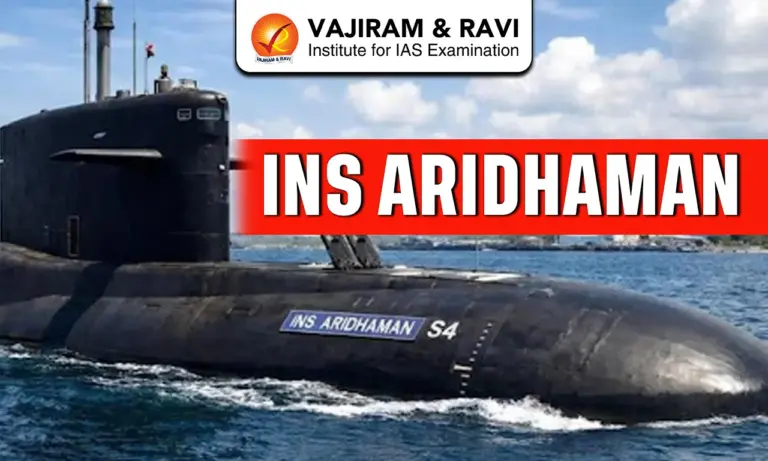
- India has inducted its third nuclear-powered ballistic missile submarine (SSBN), INS Aridhaman, along with the stealth frigate INS Taragiri at Visakhapatnam. There has been no formal announcement of its commissioning.
- The quiet induction of INS Aridhaman follows the same pattern as earlier Arihant-class submarines—INS Arihant (2016) and INS Arighaat (2024).
- Its addition is significant as it strengthens India’s sea-based nuclear deterrence, a crucial component of the country’s strategic defence capability.
Induction of INS Aridhaman
- India has inducted its third nuclear-powered ballistic missile submarine (SSBN), INS Aridhaman, significantly enhancing its sea-based nuclear deterrence.
- With this induction, India now has three operational SSBNs, marking a major milestone in its strategic capabilities.
Enhanced Capabilities of the Submarine
- INS Aridhaman is an indigenous SSBN designed to carry a greater number of long-range nuclear-tipped missiles compared to its predecessors—INS Arihant (commissioned in 2016) and INS Arighaat (2024).
- This advancement strengthens India’s ability to maintain a credible deterrent.
Strengthening India’s Nuclear Triad
- The induction further consolidates India’s nuclear triad, which refers to the capability to launch nuclear weapons from land, air, and sea.
- Land-based systems: Agni series missiles
- Air-based systems: Fighter aircraft like Rafale, Su-30MKI, and Mirage 2000
- Sea-based systems: SSBNs like INS Aridhaman
- India joins a select group of countries—the US, Russia, China, and France—that possess such capability.
Second-Strike Capability and Deterrence
- India follows a “No First Use” nuclear doctrine, meaning nuclear weapons are intended only for deterrence and retaliation.
- In this context, SSBNs play a critical role by ensuring a second-strike capability.
- Even if an adversary targets India’s land and air bases in a first strike, SSBNs operating stealthily at sea can launch a retaliatory nuclear attack, thereby maintaining credible deterrence.





Features of INS Aridhaman
- INS Aridhaman is a 7,000-tonne nuclear-powered submarine equipped with eight vertical launch tubes, nearly double that of its predecessors.
- This allows it to carry a larger number of nuclear-capable missiles.
- It is powered by upgraded nuclear reactors, enabling it to remain submerged for months without surfacing, significantly improving stealth and survivability.
- The submarine can deploy:
- K-15 SLBMs with a range of over 700 km
- K-4 SLBMs with a range of around 3,500 km
- This combination enhances India’s ability to strike targets at varying distances.
- India is also building a fourth SSBN, expected to be larger and capable of carrying more K-4 missiles, further strengthening the country’s sea-based nuclear deterrent.
Origins of India’s Nuclear Submarine Programme
- India’s nuclear-powered submarine project began over three decades ago, involving collaboration between the DRDO, private industry, and technical assistance from Russia.
- The aim was to build an indigenous sea-based nuclear deterrent.
INS Arihant: The First Milestone
- INS Arihant, launched in 2009 and commissioned in 2016, became India’s first nuclear-powered submarine, giving the country a maritime nuclear strike capability for the first time.
- In 2018, Arihant completed its first deterrence patrol, marking the operationalisation of India’s nuclear triad.
- Later, in October 2022, it successfully launched a submarine-launched ballistic missile (SLBM) in the Bay of Bengal with high accuracy.
INS Arighaat: Technological Advancement
- The induction of the 6,000-tonne INS Arighaat in 2024 further strengthened India’s nuclear strike capability.
- It is considered more technologically advanced than Arihant, incorporating improved design, engineering, and manufacturing techniques.
- Its construction involved advanced R&D, specialised materials, complex engineering processes, and skilled workmanship, reflecting India’s growing expertise in submarine technology.
Nuclear Propulsion and Stealth Capability
- Both INS Arihant and INS Arighaat are powered by 83 MW pressurised light-water nuclear reactors, enabling them to remain submerged for long durations and operate with greater stealth compared to conventional diesel-electric submarines.
- Together, these submarines form the backbone of India’s sea-based nuclear deterrent, enhancing survivability, stealth, and second-strike capability as part of the country’s broader nuclear strategy.
Future Submarine Plans of India
- India is expanding its underwater capabilities through multiple initiatives.
- It is pursuing a nuclear-powered attack submarine (SSN) programme, under which two SSNs will be built indigenously, while one submarine will be leased from Russia, expected by 2027–28, to bridge immediate capability gaps.
- Additionally, India is close to finalising the Project-75I submarine deal with Germany, where ThyssenKrupp Marine Systems will collaborate with Mazagon Dock Shipbuilders Ltd to build six advanced conventional submarines with Air Independent Propulsion (AIP) technology in India.
- However, there is still uncertainty regarding the acquisition of three additional Scorpene-class submarines.
India’s Submarine Strength and Operational Capacity
- India currently operates 16 conventional submarines, in addition to its SSBN fleet.
- These include six Kalvari-class submarines built with France’s Naval Group, four Shishumar-class, and seven Kilo (Sindhughosh)-class submarines.
- While the Navy is authorised to maintain a fleet of 18 submarines, about 30% are typically under refit at any given time, reducing the number of operational submarines available.
- In comparison, the United States operates 14 Ohio-class SSBNs and 53 attack submarines, while China has around 12 nuclear submarines, including six nuclear-powered attack submarines, highlighting the capability gap India aims to bridge.

 Last updated on March, 2026
→ UPSC Final Result 2025 is now out.
→ UPSC has released UPSC Toppers List 2025 with the Civil Services final result on its official website.
→ Anuj Agnihotri secured AIR 1 in the UPSC Civil Services Examination 2025.
→ UPSC Marksheet 2025 is now out.
→ UPSC Notification 2026 & UPSC IFoS Notification 2026 is now out on the official website at upsconline.nic.in.
→ UPSC Calendar 2026 has been released.
→ Check out the latest UPSC Syllabus 2026 here.
→ UPSC Prelims 2026 will be conducted on 24th May, 2026 & UPSC Mains 2026 will be conducted on 21st August 2026.
→ The UPSC Selection Process is of 3 stages-Prelims, Mains and Interview.
→ Prepare effectively with Vajiram & Ravi’s UPSC Prelims Test Series 2026 featuring full-length mock tests, detailed solutions, and performance analysis.
→ Enroll in Vajiram & Ravi’s UPSC Mains Test Series 2026 for structured answer writing practice, expert evaluation, and exam-oriented feedback.
→ Join Vajiram & Ravi’s Best UPSC Mentorship Program for personalized guidance, strategy planning, and one-to-one support from experienced mentors.
→ Shakti Dubey secures AIR 1 in UPSC CSE Exam 2024.
→ Also check Best UPSC Coaching in India
INS Aridhaman FAQs
Q1. What is INS Aridhaman?+
Q2. Why is INS Aridhaman important?+
Q3. What is nuclear triad and how does INS Aridhaman help?+
Q4. What missiles can INS Aridhaman carry?+
Q5. How does INS Aridhaman improve second-strike capability?+
Tags: ins aridhaman mains articles upsc current affairs upsc mains current affairs