US Government Shutdown Oil Latest News
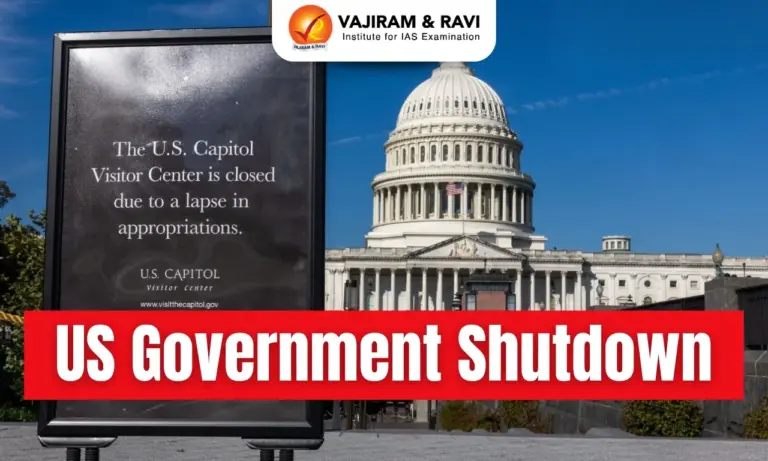
- US President Donald Trump signed a stopgap bill recently, ending the longest government shutdown in US history.
- A shutdown occurs when the government runs out of funds, forcing federal agencies to halt operations and hurting the economy.
- Since the budget system began in 1976, the US has faced 11 shutdowns, with the latest lasting 43 days — surpassing the previous record of 34 days during Trump’s earlier term.
Why Government Shutdowns Happen in the US but Not in India
- A US government shutdown occurs not because the country runs out of money, but because the government loses legislative permission to tax and spend.
- Unlike India — where the Executive is part of Parliament and a budget failure forces the government to resign — the US President is separate from Congress.
- This separation means the President cannot ensure passage of the budget and need not resign if it fails.
- When Congress, divided along party lines, cannot agree on the budget, the federal government shuts down.
- In the recent shutdown, Republicans lacked the 60 Senate votes needed, and the deadlock ended only when eight Democrats supported the resolution.





How the US Budget Cycle Works
- The US fiscal year runs from October 1 to September 30. The shutdown began on October 1 because the Trump administration could not get its budget approved by Congress in time.
Budget Preparation Begins in February
- The budget process starts much earlier. By the first Monday of February, the President must submit the budget proposal to Congress.
- Both chambers — the House and the Senate — then engage in months of deliberations, debates, and amendments on taxation and spending priorities.
- These discussions often become contentious.
Source of Conflict in the Recent Budget Debate
- A key point of disagreement during this shutdown was the scope and funding of the Supplemental Nutrition Assistance Program (SNAP), formerly known as the food stamps programme.
- Such policy disagreements create delays in approving appropriations.
October 1: The Hard Deadline
- According to the Congressional Research Service, October 1 is a strict deadline for Congress to pass appropriations.
- When the fiscal year ends, previous funding expires, and by law, the government cannot spend money without new appropriations.
Why a Shutdown Happens
- If Congress does not approve funding by October 1 — creating a “funding gap” — federal agencies must begin shutting down affected programmes and activities.
- This legal requirement triggers a government shutdown until a new budget or stopgap bill is passed.
Rising US Budget Deficit
- According to the Congressional Budget Office, the US recorded a $1.8 trillion budget deficit in FY2025.
- Government receipts were $5.2 trillion, while spending reached $7 trillion, creating a large fiscal gap.
- For comparison, the entire Indian GDP is under $4 trillion, and the central government’s total budget expenditure is about $0.6 trillion.
- This highlights the massive scale of US finances and deficits.
- The FY2025 deficit equalled 5.9% of US GDP, much higher than the long-term average of 3.8% (1975–2025).
- A deficit means the government must borrow more to sustain its expenditure.
- Larger deficits add to the rising mountain of public debt. One consequence is rising interest payments, which have now become the second-largest expenditure item for the US government, as shown in official data.
Presidential vs Parliamentary System: A Warning for India
- The US shutdown illustrates how a presidential system can suffer severe governance breakdowns when the executive and legislature disagree.
- In contrast, India’s parliamentary system ensures continuity of government, even with its own limitations.
- While system choice depends on many factors, this episode highlights why a developing country like India may struggle to withstand long, disruptive shutdowns that a presidential model can trigger.

 Last updated on March, 2026
→ UPSC Final Result 2025 is now out.
→ UPSC has released UPSC Toppers List 2025 with the Civil Services final result on its official website.
→ Anuj Agnihotri secured AIR 1 in the UPSC Civil Services Examination 2025.
→ UPSC Marksheet 2025 is now out.
→ UPSC Notification 2026 & UPSC IFoS Notification 2026 is now out on the official website at upsconline.nic.in.
→ UPSC Calendar 2026 has been released.
→ Check out the latest UPSC Syllabus 2026 here.
→ UPSC Prelims 2026 will be conducted on 24th May, 2026 & UPSC Mains 2026 will be conducted on 21st August 2026.
→ The UPSC Selection Process is of 3 stages-Prelims, Mains and Interview.
→ Prepare effectively with Vajiram & Ravi’s UPSC Prelims Test Series 2026 featuring full-length mock tests, detailed solutions, and performance analysis.
→ Enroll in Vajiram & Ravi’s UPSC Mains Test Series 2026 for structured answer writing practice, expert evaluation, and exam-oriented feedback.
→ Join Vajiram & Ravi’s Best UPSC Mentorship Program for personalized guidance, strategy planning, and one-to-one support from experienced mentors.
→ Shakti Dubey secures AIR 1 in UPSC CSE Exam 2024.
→ Also check Best UPSC Coaching in India
US Government Shutdown FAQs
Q1. What causes a US government shutdown?+
Q2. How does the US budget cycle operate?+
Q3. Why is the US budget deficit a major concern?+
Q4. Why does India avoid government shutdowns?+
Q5. What lesson does the US shutdown offer India?+
Tags: mains articles upsc current affairs upsc mains current affairs US government shutdown