INSV Kaundinya Latest News
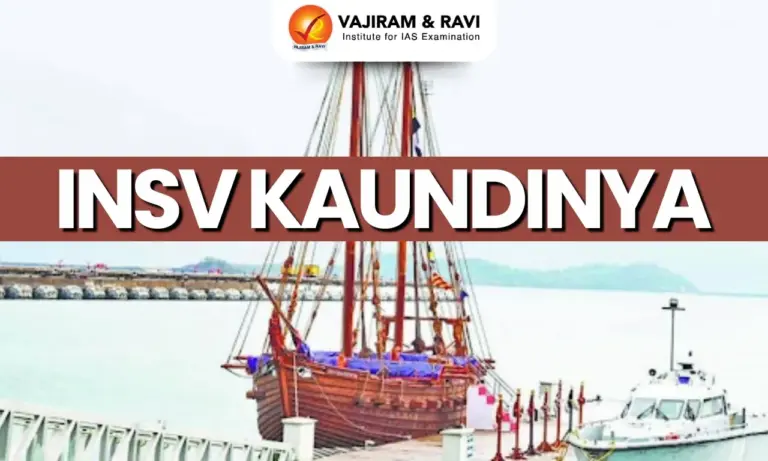
- INSV Kaundinya, the Indian Navy’s stitched sailing vessel built using traditional shipbuilding techniques, has begun its maiden overseas voyage from Porbandar, Gujarat, to Muscat, Oman.
- The voyage symbolically retraces ancient maritime routes that once linked India with the wider Indian Ocean world.
- Constructed with wooden planks stitched using coconut coir rope and sealed with natural resins, the vessel reflects an indigenous shipbuilding tradition prevalent along India’s coasts.
- This technology enabled Indian mariners to undertake long-distance voyages to West Asia, Africa, and Southeast Asia long before modern navigation methods.
- The project was executed under a tripartite agreement between the Ministry of Culture, the Indian Navy, and Hodi Innovations, as part of India’s broader effort to revive and showcase its indigenous knowledge systems and maritime heritage.
INSV Kaundinya: Revival of an Ancient Indian Vessel
- INSV Kaundinya is a stitched sail ship inspired by a 5th century CE vessel depicted in the paintings of the Ajanta Caves.
- It represents an effort to recreate India’s early maritime traditions using historically authentic methods.
Traditional Construction and Craftsmanship
- After the keel laying in September 2023, the ship was built using the traditional stitching technique by a team of skilled artisans from Kerala, led by master shipwright Babu Sankaran.
- Wooden planks forming the hull were stitched together with coir rope, coconut fibre, and sealed using natural resin.
- The vessel was launched in February 2025 at Goa.
- Navy formally inducted the naval sailing vessel in May 2025 at the Karwar Naval base, in Karnataka.
Indian Navy’s Role and Interdisciplinary Design
- The Indian Navy played a central role by overseeing the vessel’s design, technical validation, and construction.
- With no surviving blueprints or physical remains, the design was extrapolated from two-dimensional artistic depictions.
- The project required an interdisciplinary approach, combining archaeological interpretation, naval architecture, hydrodynamic testing, and traditional craftsmanship.
Dimensions, Crew, and Tankai Method
- INSV Kaundinya is about 19.6 metres long, 6.5 metres wide, with a draft of 3.33 metres.
- Powered solely by sails, it is operated by a crew of around 15 trained sailors.
- Construction follows the indigenous Tankai method, where the hull is stitched first and ribs are added later—completely avoiding the use of metal.





INSV Kaundinya: A Ship Built Without Engines or Metal
- INSV Kaundinya is a non-combat sailing vessel constructed entirely using a stitched shipbuilding technique dating back to at least the 5th century CE.
- Wooden planks are stitched together with coir rope made from coconut fibre and sealed with natural resins, cotton, and oils.
- This flexible hull design allows the vessel to absorb wave energy—an essential feature for ancient sailors navigating the Arabian Sea and Bay of Bengal.
- Hydrodynamic testing and stability studies were carried out with assistance from academic institutions, including IIT Madras, to ensure seaworthiness for open-ocean voyages.
Symbolism Embedded in INSV Kaundinya’s Design
- INSV Kaundinya’s structure incorporates culturally rich elements that reflect India’s ancient maritime heritage.
- Her sails carry motifs of the Gandabherunda and the Sun, symbolising power and continuity, while the bow features a sculpted Simha Yali, a mythical guardian figure associated with strength and protection.
- A symbolic Harappan-style stone anchor placed on the deck evokes the subcontinent’s early seafaring traditions.
- Named after Kaundinya, the Indian mariner who sailed across the Indian Ocean to Southeast Asia, the vessel stands as a living representation of India’s long history of maritime exploration, trade networks, and cultural exchange, underscoring the civilisational depth of India’s engagement with the seas.
Reviving Ancient Maritime Highways
- The Porbandar–Muscat route retraced by INSV Kaundinya was once a vital maritime corridor for trade in spices, textiles, and ideas across West Asia, Africa, and Southeast Asia.
- By sailing this route again, the vessel demonstrates the sophistication of ancient Indian shipbuilding and reaffirms India’s identity as a historic maritime civilisation.

 Last updated on March, 2026
→ UPSC Final Result 2025 is now out.
→ UPSC has released UPSC Toppers List 2025 with the Civil Services final result on its official website.
→ Anuj Agnihotri secured AIR 1 in the UPSC Civil Services Examination 2025.
→ UPSC Marksheet 2025 is now out.
→ UPSC Notification 2026 & UPSC IFoS Notification 2026 is now out on the official website at upsconline.nic.in.
→ UPSC Calendar 2026 has been released.
→ Check out the latest UPSC Syllabus 2026 here.
→ UPSC Prelims 2026 will be conducted on 24th May, 2026 & UPSC Mains 2026 will be conducted on 21st August 2026.
→ The UPSC Selection Process is of 3 stages-Prelims, Mains and Interview.
→ Prepare effectively with Vajiram & Ravi’s UPSC Prelims Test Series 2026 featuring full-length mock tests, detailed solutions, and performance analysis.
→ Enroll in Vajiram & Ravi’s UPSC Mains Test Series 2026 for structured answer writing practice, expert evaluation, and exam-oriented feedback.
→ Join Vajiram & Ravi’s Best UPSC Mentorship Program for personalized guidance, strategy planning, and one-to-one support from experienced mentors.
→ Shakti Dubey secures AIR 1 in UPSC CSE Exam 2024.
→ Also check Best UPSC Coaching in India
INSV Kaundinya FAQs
Q1. What is INSV Kaundinya and why is it significant?+
Q2. What route is INSV Kaundinya sailing and why?+
Q3. How was INSV Kaundinya constructed?+
Q4. What role did the Indian Navy play in the project?+
Q5. Why is INSV Kaundinya important for India’s soft power?+
Tags: insv kaundinya mains articles upsc current affairs upsc mains current affairs