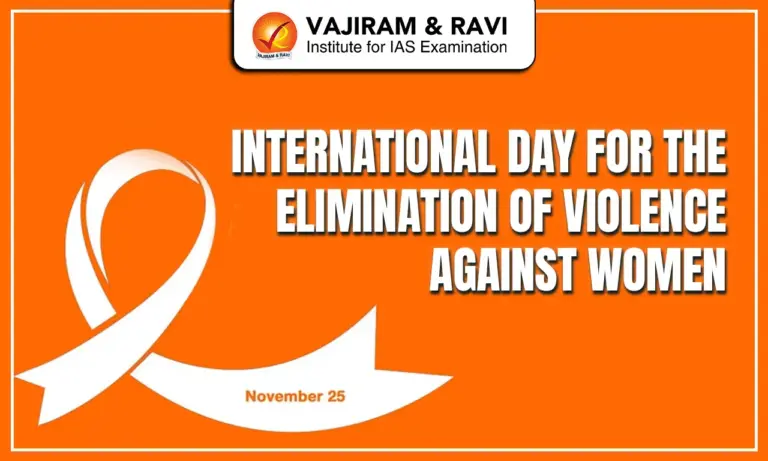
The International Day for the Elimination of Violence Against Women, observed on 25 November every year serves as a powerful reminder of the global fight to end gender-based violence. Recognised by the United Nations General Assembly in 2000, the day marks the beginning of the 16 Days of Activism (Nov 25-Dec 10). In 2025, the global theme is “UNiTE to End Digital Violence Against All Women and Girls.” For UPSC aspirants, this topic is important for GS-1 (Society), GS-2 (Governance), GS-3 (Cyber Security), and Essay.
International Day for the Elimination of Violence Against Women
Violence against women remains one of the most pervasive human-rights violations globally. India, with its vast population and diverse socio-cultural landscape, has made continuous efforts to strengthen laws, institutions, and digital safety frameworks. The increasing rise of cyberbullying, deepfakes, doxxing, cyberstalking, and online hate campaigns has broadened the challenge, making the focus on digital safety more urgent. Against this backdrop, the observance of November 25 highlights India’s commitment to creating a safer physical and digital environment for women and girls.
International Day for the Elimination of Violence Against Women Theme
The theme for the International Day for the Elimination of Violence Against Women 2025 is “UNiTE to End Digital Violence Against All Women and Girls.” It highlights the growing threat of online abuse, including cyberstalking, deepfakes, doxxing, and digital harassment. The theme urges governments, tech platforms, and communities to strengthen digital safety, promote accountability, and create secure online spaces for women and girls.





International Day for the Elimination of Violence Against Women History
The International Day for the Elimination of Violence Against Women was officially designated by the United Nations General Assembly in 2000 to raise global awareness about gender-based violence. The date, 25 November, commemorates the assassination of the Mirabal sisters in 1960, who were activists opposing dictatorship in the Dominican Republic.
- Declared by the UN General Assembly in 2000 through Resolution 54/134.
- 25 November chosen to honour the Mirabal sisters, symbols of resistance against oppression.
- Marks the start of the 16 Days of Activism (Nov 25–Dec 10).
- Aims to mobilise governments, organisations, and citizens to end gender-based violence globally.
India’s Multi-Layered Approach to Ending Violence Against Women
India adopts a multi-layered approach that combines strong legal protections, institutional mechanisms, technology-driven systems, and comprehensive support services for women. This integrated framework focuses on prevention, timely response, survivor support, and long-term empowerment.
- Robust legal reforms including Bharatiya Nyaya Sanhita 2023, PWDVA 2005, and POSH Act 2013.
- Institutional mechanisms like NCW, State Commissions for Women, Fast Track Special Courts, and Women Help Desks.
- Supportive schemes under Mission Shakti, including One Stop Centres, Swadhar Greh, and Women Helpline (181).
- Technology-driven tools such as SHe-Box, ITSSO, Cri-MAC, NDSO, and Digital Shakti Campaign for safer digital environments.
- Integrated emergency systems like ERSS (112) and specialised training programs like Stree Manoraksha for psychosocial support.
Legal Framework to Protect Women in India
India has strengthened its legal architecture with comprehensive laws addressing domestic violence, sexual harassment, cyber harms, and crimes against women and children. These reforms ensure speedy justice, survivor-friendly procedures, and stricter punishments. The introduction of the Bharatiya Nyaya Sanhita (BNS), 2023 marks a major shift in criminal law, with enhanced penalties and technology-enabled processes.
National Commission for Women (NCW)
The National Commission for Women, established on 31 January 1992, is the apex statutory body mandated to protect women’s constitutional and legal rights. It monitors safeguards, suggests law reforms, and addresses complaints online and offline. State Commissions for Women perform parallel roles at the local level. NCW also operates helpline 7827170170 providing 24×7 online support through IVR-based systems for psychological counselling, legal support, and emergency assistance.
Bharatiya Nyaya Sanhita, 2023
Effective from 1 July 2024, BNS replaces the Indian Penal Code (IPC) and introduces stronger provisions for crimes against women. It expands definitions of sexual offences, mandates audio-video recording of victim statements, and ensures that cases involving women and children receive priority in trial proceedings.
- Life imprisonment for rape of minors under 18.
- Time-bound trials and improved evidence collection.
- Wider definitions of sexual assault and exploitation.
- Survivor-friendly procedures including digital recording.
Protection of Women from Domestic Violence Act, 2005 (PWDVA)
PWDVA legally recognises domestic violence in all forms: physical, sexual, emotional, and economic. It defines an aggrieved person as any woman in a domestic relationship and ensures protection orders, residence rights, and compensation. This Act enables women to seek relief even through Protection Officers and service providers, ensuring a comprehensive support ecosystem.
Sexual Harassment of Women at Workplace Act, 2013 (POSH Act)
The POSH Act provides a robust legal framework to protect women across all workplaces: public, private, organised, and unorganised. It mandates the establishment of Internal Committees (ICs) in workplaces with more than 10 employees and Local Committees (LCs) for smaller establishments. The Ministry of Women and Child Development oversees implementation.
- Mandatory ICs and LCs for grievance redressal
- Completion of inquiries within 90 days
- Accountability mechanisms for employers
- Access to SHe-Box portal for online complaints
Digital Shakti Campaign
The NCW’s Digital Shakti Campaign aims to make women digitally skilled, aware, and empowered to combat online crimes. It trains women across India in identifying and responding to cyber threats, enhancing their ability to report and safeguard themselves online.
- Cyber safety training
- Awareness on digital rights
- Reporting mechanisms for cybercrimes
- Data privacy and protection awareness
Institutional Mechanisms for Fast and Survivor-Friendly Justice
India has invested in specialised institutions to speed up justice delivery and improve survivor experience.
- Fast Track Special Courts (FTSCs): As of August 2025, 773 FTSCs, including 400 e-POCSO courts, are functional. These courts have disposed over 3.34 lakh cases relating to rape and POCSO.
- Women Help Desks (WHDs): As of February 2025, 14,658 WHDs operate in police stations, facilitating easier reporting and improving sensitivity in investigations.
- SHe-Box Portal: A unified digital platform that routes workplace harassment complaints to relevant Internal/Local Committees. It offers real-time tracking, data monitoring, and improved accountability.
Technology-Driven Reforms for Women’s Safety
The Government has introduced several digital tools to track offenders, strengthen policing, and enhance coordination between states.
- Investigation Tracking System for Sexual Offences (ITSSO): Monitors progress of investigations to ensure timely completion.
- National Database on Sexual Offenders (NDSO): Tracks convicted offenders and helps police identify repeat offenders.
- Crime Multi-Agency Centre (Cri-MAC): Facilitates real-time sharing of information on heinous crimes across states.

 Last updated on April, 2026
→ UPSC Final Result 2025 is now out.
→ UPSC has released UPSC Toppers List 2025 with the Civil Services final result on its official website.
→ Anuj Agnihotri secured AIR 1 in the UPSC Civil Services Examination 2025.
→ UPSC Marksheet 2025 is now out.
→ UPSC Notification 2026 & UPSC IFoS Notification 2026 is now out on the official website at upsconline.nic.in.
→ UPSC Calendar 2026 has been released.
→ Check out the latest UPSC Syllabus 2026 here.
→ UPSC Prelims 2026 will be conducted on 24th May, 2026 & UPSC Mains 2026 will be conducted on 21st August 2026.
→ The UPSC Selection Process is of 3 stages-Prelims, Mains and Interview.
→ Prepare effectively with Vajiram & Ravi’s UPSC Prelims Test Series 2026 featuring full-length mock tests, detailed solutions, and performance analysis.
→ Enroll in Vajiram & Ravi’s UPSC Mains Test Series 2026 for structured answer writing practice, expert evaluation, and exam-oriented feedback.
→ Join Vajiram & Ravi’s Best UPSC Mentorship Program for personalized guidance, strategy planning, and one-to-one support from experienced mentors.
→ Shakti Dubey secures AIR 1 in UPSC CSE Exam 2024.
→ Also check Best UPSC Coaching in India
International Day for the Elimination of Violence Against Women FAQs
Q1. When is the International Day for the Elimination of Violence Against Women observed?+
Q2. Why is 25 November chosen for the observance?+
Q3. What is the theme for 2025?+
Q4. Who established this international day?+
Q5. What global campaign begins on this day?+
Tags: international day for the elimination of violence against women