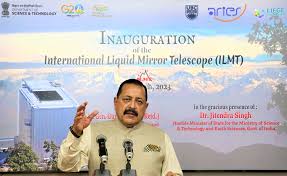
About International Liquid Mirror Telescope:
- ILMT is the first liquid mirror telescope designed exclusively for astronomical observations and is the first optical survey telescope in India.
- It has a 4-meter-diameter rotating mirror made up of a thin layer of liquid mercury to collect and focus light.
- The metal mercury is in liquid form at room temperature, which is highly reflective and designed to survey the strip of the sky passing overhead each night.
- The Devasthal observatory is equipped with the largest aperture telescope available in India that will use Big Data and Artificial Intelligence/Machine Learning (AI/ML) algorithms to classify objects in the sky.
- The telescope has three components: A bowl containing a reflecting liquid mercury metal, an air bearing (or motor) on which the liquid mirror sits, and a drive system.
- The mercury is protected from the wind by a scientific grade thin transparent film of mylar.
- The reflected light passes through a sophisticated multi-lens optical corrector that produces sharp images over a wide field of view and a 4k CCD camera, located above the mirror at the focus, records 22 arc-minute wide strips of the sky.
- The data collected from the ILMT, over an operational time of 5 years, will be ideally suited to perform a deep photometric and astrometric variability survey.
- Maintained by the Aryabhata Research Institute of Observational Sciences (ARIES).
Q1: What is element mercury?
Elemental or metallic mercury is a shiny, silver-white metal, historically referred to as quicksilver, and is liquid at room temperature. It is used in older thermometers, fluorescent light bulbs and some electrical switches. When dropped, elemental mercury breaks into smaller droplets which can go through small cracks or become strongly attached to certain materials.






 Last updated on March, 2026
→ UPSC Final Result 2025 is now out.
→ UPSC has released UPSC Toppers List 2025 with the Civil Services final result on its official website.
→ Anuj Agnihotri secured AIR 1 in the UPSC Civil Services Examination 2025.
→ UPSC Marksheet 2025 is now out.
→ UPSC Notification 2026 & UPSC IFoS Notification 2026 is now out on the official website at upsconline.nic.in.
→ UPSC Calendar 2026 has been released.
→ Check out the latest UPSC Syllabus 2026 here.
→ UPSC Prelims 2026 will be conducted on 24th May, 2026 & UPSC Mains 2026 will be conducted on 21st August 2026.
→ The UPSC Selection Process is of 3 stages-Prelims, Mains and Interview.
→ Prepare effectively with Vajiram & Ravi’s UPSC Prelims Test Series 2026 featuring full-length mock tests, detailed solutions, and performance analysis.
→ Enroll in Vajiram & Ravi’s UPSC Mains Test Series 2026 for structured answer writing practice, expert evaluation, and exam-oriented feedback.
→ Join Vajiram & Ravi’s Best UPSC Mentorship Program for personalized guidance, strategy planning, and one-to-one support from experienced mentors.
→ Shakti Dubey secures AIR 1 in UPSC CSE Exam 2024.
→ Also check Best UPSC Coaching in India