Inverted Duty Structure under GST Latest News
Tax experts have broadly welcomed the Centre’s proposal for a two-tier GST rate structure while cautioning that critical issues such as inverted duty structure need to be addressed for the reform to be fully effective.
About Inverted Duty Structure under GST
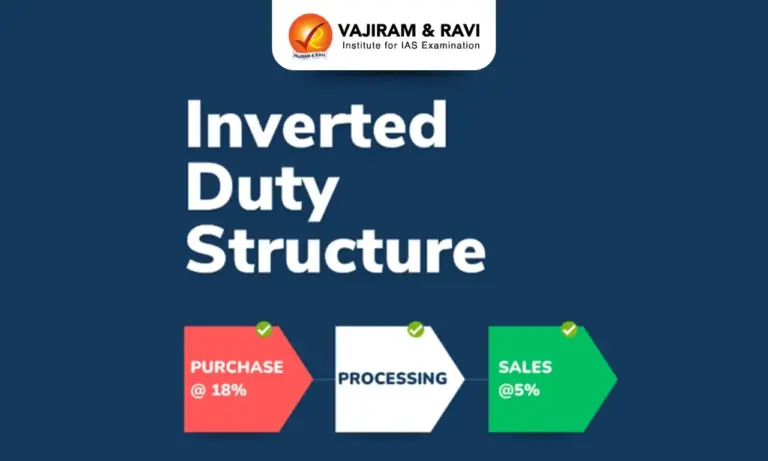
- An inverted duty structure in GST occurs when the tax rate on inputs exceeds the tax rate on output.
- For example, in the textile industry, the input tax rate ranges from 12 to 18%, while most finished products are taxed at 5%.
- This implies that sellers have fewer options for offsetting the cost of input taxes.
- This situation might result in an accumulation of input tax credit (ITC), which can’t be used for the output tax liability.
- The accumulation of ITC due to unutilized ITC will have to be carried over to the next financial year until it can be utilized by the registered taxpayer for payment of output tax liability.
- This can result in higher tax costs for businesses and/or an increase in the hidden tax cost for consumers.
- To solve this issue, the GST law allows for a refund or reversal of ITC.
- The refund is determined using a method including the turnover of the inverted rated supply, the net ITC, and the overall turnover.
- Exceptions where the refund of the unutilised input tax credit cannot be claimed, are as follows:
- Output supplies are nil-rated or fully exempt supplies except for supplies of goods or services or both as may be notified by the Government on the recommendations of the GST Council.
- If the goods exported out of India are subject to export duty.
- If the supplier claims a refund of output tax paid under the IGST Act.
- If the supplier avails duty drawback or refund of IGST on such supplies.
Source: HBL






 Last updated on April, 2026
→ UPSC Final Result 2025 is now out.
→ UPSC has released UPSC Toppers List 2025 with the Civil Services final result on its official website.
→ Anuj Agnihotri secured AIR 1 in the UPSC Civil Services Examination 2025.
→ UPSC Marksheet 2025 is now out.
→ UPSC Notification 2026 & UPSC IFoS Notification 2026 is now out on the official website at upsconline.nic.in.
→ UPSC Calendar 2026 has been released.
→ Check out the latest UPSC Syllabus 2026 here.
→ UPSC Prelims 2026 will be conducted on 24th May, 2026 & UPSC Mains 2026 will be conducted on 21st August 2026.
→ The UPSC Selection Process is of 3 stages-Prelims, Mains and Interview.
→ Prepare effectively with Vajiram & Ravi’s UPSC Prelims Test Series 2026 featuring full-length mock tests, detailed solutions, and performance analysis.
→ Enroll in Vajiram & Ravi’s UPSC Mains Test Series 2026 for structured answer writing practice, expert evaluation, and exam-oriented feedback.
→ Join Vajiram & Ravi’s Best UPSC Mentorship Program for personalized guidance, strategy planning, and one-to-one support from experienced mentors.
→ Shakti Dubey secures AIR 1 in UPSC CSE Exam 2024.
→ Also check Best UPSC Coaching in India
Inverted Duty Structure under GST FAQs
Q1. What does an inverted duty structure under GST mean?+
Q2. What is the main issue caused by an inverted duty structure?+
Q3. Under GST law, how is the issue of accumulated input tax credit (ITC) due to inverted duty structure addressed?+
Tags: inverted duty structure prelims pointers upsc current affairs upsc prelims current affairs