Iran’s Power Pyramid Latest News
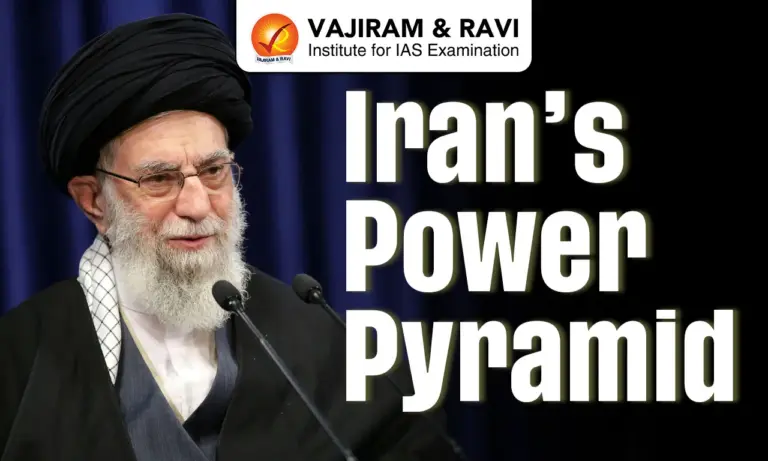
- The assassination of Ayatollah Ali Khamenei, Iran’s 86-year-old Supreme Leader, marks the end of a defining era in the country’s post-1979 Islamic Revolution leadership. He was killed in an attack by US and Israeli forces.
- Following his death, the constitutional process to appoint a successor was immediately activated. The Assembly of Experts has begun deliberations to select the next Supreme Leader.
- In the interim, a three-member Interim Leadership Council has taken over his duties, as provided under Iran’s Constitution.
- These developments highlight the structured mechanisms within Iran’s political system to manage leadership transitions during crises.
Religion and Politics in Iran: Historical Roots
- The close relationship between religion and politics in Shia-majority Iran predates the 1979 Islamic Revolution.
- Shia clerics often adopted an anti-monarchist stance and actively participated in political movements.
- Important examples include:
- the 19th-century Tobacco Movement against British concessions,
- the Constitutional Revolution of 1906–11 demanding a constitutional monarchy,
- protests against the Shah’s 1963 White Revolution reforms, and
- finally the 1979 Revolution.
The 1979 Revolution and Clerical Leadership
- The ideological leadership of Ayatollah Khomeini, even while he was in exile in France, played a decisive role in shaping the 1979 Revolution and the Islamic Republic that followed.
- Although diverse groups such as workers and communists joined the anti-Shah protests, the religious establishment gained greater legitimacy and influence after the Revolution due to its strong ideological direction.
Mosques as Political Spaces
- One key factor behind the clergy’s rise was the central role of mosques in political mobilisation. Friday prayer gatherings became important platforms for religio-political expression.
- In a repressive environment where public spaces were monitored by the Shah’s secret police, SAVAK, mosques functioned as relatively safe spaces (bast) for organising resistance.
Consolidation of a Religio-Political System
- Over the past 47 years, Iran developed a political system made up of hierarchical yet interconnected institutions rooted in revolutionary ideology.
- Ayatollah Khamenei led this system, which blends religious authority with political power and reflects the long historical intertwining of Shia clerical leadership and state governance in Iran.





Khomeini and Khamenei: Shaping Iran’s Supreme Leadership
- Before and during the 1979 Revolution, religious scholars and intellectuals reinterpreted Islamic ideas in a revolutionary way.
- Thinkers like Ali Shariati linked faith with social justice and anti-imperialist politics, though he did not support clerical political rule.
- Ayatollah Khomeini, however, advanced the doctrine of velayat-e-faqih (rule of the jurisprudent).
- He argued that a senior Islamic jurist should lead the state. This idea became the foundation of Iran’s political system.
Constitutional Framework of the Islamic Republic
- The 1979 Constitution combined Khomeini’s theory of clerical rule with elements of republicanism.
- It created the post of Supreme Leader with overarching authority over political and religious affairs.
- After Khomeini’s death in 1989, constitutional amendments redistributed some executive powers and abolished the Prime Minister’s post.
- However, the core structure of clerical supremacy remained intact.
Rise of Ayatollah Khamenei
- Ayatollah Ali Khamenei succeeded Khomeini in 1989. His selection was controversial, as Ayatollah Montazeri had earlier been designated successor.
- Khamenei had served as President from 1981 to 1989, during the Iran-Iraq War.
- The war years shaped his political outlook and strengthened his image as a defender of the Islamic Republic.
Leadership Style and Challenges
- As Supreme Leader, Khamenei combined religious authority with political control.
- Internationally, he was seen as a hardliner, though some analysts described him as pragmatic.
- Domestically, his leadership faced criticism.
- The Mahsa Amini protests in 2022 and later economic demonstrations reflected dissatisfaction with authoritarian governance and economic isolation.
- His policy of a “resistance economy,” aimed at reducing dependence on the West and countering sanctions, did not fully resolve Iran’s economic challenges.
Continuity and Change
- Both Khomeini and Khamenei shaped Iran’s unique system of clerical governance.
- While institutional adjustments occurred over time, the central principle of Supreme Leader supremacy remained the defining feature of Iran’s political order.
Iran After the Supreme Leader
- Iran has regularly held elections for the President, the Majlis (Parliament), and local bodies. Politics has long been shaped by rivalry between reformists and hardliners.
- Ayatollah Khamenei, though often supportive of hardliners, developed a practice of balancing factions and managing internal differences.
- His religious decree (fatwa) against nuclear weapons and his approval of the 2015 Joint Comprehensive Plan of Action (JCPOA) showed a mix of ideology and pragmatism in state policy.
Role of the Islamic Revolutionary Guard Corps (IRGC)
- The Islamic Revolutionary Guard Corps (IRGC), created after the 1979 Revolution, became a key pillar of the regime.
- Beyond defending the revolution internally, it expanded Iran’s regional influence by supporting groups such as Hamas in Gaza and Hezbollah in Lebanon.
- Khamenei regarded the IRGC as central to maintaining political stability.
Growing Gap Between State and Society
- Years of sanctions and international isolation have strained Iran’s economy. Many citizens have demanded greater political participation and accountability.
- This has created a widening gap between public expectations and the state’s performance.
- Economic hardships and political restrictions have intensified domestic dissatisfaction.

 Last updated on March, 2026
→ UPSC Final Result 2025 is now out.
→ UPSC has released UPSC Toppers List 2025 with the Civil Services final result on its official website.
→ Anuj Agnihotri secured AIR 1 in the UPSC Civil Services Examination 2025.
→ UPSC Marksheet 2025 is now out.
→ UPSC Notification 2026 & UPSC IFoS Notification 2026 is now out on the official website at upsconline.nic.in.
→ UPSC Calendar 2026 has been released.
→ Check out the latest UPSC Syllabus 2026 here.
→ UPSC Prelims 2026 will be conducted on 24th May, 2026 & UPSC Mains 2026 will be conducted on 21st August 2026.
→ The UPSC Selection Process is of 3 stages-Prelims, Mains and Interview.
→ Prepare effectively with Vajiram & Ravi’s UPSC Prelims Test Series 2026 featuring full-length mock tests, detailed solutions, and performance analysis.
→ Enroll in Vajiram & Ravi’s UPSC Mains Test Series 2026 for structured answer writing practice, expert evaluation, and exam-oriented feedback.
→ Join Vajiram & Ravi’s Best UPSC Mentorship Program for personalized guidance, strategy planning, and one-to-one support from experienced mentors.
→ Shakti Dubey secures AIR 1 in UPSC CSE Exam 2024.
→ Also check Best UPSC Coaching in India
Iran’s Power Pyramid FAQs
Q1. What is Iran’s Power Pyramid?+
Q2. What is velayat-e-faqih in Iran’s Power Pyramid?+
Q3. Who selects the Supreme Leader in Iran’s Power Pyramid?+
Q4. What role does the IRGC play in Iran’s Power Pyramid?+
Q5. What challenges does Iran’s Power Pyramid face today? +
Tags: Iran’s Power Pyramid mains articles upsc current affairs upsc mains current affairs