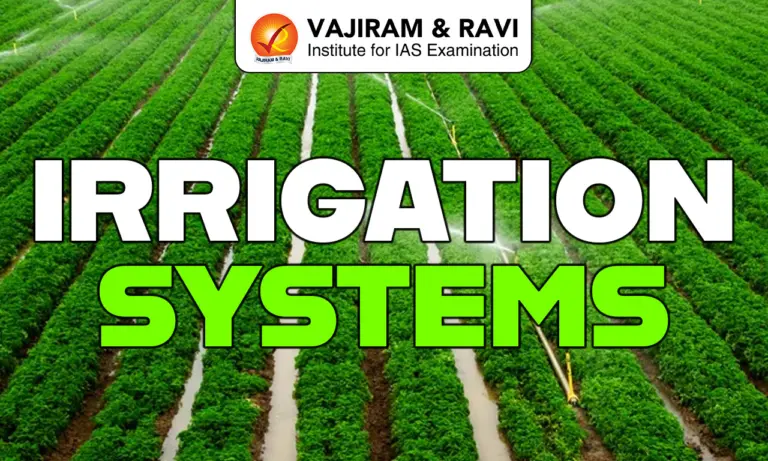
Irrigation is the artificial and controlled application of water to agricultural fields to support crop growth when rainfall is insufficient or irregular. Irrigation Systems include various methods and structures used to deliver water efficiently to crops. Since ancient times, irrigation has played a vital role in increasing agricultural productivity, reducing drought risks, and ensuring stable food production across regions.
Irrigation Systems Types
Irrigation Systems include multiple methods designed to deliver water efficiently to crops depending on soil, climate, and crop requirements.
- Surface Irrigation: Water is spread over fields by gravity through flooding, basin, border, or furrow methods. It is simple and widely used but causes high water loss through evaporation and runoff, reducing overall efficiency in large agricultural fields.
- Sprinkler Irrigation: Water is sprayed into the air through nozzles, resembling rainfall. It is suitable for uneven lands and shallow soils, and supports crops like vegetables, tea, and coffee, but requires high energy and infrastructure investment.
- Drip Irrigation: Water is delivered directly to plant roots using emitters at a low rate of 2-20 liters per hour. It minimizes water loss, reduces weed growth, and increases efficiency, especially in orchards, vegetables, and plantation crops.
- Sub surface Irrigation: Water is supplied below the soil surface through pipes or porous tubes, allowing roots to absorb moisture directly. It reduces evaporation losses and helps prevent waterlogging and salinity in high water table regions.
- Center Pivot Irrigation: A rotating sprinkler system distributes water in circular patterns over large fields. It is efficient for crops like wheat and corn but requires high capital investment and continuous energy supply.
- Well and Tube Well Irrigation: Groundwater is extracted through shallow or deep wells. Tube wells can irrigate up to 400 hectares and are widely used in states like Uttar Pradesh, Punjab, and Haryana due to reliable year round supply.
- Canal Irrigation: Water is transported from rivers through canals. Perennial canals provide continuous irrigation using barrages, while inundation canals operate during floods. This system is prominent in northern plains with fertile soils.
- Tank Irrigation: Water is stored in tanks formed by constructing bunds across streams. It is common in Karnataka, Maharashtra, and Rajasthan, but tanks often dry during dry seasons, limiting their reliability.
Irrigation Systems Features
The major features of the Irrigation System has been highlighted below:
- Need: Irrigation is required due to uneven and uncertain rainfall distribution, seasonal monsoon concentration (75% rainfall in 3-4 months), limited rainfall coverage (only 30% adequate), and torrential nature of rains causing runoff, making water supply essential for crop survival and growth.
- Purpose: The main purpose of irrigation is to provide controlled and timely water supply to crops, maintain optimum soil moisture, support use of HYV seeds and fertilizers, and enable multiple cropping cycles across different seasons.
- Significance: Irrigation ensures higher agricultural productivity, stable crop production, improved food security, and increased farmer income by enabling cultivation of water intensive crops and protecting crops from droughts and rainfall variability.
- Factors Influencing Irrigation: Key factors include soil type (water retention capacity), crop water requirements, rainfall variability, groundwater availability, and regional climatic conditions which determine the type and efficiency of irrigation systems used.
- Economic Importance: Irrigation supports rural employment, increases agricultural output, strengthens agro-based industries, and contributes significantly to overall economic growth by stabilizing farm income and reducing risks.
- Environmental Role: Proper irrigation helps in maintaining soil moisture balance, prevents desertification, supports vegetation growth, and improves climate resilience, but requires careful management to avoid waterlogging and salinity.
- Agricultural Transformation: Irrigation has enabled the Green Revolution by supporting high yielding varieties and intensive farming, reducing monoculture practices, and promoting diversification into high value crops and commercial agriculture.





Irrigation Systems in India
Irrigation Systems in India are extensive and diverse, playing a central role in agriculture with large scale infrastructure and varied water sources.
- India has around 68 million hectares of gross irrigated area as of 2025, making it one of the largest irrigated regions globally.
- About 48% of India’s net sown area is irrigated, while the remaining 52% still depends on rainfall, highlighting partial irrigation coverage.
- Groundwater contributes nearly 63% of irrigation, making India the largest user globally, but raising sustainability concerns due to excessive extraction.
- Canals account for about 24% of irrigation, mainly concentrated in northern plains due to favorable terrain and perennial rivers.
- Crops like wheat and sugarcane have more than 90% irrigation coverage, while pulses and oilseeds remain largely rainfed, affecting productivity differences.
- Northern and western regions have better irrigation facilities, whereas eastern and northeastern regions remain dependent on rainfall.
- Over 50 lakh tube wells operate across India, significantly contributing to irrigation, especially in states like Uttar Pradesh and Punjab.
- Tank irrigation is significant in peninsular regions like Karnataka and Tamil Nadu, where natural depressions and streams support water storage systems.
Irrigation Systems Challenges
Irrigation Systems face multiple structural, environmental, and socio-economic challenges affecting sustainability and efficiency.
- Groundwater Overexploitation: Excessive use of groundwater, accounting for 63% irrigation, has led to declining water tables in Punjab, Haryana, Rajasthan, and Uttar Pradesh, threatening long term water availability.
- Water Use Inefficiency: Surface irrigation methods result in significant water loss through seepage and evaporation, reducing water availability for crops, especially at canal tail ends.
- Soil Degradation: Over irrigation causes waterlogging and salinity, which deteriorates soil fertility and reduces agricultural productivity over time.
- Water Pollution: Runoff from irrigated fields carries fertilizers and pesticides into nearby water bodies, leading to ecological damage and contamination.
- Biodiversity Impact: Alteration of natural water flow disrupts ecosystems, affecting wetlands and reducing biodiversity in irrigated regions.
- Regional Inequality: Irrigation development is uneven, with better facilities in western and southern regions compared to eastern and northeastern areas.
- Socio-economic Disparity: Farmers with irrigation access benefit more, while small and marginal farmers without irrigation face lower productivity and income instability.
- Infrastructure Limitations: Poor maintenance of canals and traditional systems leads to inefficiencies, water losses, and unequal distribution across agricultural fields.
Way Forward
- Promoting drip and sprinkler systems can significantly improve water efficiency and reduce wastage.
- Monitoring and controlling groundwater extraction.
- Upgrading canal infrastructure with lining and automation can reduce seepage losses and improve water distribution efficiency.
- Expanding irrigation facilities in eastern and northeastern regions can reduce disparities and improve agricultural productivity.
- Encouraging drought resistant crops and efficient irrigation scheduling helps farmers adapt to climate variability and water scarcity.
- Promoting water storage structures like tanks and reservoirs.
- Solar powered pumps reduce dependency on conventional energy and provide cost effective irrigation solutions.
Irrigation Systems Government Initiatives
The government has launched several schemes and projects to improve Irrigation Systems coverage, efficiency, and sustainability across India.
- Pradhan Mantri Krishi Sinchai Yojana: Focuses on “Har Khet Ko Pani” and “Per Drop More Crop,” promoting micro irrigation and improving water use efficiency through integrated water management.
- Micro Irrigation Fund: Established with ₹5,000 crore under NABARD to promote drip and sprinkler irrigation and support states in expanding micro irrigation coverage.
- Atal Bhujal Yojana: Focuses on sustainable groundwater management in water stressed regions through community participation and demand side management.
- PM KUSUM Scheme: Promotes solar powered irrigation pumps, enabling farmers to reduce energy costs and even sell surplus electricity to the grid.
- Indira Gandhi Canal Project: A 600+ km canal in Rajasthan irrigating over 1.8 million hectares, transforming desert areas into productive agricultural land.
- Narmada Valley Project: Provides irrigation to over 1.7 million hectares across Gujarat, Madhya Pradesh, and Maharashtra through dams and canals.
- Sardar Sarovar Project: Irrigates more than 1.8 million hectares and supplies drinking water and hydroelectric power in Gujarat and surrounding regions.
- Krishna Godavari Basin Project: Covers over 5 million hectares in Andhra Pradesh, supporting irrigation, drinking water, and power generation through a network of dams and canals.

 Last updated on April, 2026
→ UPSC Final Result 2025 is now out.
→ UPSC has released UPSC Toppers List 2025 with the Civil Services final result on its official website.
→ Anuj Agnihotri secured AIR 1 in the UPSC Civil Services Examination 2025.
→ UPSC Marksheet 2025 is now out.
→ UPSC Notification 2026 & UPSC IFoS Notification 2026 is now out on the official website at upsconline.nic.in.
→ UPSC Calendar 2026 has been released.
→ Check out the latest UPSC Syllabus 2026 here.
→ UPSC Prelims 2026 will be conducted on 24th May, 2026 & UPSC Mains 2026 will be conducted on 21st August 2026.
→ The UPSC Selection Process is of 3 stages-Prelims, Mains and Interview.
→ Prepare effectively with Vajiram & Ravi’s UPSC Prelims Test Series 2026 featuring full-length mock tests, detailed solutions, and performance analysis.
→ Enroll in Vajiram & Ravi’s UPSC Mains Test Series 2026 for structured answer writing practice, expert evaluation, and exam-oriented feedback.
→ Join Vajiram & Ravi’s Best UPSC Mentorship Program for personalized guidance, strategy planning, and one-to-one support from experienced mentors.
→ Shakti Dubey secures AIR 1 in UPSC CSE Exam 2024.
→ Also check Best UPSC Coaching in India
Irrigation Systems FAQs
Q1. What is an Irrigation System? +
Q2. Which is the most efficient Irrigation Method? +
Q3. What is the main source of Irrigation in India? +
Q4. Why is Irrigation important in India? +
Q5. Name one major Irrigation scheme in India. +
Tags: geography irrigation systems