Isobutanol Blending Latest News
- The government is exploring isobutanol blending with diesel after ethanol blending trials failed, with ARAI conducting tests to ensure compatibility and support farmer incomes.
Introduction
- India’s biofuel sector is witnessing a shift in its approach as the government explores alternatives to ethanol blending with diesel.
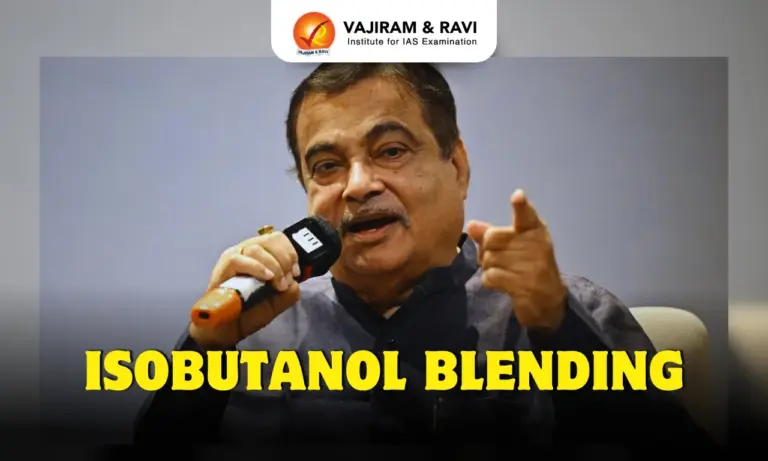
- Union Minister for Road Transport and Highways, Nitin Gadkari, recently announced that the Automotive Research Association of India (ARAI) is conducting trials to blend 10% isobutanol with diesel.
- This development comes after ethanol-diesel blending trials were found to be unsuccessful.
- The move signals India’s determination to diversify its energy mix, enhance farmer incomes, and reduce reliance on conventional fossil fuels.





Background on Ethanol Blending
- Ethanol blending has been one of the cornerstone policies in India’s biofuel roadmap.
- While ethanol blending in petrol has been relatively successful, reaching 20% ahead of schedule, it has faced technical challenges when used with diesel.
- Ethanol’s corrosive nature and compatibility issues with diesel engines limited its large-scale adoption in this segment.
- Despite these hurdles, ethanol blending has benefited farmers significantly.
- With corn being used as a major raw material for ethanol production, farmers have earned over Rs. 42,000 crore.
- The prices of corn have risen from Rs. 1,200 per quintal to Rs. 2,600-2,800 per quintal since the implementation of the policy, strengthening rural incomes.
Exploring Isobutanol as an Alternative
- Isobutanol, an alcoholic compound widely used as a solvent in industries like paints and coatings, is now being evaluated as a potential biofuel.
- Currently, trials are underway to test a 10% blend of isobutanol with diesel.
- Unlike ethanol, isobutanol has properties that may make it more compatible with diesel engines.
- It also holds promise as a standalone biofuel or in combination with compressed natural gas (CNG) in agricultural machinery and tractors.
- This shift highlights the government’s commitment to innovation in the biofuel sector.
- By diversifying fuel sources, India aims to reduce import dependence, support energy security, and encourage sustainable farming practices.
Policy Push for Farmers and the Sugar Industry
- Union Minister for Consumer Affairs, Food, and Public Distribution, Pralhad Joshi, emphasised the government’s efforts to safeguard farmer interests while ensuring the viability of sugar mills.
- Measures like clearing over 96% of payments for the current sugar season and reducing cane dues to record lows were highlighted.
- He further encouraged ethanol producers to increase output for both domestic use and exports.
- He urged the industry to adopt advanced technologies, diversify into second and third-generation ethanol using bamboo and agricultural residues, and expand distilleries for higher production.
Industry Concerns and Recommendations
- At the India Sugar and Bio-Energy Manufacturers Association (ISMA) conclave, industry representatives highlighted key challenges.
- The President of ISMA urged the government to align the fair and remunerative price (FRP) of sugarcane with rising procurement costs and revise the minimum support price (MSP), which has remained unchanged since 2019.
- He also advocated for increasing the permissible sugar export quota by 2 million tonnes for the 2025-26 season. This, he argued, would help mills secure better prices and expand their market reach.
Growth in Sugar and Ethanol Production
- India’s sugarcane production has risen by 40% over the last decade, with sugar output increasing by 58%.
- According to preliminary ISMA estimates, gross sugar production is expected to grow by 20% year-on-year, reaching 34.9 million tonnes in the current season.
- This growth underscores the importance of integrating the sugar sector with India’s energy policies to ensure better utilisation of resources and farmer benefits.
Source: TH

 Last updated on March, 2026
→ UPSC Final Result 2025 is now out.
→ UPSC has released UPSC Toppers List 2025 with the Civil Services final result on its official website.
→ Anuj Agnihotri secured AIR 1 in the UPSC Civil Services Examination 2025.
→ UPSC Marksheet 2025 is now out.
→ UPSC Notification 2026 & UPSC IFoS Notification 2026 is now out on the official website at upsconline.nic.in.
→ UPSC Calendar 2026 has been released.
→ Check out the latest UPSC Syllabus 2026 here.
→ UPSC Prelims 2026 will be conducted on 24th May, 2026 & UPSC Mains 2026 will be conducted on 21st August 2026.
→ The UPSC Selection Process is of 3 stages-Prelims, Mains and Interview.
→ Prepare effectively with Vajiram & Ravi’s UPSC Prelims Test Series 2026 featuring full-length mock tests, detailed solutions, and performance analysis.
→ Enroll in Vajiram & Ravi’s UPSC Mains Test Series 2026 for structured answer writing practice, expert evaluation, and exam-oriented feedback.
→ Join Vajiram & Ravi’s Best UPSC Mentorship Program for personalized guidance, strategy planning, and one-to-one support from experienced mentors.
→ Shakti Dubey secures AIR 1 in UPSC CSE Exam 2024.
→ Also check Best UPSC Coaching in India
Isobutanol Blending FAQs
Q1. Why is India exploring isobutanol blending with diesel?+
Q2. How will isobutanol blending benefit farmers?+
Q3. What did Nitin Gadkari announce regarding biofuels?+
Q4. How has ethanol blending impacted the sugar and corn sectors?+
Q5. What are ISMA’s key demands from the government?+
Tags: isobutanol blending mains articles upsc current affairs upsc mains current affairs