Communication Satellite Latest News
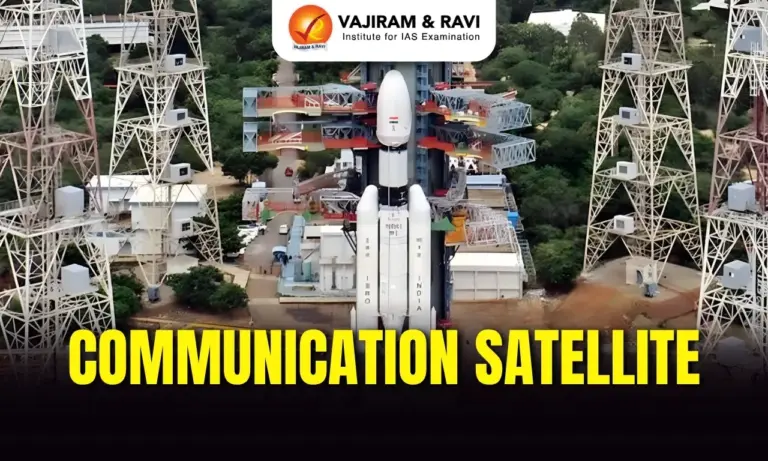
- The Indian Space Research Organisation (ISRO) is preparing to launch CMS-03, its heaviest communication satellite ever to be launched from Indian soil, on November 2, 2025, aboard the LVM3-M5 (Launch Vehicle Mark-3).
About the CMS-03 Satellite
- The CMS-03 satellite, weighing 4,410 kg, is designed as a multiband communication satellite that will provide secure and high-bandwidth communication coverage over a wide region, including the Indian subcontinent and surrounding oceanic areas.
- It will be placed in a Geosynchronous Transfer Orbit (GTO) of approximately 29,970 km x 170 km from the Earth’s surface.
- This mission marks the first time ISRO will launch a satellite exceeding 4,000 kg to a GTO from Indian soil.
- Previously, India’s heavier communication satellites, such as GSAT-11 (5,854 kg) and GSAT-20 (4,700 kg) were launched by Arianespace or SpaceX due to payload limitations.
- With CMS-03, ISRO achieves a new benchmark in self-reliant satellite launches.
- The satellite will serve critical communication needs, particularly for defence and strategic applications, providing encrypted data relay for the Indian Armed Forces.





LVM3-M5: India’s Most Powerful Rocket
- The LVM3, also known as GSLV Mk-III, is India’s most powerful and reliable launch vehicle.
- The 43.5-meter-tall three-stage rocket is designed to carry up to 4,000 kg payloads to GTO and 8,000 kg to Low Earth Orbit (LEO).
- Structure and Design
- First Stage (S200) – Two massive solid rocket boosters provide the initial thrust for lift-off.
- Second Stage (L110) – A liquid-propellant stage powered by twin Vikas engines.
- Third Stage (C25 Cryogenic Engine) – The most advanced component, using liquid hydrogen (LH2) and liquid oxygen (LOX) to provide the high thrust needed for orbit insertion.
- This launch vehicle has been developed using entirely indigenous technologies, including the C25 cryogenic stage, giving India full autonomy in launching heavy satellites.
- The LVM3 has had a 100% success rate so far, including the landmark Chandrayaan-3 mission, which made India the first country to land near the lunar south pole in 2023.
Advancements and Future Upgrades
- ISRO is continuously enhancing the performance of the LVM3. With the C25 cryogenic stage currently providing 20 tonnes of thrust using 28,000 kg of propellant, ISRO plans to replace it with a more powerful C32 cryogenic stage, capable of carrying 32,000 kg of fuel and producing 22 tonnes of thrust.
- Additionally, ISRO is developing a semi-cryogenic engine, which will replace the L110 liquid stage with a kerosene and liquid oxygen-based engine.
- This will increase payload capacity to 10,000 kg in LEO, a crucial requirement for India’s upcoming Gaganyaan human spaceflight programme and the proposed Bharatiya Antariksh Station (India’s space station).
Significance of the Mission
- Self-Reliance in Heavy Satellite Launches
- Until now, India has relied on foreign space agencies to launch heavy communication satellites.
- The CMS-03 launch demonstrates that India can now independently launch 4-tonne-class satellites, significantly reducing costs and ensuring strategic autonomy.
- Strategic and Military Capability
- CMS-03’s secure communication bands will serve as a key enabler for India’s defence communication network, linking naval, air, and ground assets through encrypted signals.
- It will enhance situational awareness, real-time data exchange, and maritime domain monitoring across the Indian Ocean Region.
- Boost to Gaganyaan Mission
- The same LVM3 vehicle, in its human-rated version (HRLV), will be used for the Gaganyaan mission, which aims to send Indian astronauts into space. This launch thus serves as another validation of the LVM3’s reliability and adaptability.
- Paving Way for Space Station Missions
- The upgraded versions of LVM3 will support future missions such as the Bharatiya Antariksh Station and Lunar Module Launch Vehicle (LMLV), which ISRO plans to use for deep-space and lunar missions carrying payloads up to 80,000 kg in LEO.
Track Record of LVM3
- The LVM3 rocket has completed seven successful missions to date, including the launches of Chandrayaan-2, Chandrayaan-3, and several GSAT satellites.
- Compared to its predecessor, GSLV Mk-II, which had multiple failures, LVM3 stands out as ISRO’s most reliable heavy-lift vehicle.
- This success rate makes it the preferred launch vehicle for both national and international missions, cementing India’s reputation as a global space technology leader.

 Last updated on March, 2026
→ UPSC Final Result 2025 is now out.
→ UPSC has released UPSC Toppers List 2025 with the Civil Services final result on its official website.
→ Anuj Agnihotri secured AIR 1 in the UPSC Civil Services Examination 2025.
→ UPSC Marksheet 2025 is now out.
→ UPSC Notification 2026 & UPSC IFoS Notification 2026 is now out on the official website at upsconline.nic.in.
→ UPSC Calendar 2026 has been released.
→ Check out the latest UPSC Syllabus 2026 here.
→ UPSC Prelims 2026 will be conducted on 24th May, 2026 & UPSC Mains 2026 will be conducted on 21st August 2026.
→ The UPSC Selection Process is of 3 stages-Prelims, Mains and Interview.
→ Prepare effectively with Vajiram & Ravi’s UPSC Prelims Test Series 2026 featuring full-length mock tests, detailed solutions, and performance analysis.
→ Enroll in Vajiram & Ravi’s UPSC Mains Test Series 2026 for structured answer writing practice, expert evaluation, and exam-oriented feedback.
→ Join Vajiram & Ravi’s Best UPSC Mentorship Program for personalized guidance, strategy planning, and one-to-one support from experienced mentors.
→ Shakti Dubey secures AIR 1 in UPSC CSE Exam 2024.
→ Also check Best UPSC Coaching in India
Communication Satellite FAQs
Q1. What is the CMS-03 satellite?+
Q2. What rocket is being used to launch CMS-03?+
Q3. Why is the CMS-03 mission significant?+
Q4. How does LVM3 differ from ISRO’s PSLV?+
Q5. What are ISRO’s future plans for the LVM3 rocket?+
Tags: communication satellite mains articles upsc current affairs upsc mains current affairs