What’s in today’s article?
- Why in News?
- What is a Small Satellite Launch Vehicle (SSLV)?
- What are the key features of SSLV?
- What’s Onboard the SSLV-D2?
Why in News?
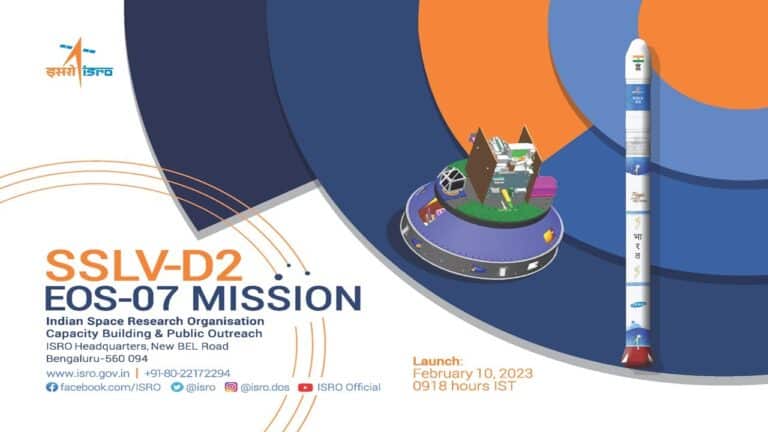
- In its second development flight, the Indian Space Research Organisation’s (ISRO) smallest vehicle – Small Satellite Launch Vehicle (SSLV-D2), was launched from the Satish Dhawan Space Centre SHAR, Sriharikota, Andhra Pradesh.
- It will place the ISRO’s earth observation satellite EOS-07 and two co-passenger satellites – Janus-1 and AzaadiSat2 – developed by start-ups, in a 450-km circular orbit around the Earth.
What is a Small Satellite Launch Vehicle (SSLV)?

Image Caption: SSLV vs PSLV
- SSLV is a 3 stage Launch Vehicle configured with –
- Three Solid Propulsion Stages and
- Liquid propulsion-based Velocity Trimming Module (VTM) as a terminal stage.
- It is 2m in diameter and 34m in length with a lift off weight of ~120 tonnes and is capable of launching ~500 kg satellite in 500 km planar orbit from SHAR.





What are the key features of SSLV?
The key features of SSLV are –
- Low cost,
- With low turn-around time,
- Flexibility in accommodating multiple satellites,
- Minimal launch infrastructure requirements (assembled by a small team in a week, compared to 6 months and 600 people for ISRO’s workhorse PSLV), etc.
- The new vehicle was developed to capture the emerging small (nano-micro-mini) satellite commercial market, with launches offered on demand.
- The vehicle’s first development flight (August 2022, EOS 02), failed to place the satellites in precise orbit.
- A new vehicle is declared operational by the space agency after it completes two successful development flights.
- The last vehicle to be declared operational was the GSLV Mk III, now called LVM 3, when it carried Chandrayaan-2 in 2019.
What’s Onboard the SSLV-D2?
- Janus-1 (weight 10.2 kg) is a technology demonstrator satellite built by US-based Antaris and its Indian partners XDLinks and Ananth Technologies.
- It is a cube satellite with five payloads on board – two from Singapore, and one each from Kenya, Australia, and Indonesia.
- AzaadiSat2 is a Cubesat weighing around 8 kg and carries 75 different payloads.
- Girl students from rural regions across the country were provided guidance to build these payloads.
- The payloads are integrated by the student team of “Space Kidz India”.
- EOS-07 is a 156.3 kg satellite designed, developed and realized by ISRO.
- Its mission objective is to design and develop payload instruments compatible with microsatellite buses and new technologies for future operational satellites.
- It would also design and develop a microsatellite accommodating new technology payloads in a quick turn-around time.
Q1) When does ISRO declare a new vehicle operational?
A new vehicle is declared operational by the space agency after it completes two successful development flights. The last vehicle to be declared operational was the GSLV Mk III, now called LVM 3, when it carried Chandrayaan-2 in 2019.
Q2) What are the key features of ISRO’s SSLV vehicle?
Key features of SSLV are low cost, with low turn-around time, flexibility in accommodating multiple satellites, minimal launch infrastructure requirements (assembled by a small team in a week, compared to 6 months and 600 people for ISRO’s workhorse PSLV), etc.
Source: ISRO’s SSLV-D2: The mini vehicle’s second flight, with promise on board | TH | ISRO | India Today

 Last updated on March, 2026
→ UPSC Final Result 2025 is now out.
→ UPSC has released UPSC Toppers List 2025 with the Civil Services final result on its official website.
→ Anuj Agnihotri secured AIR 1 in the UPSC Civil Services Examination 2025.
→ UPSC Marksheet 2025 is now out.
→ UPSC Notification 2026 & UPSC IFoS Notification 2026 is now out on the official website at upsconline.nic.in.
→ UPSC Calendar 2026 has been released.
→ Check out the latest UPSC Syllabus 2026 here.
→ UPSC Prelims 2026 will be conducted on 24th May, 2026 & UPSC Mains 2026 will be conducted on 21st August 2026.
→ The UPSC Selection Process is of 3 stages-Prelims, Mains and Interview.
→ Prepare effectively with Vajiram & Ravi’s UPSC Prelims Test Series 2026 featuring full-length mock tests, detailed solutions, and performance analysis.
→ Enroll in Vajiram & Ravi’s UPSC Mains Test Series 2026 for structured answer writing practice, expert evaluation, and exam-oriented feedback.
→ Join Vajiram & Ravi’s Best UPSC Mentorship Program for personalized guidance, strategy planning, and one-to-one support from experienced mentors.
→ Shakti Dubey secures AIR 1 in UPSC CSE Exam 2024.
→ Also check Best UPSC Coaching in India