What’s in today’s article?
● Why in News?
● What is POEM?
● Space debris: a challenge
● How are space agencies dealing with debris?
Why in News?
ISRO launched a mission called PSLV-C58/XPoSat and made sure it left no debris in space. It did this by turning the last stage of the rocket into a small space station called POEM-3 (PSLV Orbital Experimental Module-3).
Instead of leaving it to float in space, they let it come back into the Earth’s atmosphere after the mission was completed.





What is POEM?
- About
- It has been developed by the Vikram Sarabhai Space Centre (VSSC) as an inexpensive space platform.
- It uses the spent fourth stage of a PSLV rocket as an orbital platform.
- Used for the first time in the PSLV-C53 mission in June 2022, ISRO had POEM orbit the earth as a stabilised platform to perform in-orbit scientific experiments with various payloads.
- Features
- POEM is powered by solar panels mounted on the fuel tank of the rocket’s fourth stage and a lithium-ion (Li-ion) battery.
- It has a dedicated navigation, guidance, and control (NGC) system to stabilise its altitude along with helium control thrusters.
- It talks to ISRO’s NavIC satellite constellation for navigation and it also has a telecommand system to communicate with the ground station.
- Achievement of POEM-3
- POEM-3 featured nine payloads
- POEM-3 completed 400 orbits around the earth by its 25th day. The payloads were operationalised to perform their experiments during this time.

Space debris: a challenge
- Increasing space debris
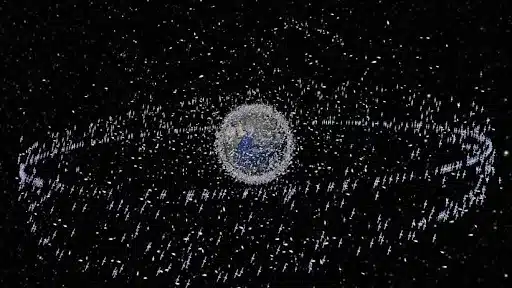
- With the rise in the number of satellites in orbit around the earth, space debris has become a pressing issue.
- Space debris in the low earth orbit (LEO) mainly comprises pieces of spacecraft, rockets, and defunct satellites, and the fragments of objects that have deteriorated explosively as a result of anti-satellite missile tests.
- The LEO extends from 100 km above the earth’s surface up to 2000 km above.
- It includes satellites tracking intelligence data, encrypted communication, and navigation.
- According to ISRO’s Space Situational Assessment report 2022, the world placed 2,533 objects in space in 179 launches in 2022.
- As more communication satellites/constellations are launched and more anti-satellite tests are conducted, more on-orbit breakup and collisions occur, producing smaller and smaller fragments in orbit.
- The number of space objects greater than 10 cm in size in LEO is expected to be about 60,000 by 2030, as per ISRO estimates.
- Threat to several space assets
- This debris often flies around at high speeds of up to 27,000 kilometres per hour.
- Due to their sheer volume and momentum, they pose a risk to several space assets.
- Threats on the ground
- Recently, a chunk of metal believed to be a discarded battery pallet from the International Space Station ripped through the roof and two stories of a house in Florida.
- Kessler syndrome
- Space debris also leads to two major risks:
- it creates unusable regions of the orbit due to excessive debris, and
- leads to the ‘Kessler syndrome’ – creation of more debris due to cascading collisions resulting from one collision.
How are space agencies dealing with debris?
- Legal provisions
- Currently, there are no international space laws pertaining to LEO debris.
- However, most space-exploring nations abide by the Space Debris Mitigation Guidelines 2002 specified by the Inter-Agency Space Debris Coordination Committee (IADC).
- This was endorsed by the U.N. in 2007.
- Space Debris Mitigation Guidelines 2002
- The guidelines outline methods to limit accidental collisions in orbit, break-ups during operations, intentional destruction, and post-mission break-ups.
- They also advise against the long-term presence of spacecraft and launch vehicle orbital stages in LEO and limit their interference in the GEO region.
- Steps taken by other countries
- NASA had instituted its Orbital Debris Program in 1979 to find ways to create less orbital debris and design equipment to track and remove existing debris.
- Currently, its Space Force tracks space debris and collisions in LEO.
- However, the agency has not implemented any technology to clean such debris yet; most such ideas are in the conceptual stage.
- The European Space Agency (ESA) has adopted a ‘Zero Debris charter,’ which includes multiple ways to mitigate space debris.
- It has also called for zero space debris by 2030 and seeks that other agencies adopt it as well.
- Recently, China deployed a large spacecraft designed to de-orbit its defunct spacecraft.
- Japan also has a project, called the Commercial Removal of Debris Demonstration (CRD2), to tackle space junk.
- India is working to mitigate space debris.
- Apart from the POEM missions, ISRO has set up a Space Situational Awareness Control Centre to protect its high-value assets from close approaches and collisions.
- An Indian start-up named Manastu Space is working on technologies like in-space refuelling, de-orbiting of old satellites, and satellite life extension.
Q.1. What is Kessler syndrome?
Kessler syndrome is a hypothetical scenario where Earth’s orbit becomes so crowded with debris and objects that satellites can no longer be used in certain areas.
Q.2. What is NavIC?
NavIC, or Navigation with Indian Constellation, is a satellite-based system that provides navigation, positioning, and timing services. It was previously known as the Indian Regional Navigation Satellite System (IRNSS).
Source: ISRO’s ‘zero orbital debris’ milestone & the space debris crisis | Explained

 Last updated on March, 2026
→ UPSC Final Result 2025 is now out.
→ UPSC has released UPSC Toppers List 2025 with the Civil Services final result on its official website.
→ Anuj Agnihotri secured AIR 1 in the UPSC Civil Services Examination 2025.
→ UPSC Marksheet 2025 is now out.
→ UPSC Notification 2026 & UPSC IFoS Notification 2026 is now out on the official website at upsconline.nic.in.
→ UPSC Calendar 2026 has been released.
→ Check out the latest UPSC Syllabus 2026 here.
→ UPSC Prelims 2026 will be conducted on 24th May, 2026 & UPSC Mains 2026 will be conducted on 21st August 2026.
→ The UPSC Selection Process is of 3 stages-Prelims, Mains and Interview.
→ Prepare effectively with Vajiram & Ravi’s UPSC Prelims Test Series 2026 featuring full-length mock tests, detailed solutions, and performance analysis.
→ Enroll in Vajiram & Ravi’s UPSC Mains Test Series 2026 for structured answer writing practice, expert evaluation, and exam-oriented feedback.
→ Join Vajiram & Ravi’s Best UPSC Mentorship Program for personalized guidance, strategy planning, and one-to-one support from experienced mentors.
→ Shakti Dubey secures AIR 1 in UPSC CSE Exam 2024.
→ Also check Best UPSC Coaching in India