About Jaisamand Wildlife Sanctuary:
- Location: It is located in the Udaipur district of Rajasthan surrounding Debar Lake (Jaisamand Lake).
- The forest of the Sanctuary used to be a Shikargah (Game Reserve) of the erstwhile Maharanas of Mewar.
- It was declared a Wildlife Sanctuary in the year 1957.
- Vegetation: Dry deciduous forests, and scrub forests.
- Flora: The flora of this Sanctuary comprises of thickly wooded forests of mainly Teak wood.
- Fauna:
- It is habitat to a large variety of animals like Bears, Black Bucks, Blue Bulls, Chinkaras, Chittal or Spotted Deer, Civets, Common Langurs, Four-horned Antelope, Foxes etc.
- It is also home to a huge variety of over 300 species of resident as well as migratory birds like Babblers, Buzzards, Curlews, Dalmatian Pelicans, Darters, Doves, Eagles, Egrets, Falcons, etc.
Key Facts about Debar Lake (Jaisamand Lake):
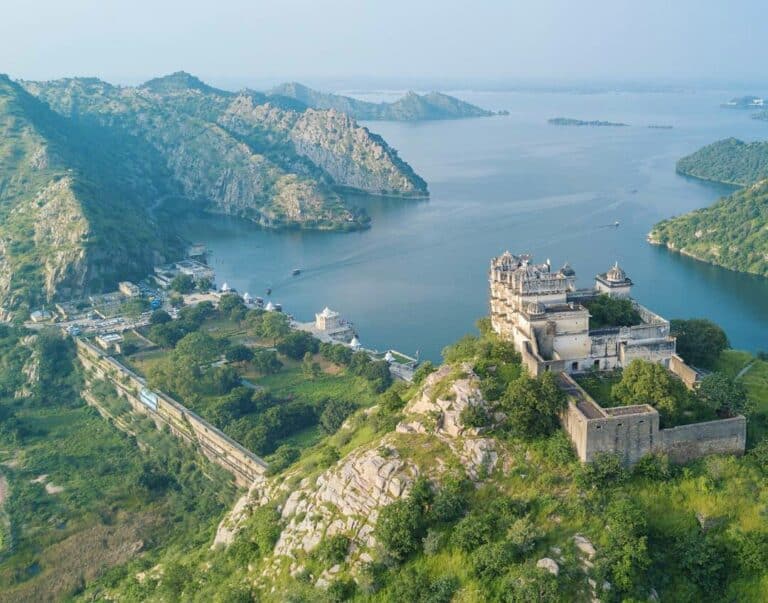
- It is renowned for being the second largest artificial lake in Asia.
- In 1685, Maharana Jai Singh built this lake while making a dam on the Gomti River.
- This lake covers an area of 36sq km, stretches to the length of 14 km and width of 9 km. The lake is deep to the maximum of 102 feet and has a circumference of 30 miles.
- The lake receives water from four main rivers, the Gomti, Jhamari, Rooparel and Bagaar.
- The massive dam was constructed on this lake also houses a centrally located Shiva temple.
- The northern end of the lake has a palace with a courtyard while its southern end has a pavilion of 12 pillars.
- Islands:
- There are seven islands on the lake and the tribe of Bhil Minas inhabit these islands.
- There are two main islands which are large in size. The biggest island is called Babaka Bhagra while the smallest is called “Piari”.
Q1) What is a Wildlife Sanctuary?
Regions with enough ecology, biological variety, species diversity, geological value, morphological value, biological value, and zoological worth are considered wildlife sanctuaries. These areas are used to protect, reproduce, or expand wildlife. Territorial waters and areas included in forest reserves are exempt from this rule.
Source: Rajasthan: CM Ashok Gehlot inaugurates ‘Jungle Safari’ at Jaisamand Wildlife Sanctuary







 Last updated on April, 2026
→ UPSC Final Result 2025 is now out.
→ UPSC has released UPSC Toppers List 2025 with the Civil Services final result on its official website.
→ Anuj Agnihotri secured AIR 1 in the UPSC Civil Services Examination 2025.
→ UPSC Marksheet 2025 is now out.
→ UPSC Notification 2026 & UPSC IFoS Notification 2026 is now out on the official website at upsconline.nic.in.
→ UPSC Calendar 2026 has been released.
→ Check out the latest UPSC Syllabus 2026 here.
→ UPSC Prelims 2026 will be conducted on 24th May, 2026 & UPSC Mains 2026 will be conducted on 21st August 2026.
→ The UPSC Selection Process is of 3 stages-Prelims, Mains and Interview.
→ Prepare effectively with Vajiram & Ravi’s UPSC Prelims Test Series 2026 featuring full-length mock tests, detailed solutions, and performance analysis.
→ Enroll in Vajiram & Ravi’s UPSC Mains Test Series 2026 for structured answer writing practice, expert evaluation, and exam-oriented feedback.
→ Join Vajiram & Ravi’s Best UPSC Mentorship Program for personalized guidance, strategy planning, and one-to-one support from experienced mentors.
→ Shakti Dubey secures AIR 1 in UPSC CSE Exam 2024.
→ Also check Best UPSC Coaching in India