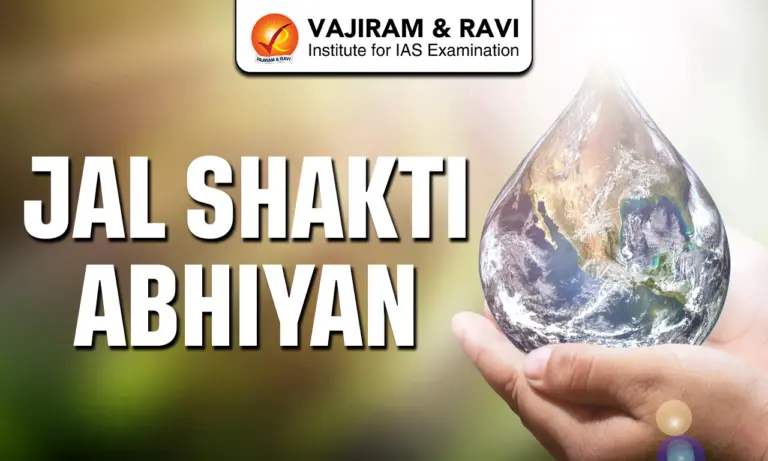
Jal Shakti Abhiyan is a national water conservation campaign launched on 1 July 2019 by the Ministry of Jal Shakti to address growing water scarcity in India. It focuses on water stressed regions through community participation and coordinated government efforts. It was implemented in two phases during monsoon and retreating monsoon periods. The campaign promotes sustainable water management through conservation, recharge, reuse and restoration of water resources across rural and urban areas.
Jal Shakti Abhiyan Objectives
The key objectives and ambitions of the Jal Shakti Abhiyan has been listed below:
- Water conservation: The campaign focuses on conserving water through rainwater harvesting, groundwater recharge and efficient usage practices to reduce dependency on declining water resources and improve long term sustainability.
- Targeting water stressed regions: It prioritizes 1,592 water stressed blocks across 256 districts, ensuring focused intervention where groundwater depletion and water scarcity are most severe.
- Community participation: The initiative encourages citizen involvement, making water conservation a mass movement through awareness campaigns and local level participation in planning and implementation activities.
- Integrated water management: It promotes convergence of multiple ministries and state governments to implement coordinated strategies for water conservation, ensuring better policy alignment and resource utilization.
- Sustainable resource planning: The campaign emphasizes preparation of district and block level water conservation plans using scientific tools, GIS mapping and local knowledge for long term water security.
Jal Shakti Abhiyan Features
The Jal Shakti Abhiyan campaign includes targeted interventions and institutional mechanisms to ensure effective implementation of water conservation strategies across India.
- Five key interventions: The campaign focuses on rainwater harvesting, renovation of water bodies, reuse and recharge structures, watershed development and intensive afforestation to improve water availability and groundwater levels.
- Two Phase implementation: Conducted from July to September 2019 and October to November 2019, covering both southwest and northeast monsoon regions for maximum water conservation impact.
- Catch the Rain Initiative: It was launched as an annual campaign with the theme “Catch the Rain – Where it Falls When it Falls,” it promotes rainwater harvesting across all districts in rural and urban areas.
- Rainwater Harvesting Structures (RWHS): Promotes large scale construction of RWHS in both rural and urban areas to capture rainwater and improve groundwater recharge capacity.
- Establishment of Rain Centres: Rain Centres are set up at district levels to guide citizens on water conservation techniques and support creation of local water harvesting systems.
- Institutional coordination: Coordinated by the Department of Drinking Water and Sanitation with involvement of central ministries, state governments and district administrations for unified action.
- Expert involvement: Central teams including 256 Central Nodal Officers, 446 Block Nodal Officers and technical experts conducted field visits to guide implementation and monitor progress.
- Special interventions: Includes enforcement of rainwater harvesting rules, reuse of treated wastewater, rejuvenation of urban water bodies, plantation drives and promotion of efficient irrigation through Krishi Vigyan Kendras.





Jal Shakti Abhiyan Significance
Jal Shakti Abhiyan plays a crucial role in addressing India’s declining water availability and ensuring long term ecological and economic sustainability.
- Addressing water stress: With per capita water availability declining from about 5,000 cubic meters to nearly 1,500 cubic meters, the campaign aims to reverse this trend through conservation and recharge measures.
- Groundwater sustainability: India is among the largest users of groundwater and the campaign promotes recharge structures and reduced dependency to prevent aquifer depletion and future crises.
- Climate resilience: By promoting watershed development and afforestation, the campaign enhances resilience against climate change impacts such as erratic rainfall and drought conditions.
- Agricultural efficiency: Encourages efficient irrigation practices and crop choices, reducing excessive water consumption in agriculture, which accounts for nearly 80% of water usage in India.
- Social and economic benefits: Improved water availability supports drinking water supply, agriculture productivity and rural livelihoods, contributing to overall socio-economic development.
Jal Shakti Abhiyan Achievements
Jal Shakti Abhiyan has achieved significant progress in water conservation infrastructure, resource mapping and community participation since its launch.
- Coverage: In 2019, central teams conducted 706 visits across 1,592 blocks in 256 districts, ensuring direct monitoring and implementation support at the grassroots level.
- Infrastructure Development: Over 92,216 rainwater harvesting projects and 1,41,551 watershed development works have been completed, significantly improving water conservation capacity across regions.
- Restoration: Around 25,397 traditional water bodies have been renovated, enhancing storage capacity and reviving local water ecosystems for long term sustainability.
- Recharge Structures Expansion: More than 71,096 recharge structures have been completed, improving groundwater levels and supporting drinking water and irrigation needs.
- Technological Integration: Over 24.24 lakh water bodies have been enumerated and geo-tagged, while 671 Jal Shakti Kendras have been established to provide technical guidance and awareness.
Jal Shakti Abhiyan Challenges
Despite progress, the Jal Shakti Abhiyan faces structural, technical and implementation related challenges that limit its full effectiveness.
- Lack of basin level planning: The campaign often uses districts as planning units instead of river basins, limiting holistic water management and coordination across hydrological systems.
- Inadequate data availability: Absence of detailed data on rainfall patterns, aquifer mapping and surface runoff reduces the effectiveness of scientific planning and decision making.
- Weak urban focus: The campaign largely emphasizes rural areas, while urban regions with high water consumption and wastage receive relatively less attention in conservation strategies.
- Quality concerns in structures: Many water conservation structures built under convergence schemes face durability issues due to poor construction quality and inadequate financial allocation.
- Monitoring and evaluation gaps: Lack of clear performance indicators and long term impact assessment mechanisms makes it difficult to measure improvements in groundwater levels and water availability.

 Last updated on March, 2026
→ UPSC Final Result 2025 is now out.
→ UPSC has released UPSC Toppers List 2025 with the Civil Services final result on its official website.
→ Anuj Agnihotri secured AIR 1 in the UPSC Civil Services Examination 2025.
→ UPSC Marksheet 2025 is now out.
→ UPSC Notification 2026 & UPSC IFoS Notification 2026 is now out on the official website at upsconline.nic.in.
→ UPSC Calendar 2026 has been released.
→ Check out the latest UPSC Syllabus 2026 here.
→ UPSC Prelims 2026 will be conducted on 24th May, 2026 & UPSC Mains 2026 will be conducted on 21st August 2026.
→ The UPSC Selection Process is of 3 stages-Prelims, Mains and Interview.
→ Prepare effectively with Vajiram & Ravi’s UPSC Prelims Test Series 2026 featuring full-length mock tests, detailed solutions, and performance analysis.
→ Enroll in Vajiram & Ravi’s UPSC Mains Test Series 2026 for structured answer writing practice, expert evaluation, and exam-oriented feedback.
→ Join Vajiram & Ravi’s Best UPSC Mentorship Program for personalized guidance, strategy planning, and one-to-one support from experienced mentors.
→ Shakti Dubey secures AIR 1 in UPSC CSE Exam 2024.
→ Also check Best UPSC Coaching in India
Jal Shakti Abhiyan FAQs
Q1. What is Jal Shakti Abhiyan? +
Q2. When was Jal Shakti Abhiyan launched? +
Q3. What are the key focus areas of the campaign? +
Q4. Which areas are targeted under Jal Shakti Abhiyan? +
Q5. What is ‘Catch the Rain’ under Jal Shakti Abhiyan? +
Tags: geography geography notes jal shakti abhiyan