What’s in today’s article?
- Why in News?
- What Concerns are Japanese Authorities Currently Facing?
- Why was Alert Issued if Earthquakes can’t be Predicted?
- What is the Ring of Fire?
Why in News?
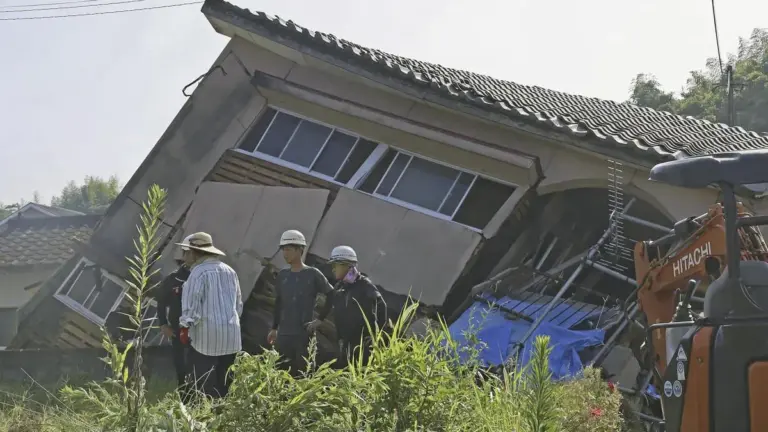
- A recent earthquake (of magnitude 7.1 on Richter scale) in southern Japan was promptly followed by a major warning from Japan’s meteorological agency, stating that there was a heightened risk of a first-ever “mega earthquake”.
- Earthquakes with a magnitude greater than 8 (on Richter scale) are classified as megaquakes.




What Concerns are Japanese Authorities Currently Facing?
- Japan is situated on the Ring of Fire:
- Though Japan is no stranger to seismic activity (experiencing approx. 1,500 earthquakes annually), most of these tremors cause minimal damage.
- However, there have been devastating exceptions, such as the magnitude 9.0 quake that struck in 2011, triggering a tsunami and nuclear disaster that claimed over 18,000 lives along the north-east coast.
- The Nankai Trough:
- The Nankai Trough, situated off the southwest Pacific coast of Japan, is a significant geological feature that extends for roughly 900 km (600 miles).
- This trough is formed by the subduction of the Philippine Sea Plate beneath the Eurasian Plate.
- The convergence of these two tectonic plates along the Nankai Trough results in the accumulation of immense tectonic strains over time.
- These built-up strains have the potential to trigger a devastating megaquake approximately once every 100 to 150 years.
- For example, a rupture spanning the entire 600km length of the Nankai Trough triggered Japan’s 2nd-largest recorded earthquake (followed by the eruption of Mount Fuji) in 1707.
- According to experts, there is a 70% to 80% probability of a magnitude 8 or 9 earthquake occurring somewhere along the trough within the next three decades.
Why was Alert Issued if Earthquakes can’t be Predicted?
- According to experts, the issuance of the warning has almost nothing to do with science.
- This is because earthquakes are known to be a “clustered phenomenon“, and it is not possible to tell in advance whether a quake is a foreshock or an aftershock.
- However, the alert was sent out urging individuals to be ready for potential evacuation. For example,in several towns authorities are encouraging elderly residents and others to voluntarily relocate to safer areas.
What is the Ring of Fire?
- The Ring of Fire is a tectonic belt of volcanoes and earthquakes, which is about 40,000 km (25,000 mi) long] and up to about 500 km (310 mi) wide.
- It surrounds most of the Pacific Ocean, hence it is also called Circum-Pacific Belt.
- It contains between 750 and 915 active or dormant volcanoes, which is around two-thirds of the world total.
- About 90% of the world’s earthquakes, including most of its largest, occur within the belt.
Q.1. What is the difference between the mercalli and richter scales of seismic activity?
The Mercalli and Richter scales are both used when measuring the impacts of seismic activity. However, while the Richter scale measures the magnitude/ force of the earthquake, the Mercalli scale measures the physical impact/ intensity of the earthquake within a given location.
Q.2. What is the difference between the epicenter and the focus of an earthquake?
The focus is the place inside Earth’s crust where an earthquake originates. The point on the Earth’s surface directly above the focus is the epicenter.
Source: Japan’s ‘megaquake‘ warning | Explained | ToI | IE

 Last updated on March, 2026
→ UPSC Final Result 2025 is now out.
→ UPSC has released UPSC Toppers List 2025 with the Civil Services final result on its official website.
→ Anuj Agnihotri secured AIR 1 in the UPSC Civil Services Examination 2025.
→ UPSC Marksheet 2025 is now out.
→ UPSC Notification 2026 & UPSC IFoS Notification 2026 is now out on the official website at upsconline.nic.in.
→ UPSC Calendar 2026 has been released.
→ Check out the latest UPSC Syllabus 2026 here.
→ UPSC Prelims 2026 will be conducted on 24th May, 2026 & UPSC Mains 2026 will be conducted on 21st August 2026.
→ The UPSC Selection Process is of 3 stages-Prelims, Mains and Interview.
→ Prepare effectively with Vajiram & Ravi’s UPSC Prelims Test Series 2026 featuring full-length mock tests, detailed solutions, and performance analysis.
→ Enroll in Vajiram & Ravi’s UPSC Mains Test Series 2026 for structured answer writing practice, expert evaluation, and exam-oriented feedback.
→ Join Vajiram & Ravi’s Best UPSC Mentorship Program for personalized guidance, strategy planning, and one-to-one support from experienced mentors.
→ Shakti Dubey secures AIR 1 in UPSC CSE Exam 2024.
→ Also check Best UPSC Coaching in India