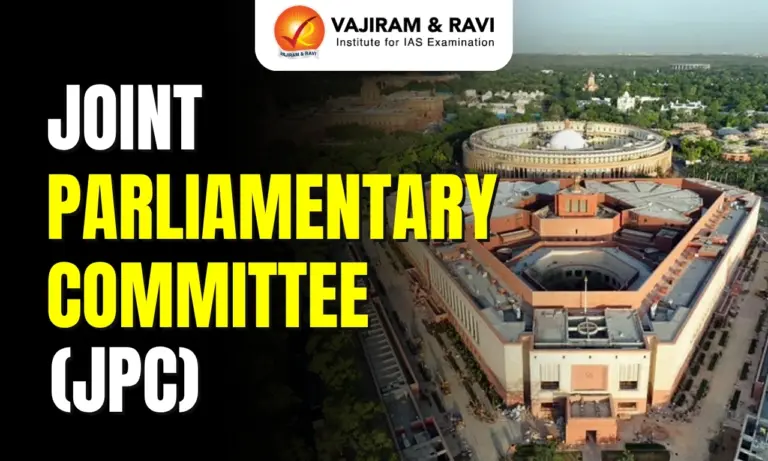
The Joint Parliamentary Committee (JPC) is an important ad hoc committee of the Indian Parliament formed to examine a specific Bill or matter of national importance in detail. It brings together members from both the Lok Sabha and the Rajya Sabha to conduct wider consultations before submitting recommendations. Although its recommendations are not legally binding, they carry significant parliamentary value and often influence law making and public policy decisions.
What is a Joint Parliamentary Committee?
The Joint Parliamentary Committee is a temporary parliamentary committee constituted by Parliament to conduct a detailed examination of a specific Bill, policy issue, scam or matter requiring legislative scrutiny. It functions as a fact finding and consultative body before submitting its report to Parliament. It automatically ceases to exist after completing the assigned task and presenting its report to Parliament.
Joint Parliamentary Committee Features
The key highlighting features of the Joint Parliamentary Committee has been provided below:
- Headquarters: The JPC functions from the Parliament House Complex in New Delhi and receives secretarial and administrative assistance through the Lok Sabha Secretariat during its tenure.
- Legal Framework: The Constitution does not specifically provide for a Joint Parliamentary Committee. It is constituted through a motion adopted by one House of Parliament and agreed to by the other House under the parliamentary rules and procedures.
- Purpose: Parliament forms a JPC when an issue requires detailed examination beyond normal parliamentary debates, particularly for complex Bills, financial irregularities, governance reforms or matters involving significant public interest.
- Composition: Members are nominated from both the Lok Sabha and the Rajya Sabha. The strength of the committee is decided separately for every JPC and there is no fixed limit on the number of members.
- Chairperson: The committee is chaired by a Lok Sabha Member of Parliament appointed by the Speaker of the Lok Sabha. Members are drawn from both the ruling alliance and opposition parties.
- Decision making: The committee studies evidence, hears stakeholders, discusses issues in detail and prepares a report containing recommendations, observations and, where applicable, dissent notes submitted by members disagreeing with the majority view.
- Advisory Status: The recommendations of a JPC are advisory rather than legally binding. However, governments frequently accept many recommendations because they emerge from detailed parliamentary examination involving members across political parties.
- Representation: Members belong to different political parties, including both the ruling alliance and opposition, ensuring wider parliamentary participation in discussions and recommendations on national issues.
- Evidence Collection Powers: The committee can summon experts, government departments, public authorities, associations, organisations, private individuals and other stakeholders to present evidence, opinions and relevant documents during its examination.
- Public Consultation: The JPC may invite written suggestions and oral submissions from interested persons and institutions, allowing broader participation in the legislative examination process wherever considered necessary.
- Report Submission: After completing deliberations, the committee submits a detailed report to Parliament containing findings, recommendations and, if required, separate dissent notes submitted by members holding different opinions.
- Historical Examples: Major JPCs have examined the Bofors scandal (1987), Harshad Mehta Stock Market Scam (1992), Ketan Parekh Share Market Scam (2001), National Register of Citizens (2016) and the Personal Data Protection Bill (2019).
- Dissolution: The committee automatically stands dissolved after completing the task assigned by Parliament or after submitting its final report, making it a temporary rather than a permanent parliamentary body.


Joint Parliamentary Committee Recent Developments 2026
During 2026, the Joint Parliamentary Committee remained in focus due to its examination of major constitutional reform proposals, especially the 129th Constitutional Amendment Bill on simultaneous elections and the proposed 130th Constitution Amendment Bill.
- 130th Constitution Amendment Bill: The 31 member JPC chaired by BJP MP Aparajita Sarangi is examining the proposed amendment that seeks to provide for removal of the Prime Minister, Chief Ministers and Union or State Ministers from office if they remain in custody for 30 consecutive days in specified serious criminal cases.
- Likely Recommendations: After multiple meetings held since December 2025, the committee is expected to recommend retaining the proposed provision while suggesting safeguards to ensure its fair implementation and prevent misuse, before submitting its report during the Monsoon Session 2026.
- One Nation, One Election Bills: A separate 39 member JPC headed by BJP MP P. P. Chaudhary is examining the Constitution (129th Amendment) Bill, 2024 and the Union Territories Laws (Amendment) Bill, 2024, which aim to enable simultaneous elections to the Lok Sabha and State Legislative Assemblies.
- Nationwide Consultations: The Lok Sabha has extended the tenure of the committee to allow wider consultations with states and stakeholders. The panel has already visited 10 states and continues to gather inputs before finalising its recommendations.
- Significance of the Review: The committee’s examination is focused on constitutional, legal and administrative aspects of the proposed reforms, including governance, electoral management and implementation challenges, before placing its recommendations before Parliament for further legislative consideration.

 Last updated on July, 2026
→ UPSC Mains 2026 will be conducted on 21st, 22nd, 23rd, 29th and 30th August 2026.
→ Enroll in Vajiram & Ravi’s UPSC Mains Test Series 2026 for structured answer writing practice, expert evaluation, and exam-oriented feedback.
→ Go through the UPSC Mains Previous Year Papers to enhance your preparation.
→ Download UPSC Mains Essay Paper 2025, UPSC Mains GS Paper-I 2025, UPSC Mains GS Paper-II 2025, UPSC Mains GS Paper-III 2025, UPSC Mains GS Paper-IV 2025, UPSC Mains English (Compulsory) Paper 2025, UPSC Mains Hindi (Qualifying) Paper 2025 here.
→ UPSC has released UPSC Toppers List 2025 with the Civil Services final result on its official website.
→ UPSC Calendar 2027 has been released.
→ Also check Best UPSC Coaching in India
Joint Parliamentary Committee FAQs
Q1. What is the Joint Parliamentary Committee (JPC)?+
Q2. Is the Joint Parliamentary Committee a permanent committee?+
Q3. Are the recommendations of the Joint Parliamentary Committee legally binding?+
Q4. Who appoints the Chairperson of the Joint Parliamentary Committee?+
Q5. Why is the Joint Parliamentary Committee in the news in 2026?+
Tags: committee joint parliamentary committee