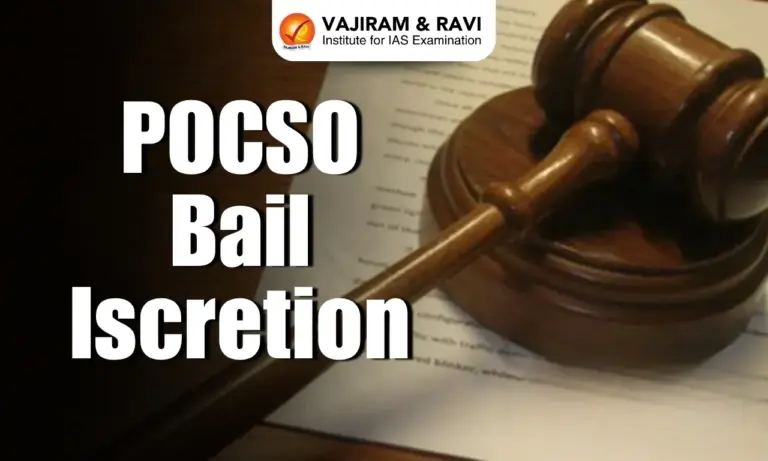
POCSO Bail Discretion Latest News
- A special POCSO court in Mumbai recently granted bail to a 40-year-old teacher accused of sexually assaulting a minor, citing consensual relations.
- The order has renewed focus on the complexities of bail under the POCSO Act, which is stricter than standard criminal law.
- Unlike regular cases where the prosecution must prove guilt, in POCSO cases the burden shifts to the accused to prove innocence.
- This reversal makes securing bail—especially in the early stages of investigation—particularly difficult.
POCSO Act
- The Protection of Children from Sexual Offences (POCSO) Act, 2012 is a special law enacted to safeguard children (individuals below 18 years of age) from sexual offences.
- It provides a comprehensive legal framework to address sexual abuse, harassment, and exploitation of minors.
Key features of the Act
- Gender-neutral protection: Applies to both boys and girls.
- Wide range of offences: Covers penetrative and non-penetrative assault, sexual harassment, and pornography involving children.
- Special courts: Mandates the establishment of child-friendly Special Courts for speedy trial.
- Mandatory reporting: Any person who has knowledge of child sexual abuse is legally required to report it.
- Presumption of guilt: The accused must prove innocence, reversing the general legal principle of “innocent until proven guilty.”
- Confidentiality: Protects the identity of the child during investigation and trial to avoid further trauma.
- Support for Victims: It provides a framework for supporting and rehabilitating victims of sexual offenses.
- Child-Friendly Procedures: The act emphasizes child-friendly procedures for recording statements, medical examinations, and court appearances.




Judicial Discretion and Bail in POCSO Cases
- Offences under the POCSO Act are cognizable and non-bailable, meaning arrests can occur without a warrant and bail is not guaranteed.
- However, the Act does not lay down specific bail criteria.
- Courts rely on Section 483 of the Bharatiya Nagarik Suraksha Sanhita, 2023 (formerly Section 439 CrPC), which considers factors like the gravity of the offence, potential punishment, flight risk, and risk of evidence tampering.
- Over time, courts have introduced additional considerations.
- In Dharmander Singh (2020), the Delhi High Court listed factors like the ages of the victim and accused, their age gap, relationship dynamics, coercion, and post-offence conduct—though not binding, they serve as a guide.
- In Deshraj @ Musa vs State of Rajasthan (2024), the Supreme Court granted bail to an 18-year-old in a consensual relationship with a 16-year-old, given the minor age gap, time spent in custody, and slow trial progress.
- These cases underscore that bail in POCSO matters ultimately depends on judicial discretion balancing individual liberty with victim protection.
Consent and Legal Grey Zones Under POCSO
- The POCSO Act does not recognise consent from individuals below the age of 18, treating all sexual activity with minors as an offence, regardless of whether it was voluntary.
- This creates a legal grey area, particularly in cases involving consensual adolescent relationships that are later criminalised.
- While courts have started considering such nuances during bail hearings—especially when the alleged victim confirms the consensual nature of the relationship in a magistrate’s statement—bail remains difficult in the early investigation phase.
- Courts often wait for critical evidence and victim testimony before granting relief, leading to prolonged custody for the accused.
- Due to this, Senior Advocate Indira Jaising has urged the Supreme Court to lower the age of consent to 16, citing infringement of adolescent rights.
- However, the Centre opposed this, warning that reducing the age could weaken protections for minors and potentially increase vulnerability to abuse.

 Last updated on March, 2026
→ UPSC Final Result 2025 is now out.
→ UPSC has released UPSC Toppers List 2025 with the Civil Services final result on its official website.
→ Anuj Agnihotri secured AIR 1 in the UPSC Civil Services Examination 2025.
→ UPSC Marksheet 2025 is now out.
→ UPSC Notification 2026 & UPSC IFoS Notification 2026 is now out on the official website at upsconline.nic.in.
→ UPSC Calendar 2026 has been released.
→ Check out the latest UPSC Syllabus 2026 here.
→ UPSC Prelims 2026 will be conducted on 24th May, 2026 & UPSC Mains 2026 will be conducted on 21st August 2026.
→ The UPSC Selection Process is of 3 stages-Prelims, Mains and Interview.
→ Prepare effectively with Vajiram & Ravi’s UPSC Prelims Test Series 2026 featuring full-length mock tests, detailed solutions, and performance analysis.
→ Enroll in Vajiram & Ravi’s UPSC Mains Test Series 2026 for structured answer writing practice, expert evaluation, and exam-oriented feedback.
→ Join Vajiram & Ravi’s Best UPSC Mentorship Program for personalized guidance, strategy planning, and one-to-one support from experienced mentors.
→ Shakti Dubey secures AIR 1 in UPSC CSE Exam 2024.
→ Also check Best UPSC Coaching in India
POCSO Bail Discretion FAQs
Q1. What is the POCSO Act?+
Q2. Why is bail difficult under POCSO?+
Q3. What guides bail decisions under POCSO?+
Q4. How does POCSO treat adolescent relationships?+
Q5. What debate exists on age of consent?+
Tags: mains articles POCSO bail discretion upsc current affairs upsc mains current affair