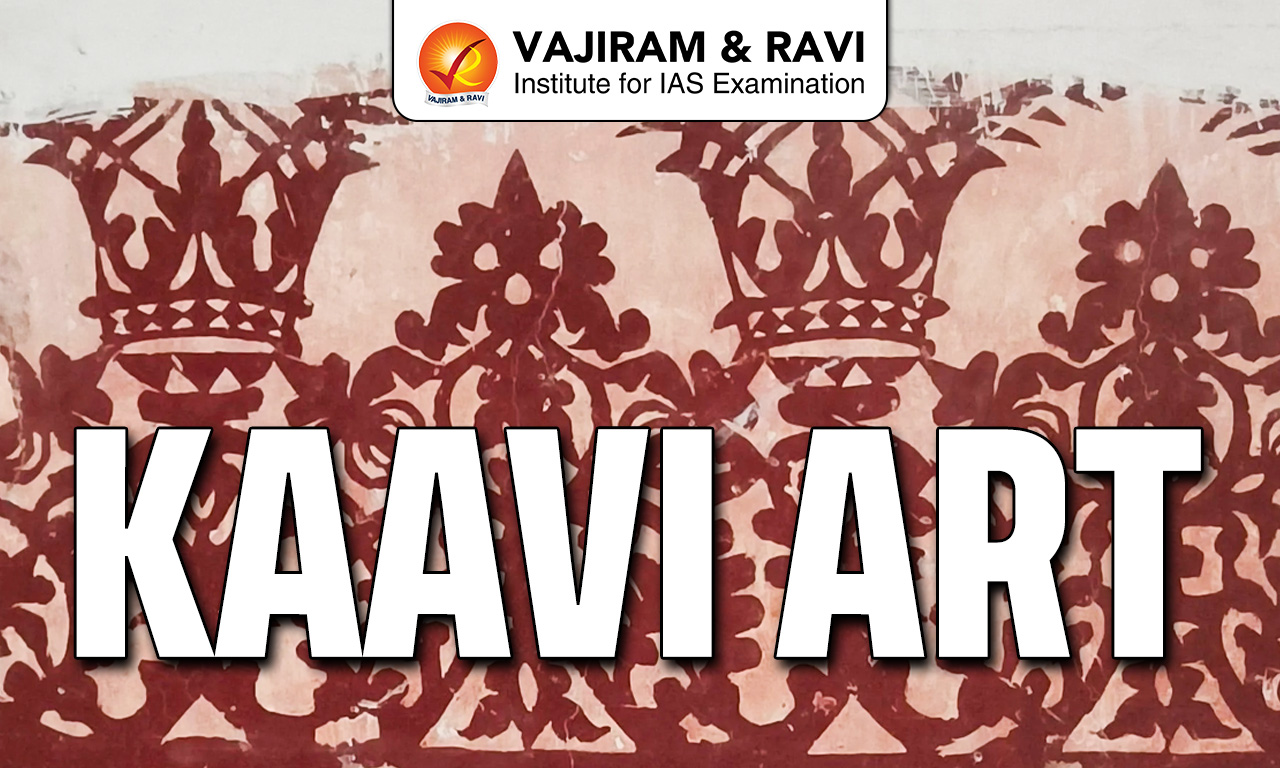
Kaavi Art is a traditional mural painting style developed in the Konkan coastal belt, mainly visible in temples and historic houses of Goa, coastal Maharashtra, and Karnataka. The art uses a single reddish-brown pigment derived from laterite soil called “kaav” in Konkani. Created on wet lime plaster similar to fresco technique, Kaavi murals depict mythological themes, geometric motifs, and elements of Indian cultural history on architectural walls.
Kaavi Art Features
Kaavi Art represents a distinctive red-oxide mural tradition of the Konkan region, recognized for its fresco-like technique and temple wall decoration.
- Origin: Kaavi Art developed around 400-600 years ago along India’s Konkan coast, especially in Goa, coastal Maharashtra, and Karnataka. Historical migration and Portuguese rule in Goa until 1961 helped spread this mural tradition to surrounding regions and communities.
- Technique: The murals are created on freshly applied wet lime plaster similar to the fresco technique. Artists engrave patterns while the plaster remains moist, ensuring the artwork becomes permanently embedded within the hardened wall surface.
- Material: The painting uses only one natural pigment called “kaav,” a reddish-brown oxide obtained from laterite soil. The plaster base is prepared using shell-lime, washed river sand, and jaggery that ferments before being applied to walls.
- Architectural Wall Decoration: Kaavi murals are commonly painted on inner and outer walls of sacred spaces including temples, shrines, and traditional houses. Historic examples survive in locations such as Pernem, Ponda, Sattari, Canacona, and Morjim in Goa and coastal Karnataka towns.
- Design: The murals include geometric patterns such as circles, spirals, semi-circles, and hexagons along with floral medallions and mythological figures. These motifs often reflect historical narratives, religious symbols, and elements of Indian cultural heritage.
- Significance: The art reflects indigenous architectural decoration suited for humid coastal climates. Its carved red-oxide designs remain durable during heavy monsoon rainfall, making it a practical and culturally expressive wall art tradition.
- Decline and Revival: By the late twentieth century the tradition nearly disappeared due to renovation of old structures and loss of skilled artisans. Documentation of more than twenty temples and several houses in Goa and recent exhibitions have revived awareness of this heritage form.
Also Read: Rajput Paintings


 Last updated on Oct, 2026
→ UPSC 2027 Notification will be released on 13 January 2027 at upsconline.nic.in.
→ Check Nobel Prize 2026 Winners List here.
→ Download PIB PRiSM Monthly Magazine 2026 here.
→ Check UPSC Monthly Current Affairs Magazine The Recitals here.
→ Check out the latest UPSC Syllabus here.
→ Download UPSC Model Answers for Mains 2026
→ UPSC Mains Question Paper 2026 is out now for Essay & GS Paper 1, 2, 3 & 4.
→ UPSC Calendar 2027 has been released.
→ Enroll in Vajiram & Ravi’s UPSC Mains Test Series 2027 for structured answer writing practice, expert evaluation, and exam-oriented feedback.
→ Join Vajiram & Ravi’s UPSC Mentorship Program 2027 for personalized guidance, strategy planning, and one-to-one support from experienced mentors.
→ Go through the UPSC Mains Previous Year Papers to enhance your preparation.
→ UPSC has released UPSC Toppers List 2025 with the Civil Services final result on its official website.
→ Also check Best UPSC Coaching in India
Kaavi Art FAQs
Q1. What is Kaavi Art? +
Q2. Which technique is used in Kaavi Art murals? +
Q3. Where can Kaavi Art commonly be seen? +
Q4. What materials are used to prepare the wall surface for Kaavi Art murals? +
Q5. Which regions in India preserve important examples of Kaavi Art? +
Tags: indian art & culture kaavi art