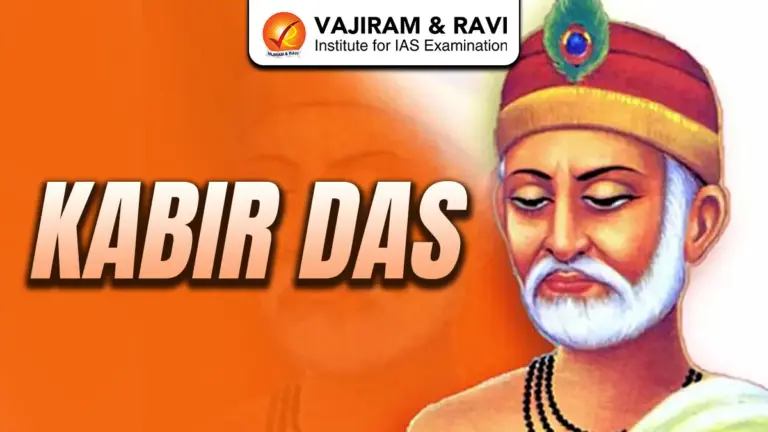
Kabir Das was a mystic poet and a popular Bhakti saint of medieval India. He is regarded as one of the most influential figures of the Bhakti movement, which sought to bring religion closer to the common people through devotion, ethical living, and social reform.
Kabir Das Early Life and Background
While the exact details of Kabir’s birth remain unclear, he is believed to have lived between 1440 and 1518. He was born in the city of Varanasi, Uttar Pradesh, with some stories suggesting he was born to a Brahmin mother but raised by a Muslim weaver.
Though he didn’t receive any formal education but from an early age, he was deeply drawn to spiritual inquiry. In his quest for spiritual enquiry, he became a disciple of Saint Ramananda, a prominent Hindu Bhakti saint of medieval India.
Kabir and the Bhakti Movement
The Bhakti movement was a religious and cultural movement in India that emphasized personal devotion over caste, rituals, and orthodoxy. It promoted equality, religious harmony, and devotion as the path to salvation. It began in the 7th century in South India and began to spread across north India in the 14th and the 15th centuries.
One school within the Bhakti movement was the Nirguni tradition and Kabir Das was a prominent member of it. In this tradition, God was understood to be a universal and formless being.





Kabir Das Teachings
Kabir Das’ teachings were secular and universal and therefore he was respected across different religious traditions. Sikhs regard him as a precursor to Guru Nanak, Muslims associate him with Sufi lineages, and Hindus venerate him as a Nirguna saint.
His teachings are as follows:
- Monotheism: There is only one God (Nirguna), who is formless and resides within the heart of every living being.
- Rejection of Rituals: Kabir rejected formal worship, idolatry, scriptural knowledge and emphasised on personal spiritual experience as the true path to knowledge.
- Social Equality: He opposed the caste system and other forms of discrimination. For Kabir, the divine (Brahman) and truth (Satya) exist in all living beings (jiva), and therefore humans must transcend the divisions of “me” and “you”.
- Simple living: He believed in simple living as a householder and rejected severe asceticism.
Kabir Das preached his teachings in simple vernacular language like Awadhi, Bhojpuri, and Braj, making his ideas accessible to common people.
After his death, his teachings were carried forward by his followers, who formed the Kabir Panth, a community that believes in devotion to a formless God, rejecting idol worship and caste distinctions. Two major centres emerged -Kabir Chaura at Banaras, established by his disciple Surat Gopal, and Dham Khera in Chhattisgarh, founded by Dharamdas.
Kabir Das was a mystic poet and a popular Bhakti saint of medieval India. He is regarded as one of the most influential figures of the Bhakti movement, which sought to bring religion closer to the common people through devotion, ethical living, and social reform.
Kabir Das Early Life and Background
While the exact details of Kabir’s birth remain unclear, he is believed to have lived between 1440 and 1518. He was born in the city of Varanasi, Uttar Pradesh, with some stories suggesting he was born to a Brahmin mother but raised by a Muslim weaver.
Though he didn’t receive any formal education but from an early age, he was deeply drawn to spiritual inquiry. In his quest for spiritual enquiry, he became a disciple of Saint Ramananda, a prominent Hindu Bhakti saint of medieval India.
Kabir and the Bhakti Movement
The Bhakti movement was a religious and cultural movement in India that emphasized personal devotion over caste, rituals, and orthodoxy. It promoted equality, religious harmony, and devotion as the path to salvation. It began in the 7th century in South India and began to spread across north India in the 14th and the 15th centuries.
One school within the Bhakti movement was the Nirguni tradition and Kabir Das was a prominent member of it. In this tradition, God was understood to be a universal and formless being.
Kabir Das Teachings
Kabir Das’ teachings were secular and universal and therefore he was respected across different religious traditions. Sikhs regard him as a precursor to Guru Nanak, Muslims associate him with Sufi lineages, and Hindus venerate him as a Nirguna saint.
His teachings are as follows:
- Monotheism: There is only one God (Nirguna), who is formless and resides within the heart of every living being.
- Rejection of Rituals: Kabir rejected formal worship, idolatry, scriptural knowledge and emphasised on personal spiritual experience as the true path to knowledge.
- Social Equality: He opposed the caste system and other forms of discrimination. For Kabir, the divine (Brahman) and truth (Satya) exist in all living beings (jiva), and therefore humans must transcend the divisions of “me” and “you”.
- Simple living: He believed in simple living as a householder and rejected severe asceticism.
Kabir Das preached his teachings in simple vernacular language like Awadhi, Bhojpuri, and Braj, making his ideas accessible to common people.
After his death, his teachings were carried forward by his followers, who formed the Kabir Panth, a community that believes in devotion to a formless God, rejecting idol worship and caste distinctions. Two major centres emerged -Kabir Chaura at Banaras, established by his disciple Surat Gopal, and Dham Khera in Chhattisgarh, founded by Dharamdas.
Kabir Das Literary Works
Kabir Das writings were not composed as formal books but were orally transmitted and later compiled by his followers in works such as the Bijak, Kabir Granthavali, and Anurag Sagar. A large amount of Kabir’s works were compiled by the fifth Sikh Guru, Guru Arjan Dev, and placed in the Sikh scripture, Guru Granth Sahib.
Sant Kabir Das used everyday metaphors, sharp satire, and paradoxes to criticise caste discrimination, ritualism, and religious hypocrisy in both Hinduism and Islam.
His dohas, also known as shabad or sakhi, played a major role in the growth of vernacular literature.
He employed a unique literary technique called ulatbansi (upside-down language) to convey deeper spiritual meanings.
Relevance of Kabir Das Teachings in Today’s World
Kabir’s ideas are highly relevant in contemporary society
- His rejection of caste is relevant in addressing social inequality
- Message of religious unity counters communalism and extremism
- Emphasis on inner ethics supports moral governance and integrity
- Simplicity and humanism align with constitutional values
- Encourages critical thinking against blind traditions
In an age of polarization, Kabir’s teachings promote tolerance, harmony, and shared humanity.
Kabir Das writings were not composed as formal books but were orally transmitted and later compiled by his followers in works such as the Bijak, Kabir Granthavali, and Anurag Sagar. A large amount of Kabir’s works were compiled by the fifth Sikh Guru, Guru Arjan Dev, and placed in the Sikh scripture, Guru Granth Sahib.
Sant Kabir Das used everyday metaphors, sharp satire, and paradoxes to criticise caste discrimination, ritualism, and religious hypocrisy in both Hinduism and Islam.
His dohas, also known as shabad or sakhi, played a major role in the growth of vernacular literature.
He employed a unique literary technique called ulatbansi (upside-down language) to convey deeper spiritual meanings.
Relevance of Kabir Das Teachings in Today’s World
Kabir’s ideas are highly relevant in contemporary society
- His rejection of caste is relevant in addressing social inequality
- Message of religious unity counters communalism and extremism
- Emphasis on inner ethics supports moral governance and integrity
- Simplicity and humanism align with constitutional values
- Encourages critical thinking against blind traditions
In an age of polarization, Kabir’s teachings promote tolerance, harmony, and shared humanity.

 Last updated on March, 2026
→ UPSC Final Result 2025 is now out.
→ UPSC has released UPSC Toppers List 2025 with the Civil Services final result on its official website.
→ Anuj Agnihotri secured AIR 1 in the UPSC Civil Services Examination 2025.
→ UPSC Marksheet 2025 is now out.
→ UPSC Notification 2026 & UPSC IFoS Notification 2026 is now out on the official website at upsconline.nic.in.
→ UPSC Calendar 2026 has been released.
→ Check out the latest UPSC Syllabus 2026 here.
→ UPSC Prelims 2026 will be conducted on 24th May, 2026 & UPSC Mains 2026 will be conducted on 21st August 2026.
→ The UPSC Selection Process is of 3 stages-Prelims, Mains and Interview.
→ Prepare effectively with Vajiram & Ravi’s UPSC Prelims Test Series 2026 featuring full-length mock tests, detailed solutions, and performance analysis.
→ Enroll in Vajiram & Ravi’s UPSC Mains Test Series 2026 for structured answer writing practice, expert evaluation, and exam-oriented feedback.
→ Join Vajiram & Ravi’s Best UPSC Mentorship Program for personalized guidance, strategy planning, and one-to-one support from experienced mentors.
→ Shakti Dubey secures AIR 1 in UPSC CSE Exam 2024.
→ Also check Best UPSC Coaching in India
Kabir Das FAQs
Q1. Who was Kabir Das?+
Q2. Whose disciple was Kabir Das?+
Q3. What were the core teachings of Kabir Das?+
Q4. Which literary works preserve Kabir’s teachings?+
Q5. How did Kabir influence the Bhakti movement?+
Tags: kabir das