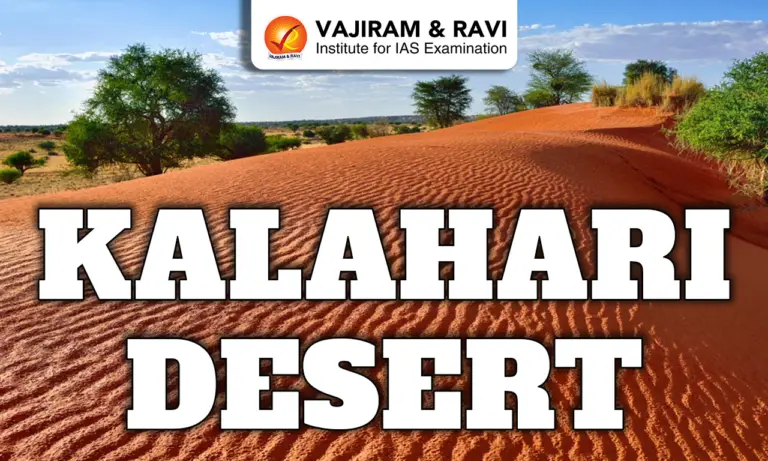
The Kalahari Desert is one of the largest semi-arid regions of the world, located in the interior plateau of Southern Africa. It extends across Botswana, Namibia, and South Africa and is known for its vast sandy landscape. Although it is called a desert, it is more accurately described as a “thirstland” because some parts receive seasonal rainfall.
Kalahari Desert Location and Extent
- The Kalahari Desert is a vast sandy basin located in the interior of Southern Africa, covering multiple countries and forming a major physiographic unit of the African plateau.
- It extends across almost the whole of Botswana, the eastern part of Namibia, and the northern region of Northern Cape in South Africa.
- The desert stretches approximately 1600 km from north to south and about 960 km from east to west, covering nearly 9,30,000 square kilometres.
- In the southwest, it gradually merges with the Namib Desert, forming a transition between inland and coastal desert systems.
Kalahari Desert Physiography and Geology
- The Kalahari is characterized by a gently undulating sandy plain situated at an average elevation of about 900 metres above sea level, giving it a plateau-like appearance.
- The surface is largely featureless, with occasional rocky outcrops known as kopjes, which rise abruptly and expose the underlying bedrock.
- The eastern part is dominated by extensive sand sheets formed during the Pleistocene period, which show minimal relief and are relatively stable.
- The western part contains long, parallel sand dunes aligned in a northwest direction, separated by natural corridors called straats, which facilitate movement.
- Depressions known as pans or vleis, such as the Makgadikgadi Pans, represent ancient lake beds where salts accumulate due to evaporation.





Kalahari Desert Drainage System
- The Kalahari has an internal drainage system where most of the rainwater does not form rivers but is absorbed into the sandy surface or evaporates quickly.
- Surface drainage is largely absent in the central and southern parts, resulting in a lack of permanent rivers.
- Water that does accumulate flows into pans, where it evaporates and leaves behind mineral deposits.
- A unique exception exists in the north, where the Okavango River flows into the desert and forms the Okavango Delta, creating wetlands.
- In years of heavy rainfall, water may extend to Lake Ngami, illustrating a rare case of water surplus within a desert region.
Kalahari Desert Climate
- The climate of the Kalahari is semi-arid, with significant variation in rainfall across regions, making it a transitional desert environment.
- Rainfall decreases from northeast to southwest, ranging from more than 500 mm annually in the north to less than 125 mm in the south.
- Most rainfall occurs during summer in the form of localized thunderstorms, leading to high variability both spatially and temporally.
- The region experiences extreme temperature variations, with very hot days and cold nights due to clear skies and low humidity.
- Despite receiving rainfall in some areas, the region suffers from edaphic drought, where water quickly infiltrates sand and is unavailable to plants.
Kalahari Desert Soils
- The soils of the Kalahari are predominantly sandy, red in colour due to iron oxide, and have very low organic content.
- These soils are generally alkaline and lack fertility, making agriculture difficult.
- In areas around pans, soils are highly saline or calcareous, often becoming toxic for most types of vegetation.
- The porous nature of the soil leads to rapid infiltration of water, reducing surface moisture availability.
Kalahari Desert Natural Vegetation
- Vegetation in the Kalahari varies significantly based on rainfall distribution and soil conditions.
- The southern part supports sparse vegetation, mainly consisting of drought-resistant shrubs and grasses.
- The central region has scattered trees such as acacia, along with mixed grasslands and shrubs.
- The northern region resembles savanna woodland, with taller trees like baobabs and denser vegetation.
- Plants in this region are typically deep-rooted or adapted to survive long dry periods.
Kalahari Desert Fauna
- The Kalahari supports a diverse range of wildlife, particularly in the relatively wetter northern areas.
- Herbivores such as springbok, wildebeest, and antelopes are common, often moving in herds.
- Predators include lions, cheetahs, leopards, and hyenas, forming a balanced ecosystem.
- Many species have adapted to survive with minimal water, deriving moisture from food and metabolic processes.
- The region also supports reptiles, birds, and small mammals, contributing to its ecological richness.
Kalahari Desert Human Geography
- The desert is inhabited by indigenous groups such as the San people, who traditionally practiced hunting and gathering.
- Bantu-speaking communities like the Tswana and Herero later migrated into the region and adopted pastoral and agricultural practices.
- Settlements are sparse and usually located near water sources such as wells and boreholes due to water scarcity.
- Overgrazing and population pressures have led to environmental degradation in some areas.
Kalahari Desert Economic Activities
- Pastoralism, especially cattle rearing, forms the backbone of the local economy, though it often leads to overgrazing.
- Mining, particularly diamond mining in Botswana, has become an important economic activity.
- Tourism, including wildlife safaris and desert exploration, contributes significantly to the regional economy.
- Local communities also engage in handicrafts and small-scale agriculture where conditions permit.

 Last updated on March, 2026
→ UPSC Final Result 2025 is now out.
→ UPSC has released UPSC Toppers List 2025 with the Civil Services final result on its official website.
→ Anuj Agnihotri secured AIR 1 in the UPSC Civil Services Examination 2025.
→ UPSC Marksheet 2025 is now out.
→ UPSC Notification 2026 & UPSC IFoS Notification 2026 is now out on the official website at upsconline.nic.in.
→ UPSC Calendar 2026 has been released.
→ Check out the latest UPSC Syllabus 2026 here.
→ UPSC Prelims 2026 will be conducted on 24th May, 2026 & UPSC Mains 2026 will be conducted on 21st August 2026.
→ The UPSC Selection Process is of 3 stages-Prelims, Mains and Interview.
→ Prepare effectively with Vajiram & Ravi’s UPSC Prelims Test Series 2026 featuring full-length mock tests, detailed solutions, and performance analysis.
→ Enroll in Vajiram & Ravi’s UPSC Mains Test Series 2026 for structured answer writing practice, expert evaluation, and exam-oriented feedback.
→ Join Vajiram & Ravi’s Best UPSC Mentorship Program for personalized guidance, strategy planning, and one-to-one support from experienced mentors.
→ Shakti Dubey secures AIR 1 in UPSC CSE Exam 2024.
→ Also check Best UPSC Coaching in India
Kalahari Desert FAQs
Q1. Where is the Kalahari Desert located?+
Q2. What is the Kalahari Desert known for?+
Q3. Why is the Kalahari Desert called a thirstland?+
Q4. What type of climate does the Kalahari Desert have?+
Q5. What is unique about the drainage system of the Kalahari Desert?+
Tags: kalahari desert