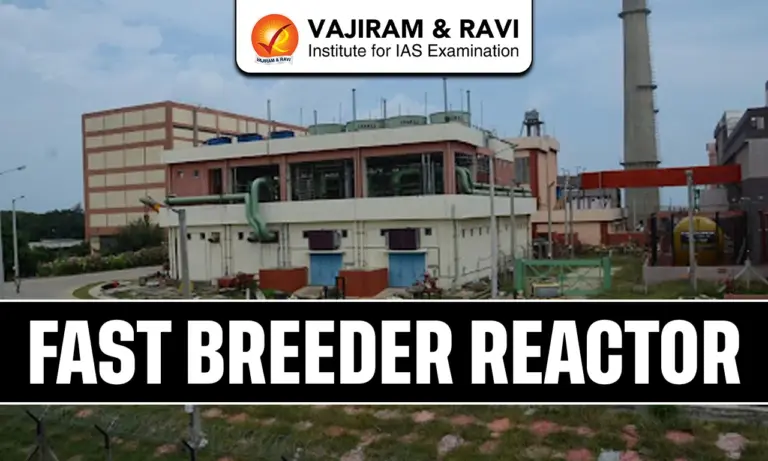
Fast Breeder Reactor Latest News
- India’s Prototype Fast Breeder Reactor (PFBR) at Kalpakkam has achieved criticality, marking a key milestone in the nuclear programme.
About Fast Breeder Reactor
- A Fast Breeder Reactor (FBR) is a type of nuclear reactor that generates more fissile material than it consumes.
- Unlike conventional reactors, which use thermal (slow) neutrons, FBRs use fast neutrons to sustain nuclear fission. This allows efficient utilisation of fuel and enhances energy output.
- FBRs typically use plutonium-based fuel, often in the form of Mixed Oxide (MOX), along with fertile materials such as uranium-238. These fertile materials are converted into fissile material (like plutonium-239) during reactor operation.
- A key feature of FBRs is the “breeding” process. In this process, non-fissile material is transformed into fissile material through neutron absorption, thereby creating additional fuel.
- FBRs are crucial for countries like India that have limited uranium reserves but abundant thorium resources.
- They form the second stage of India’s three-stage nuclear programme, enabling the transition toward thorium-based energy systems.





Significance of Fast Breeder Reactors
- Fast breeder reactors play a critical role in ensuring long-term energy security.
- They significantly improve fuel efficiency by extracting more energy from available uranium resources.
- They also reduce nuclear waste by utilising materials that would otherwise remain unused.
- In India’s context, FBRs are essential for converting thorium into uranium-233, which is vital for the third stage of the nuclear programme.
Criticality in Nuclear Reactors
- Criticality refers to the state in which a nuclear reactor achieves a self-sustaining chain reaction.
- At this stage, each fission event produces enough neutrons to sustain further fission reactions without external intervention.
- Criticality is a crucial milestone in reactor commissioning. It indicates that the reactor core is functioning as designed and is ready to move toward power generation.
- There are three states associated with criticality:
- Subcritical state, where the reaction dies out over time.
- Critical state, where the reaction is stable and self-sustaining.
- Supercritical state, where the reaction increases rapidly.
- Achieving controlled criticality is essential for the safe and efficient operation of nuclear reactors.
News Summary
- India’s 500 MWe Prototype Fast Breeder Reactor (PFBR) at Kalpakkam in Tamil Nadu has attained criticality, marking a defining step in the country’s nuclear energy programme.
- The reactor is located at the Indira Gandhi Centre for Atomic Research and is operated by Bharatiya Nabhikiya Vidyut Nigam Limited (BHAVINI), a public sector enterprise under the Department of Atomic Energy.
- The PFBR is a sodium-cooled, pool-type fast breeder reactor that uses mixed oxide (MOX) fuel consisting of uranium-238 and plutonium-239. It is designed to generate more fissile material than it consumes, thereby enhancing fuel sustainability.
- Achieving criticality means that the reactor has initiated a self-sustaining nuclear fission chain reaction, indicating readiness for eventual power generation.
- The project is a key component of India’s three-stage nuclear programme.
- In the first stage, Pressurised Heavy Water Reactors (PHWRs) produce plutonium.
- In the second stage, fast breeder reactors like PFBR use this plutonium to generate additional fissile material.
- The third stage aims to use thorium to produce uranium-233 for long-term energy security.
- India is now among a select group of countries possessing advanced fast breeder reactor technology, with Russia being the only other nation operating commercial-scale FBRs.
- The reactor also incorporates important safety features such as a negative void coefficient, which reduces reaction rates in case of overheating, enhancing operational safety.
- Overall, the achievement of criticality at Kalpakkam marks a significant step toward India’s goal of developing a closed nuclear fuel cycle and reducing dependence on imported uranium.

 Last updated on April, 2026
→ UPSC Final Result 2025 is now out.
→ UPSC has released UPSC Toppers List 2025 with the Civil Services final result on its official website.
→ Anuj Agnihotri secured AIR 1 in the UPSC Civil Services Examination 2025.
→ UPSC Marksheet 2025 is now out.
→ UPSC Notification 2026 & UPSC IFoS Notification 2026 is now out on the official website at upsconline.nic.in.
→ UPSC Calendar 2026 has been released.
→ Check out the latest UPSC Syllabus 2026 here.
→ UPSC Prelims 2026 will be conducted on 24th May, 2026 & UPSC Mains 2026 will be conducted on 21st August 2026.
→ The UPSC Selection Process is of 3 stages-Prelims, Mains and Interview.
→ Prepare effectively with Vajiram & Ravi’s UPSC Prelims Test Series 2026 featuring full-length mock tests, detailed solutions, and performance analysis.
→ Enroll in Vajiram & Ravi’s UPSC Mains Test Series 2026 for structured answer writing practice, expert evaluation, and exam-oriented feedback.
→ Join Vajiram & Ravi’s Best UPSC Mentorship Program for personalized guidance, strategy planning, and one-to-one support from experienced mentors.
→ Shakti Dubey secures AIR 1 in UPSC CSE Exam 2024.
→ Also check Best UPSC Coaching in India
Fast Breeder Reactor FAQs
Q1. What is a Fast Breeder Reactor?+
Q2. What does criticality mean in nuclear terms?+
Q3. Where is India’s PFBR located?+
Q4. What fuel is used in the PFBR?+
Q5. Why are FBRs important for India?+
Tags: fast breeder reactor mains articles upsc current affairs upsc mains current affairs