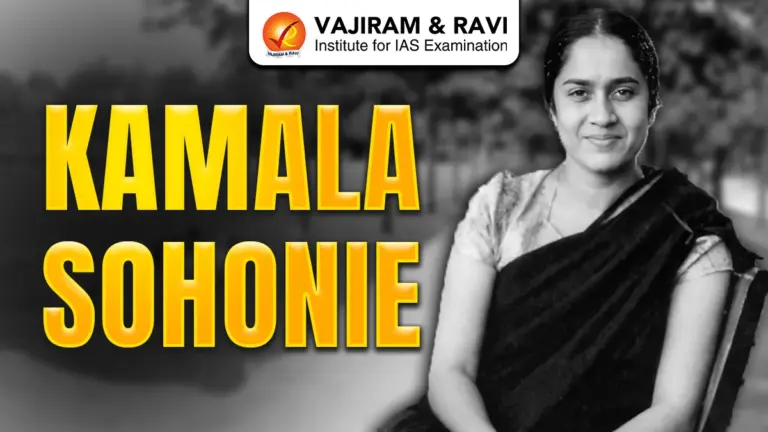
Kamala Sohonie was an Indian biochemist and a pioneer in Indian science. She became the first Indian woman to earn a PhD in a scientific subject at a time when women were largely kept out of research.
Kamala Sohonie Early Life and Education
- Kamala Sohonie was born on 18 June 1911 in Indore, in present-day Madhya Pradesh.
- She graduated in 1933 with a BSc degree in Chemistry and Physics from Bombay University, securing the top rank in the merit list.
- Despite her excellent academic record, Kamala Sohonie’s application to the Indian Institute of Science (IISc) was first rejected because C.V. Raman, head of IISc, believed that women were not suited for scientific research. She protested peacefully, and Raman eventually agreed to admit her under strict conditions. Her outstanding work later changed his attitude, and IISc was opened to women researchers.
- She secured admission to Cambridge University, England, in 1936. At Cambridge, she finished her PhD in merely 14 months, and her thesis was just 40 pages.
- In 1939, she came back to India to serve her country.
Also Read: Annie Besant
Kamala Sohonie Contribution
- As the first woman admitted to the Indian Institute of Science (IISc), she challenged gender bias, leading C.V. Raman to allow her and other women to join the institute.
- During her time in Cambridge University, Kamala Sohonie worked on potatoes and discovered the enzyme ‘Cytochrome C’, a type of protein in the mitochondria which plays an important role in cellular respiration.
- Kamala Sohonie’s most impactful contribution was her research on Neera, a natural palm extract. She demonstrated that Neera is rich in vitamins, minerals, and nutrients and could fight malnutrition among children from tribal communities in India. For this socially transformative work, she was awarded the Rashtrapati Award.
- She became the first female director of the Institute of Science, Mumbai.
- She was also a founding member of the Consumer Guidance Society of India, advocating for consumer rights.
- She served as head of the Department of Biochemistry at Lady Hardinge College, New Delhi.
- She also served as Assistant Director of the Nutrition Research Lab, Coonoor.






 Last updated on April, 2026
→ UPSC Final Result 2025 is now out.
→ UPSC has released UPSC Toppers List 2025 with the Civil Services final result on its official website.
→ Anuj Agnihotri secured AIR 1 in the UPSC Civil Services Examination 2025.
→ UPSC Marksheet 2025 is now out.
→ UPSC Notification 2026 & UPSC IFoS Notification 2026 is now out on the official website at upsconline.nic.in.
→ UPSC Calendar 2026 has been released.
→ Check out the latest UPSC Syllabus 2026 here.
→ UPSC Prelims 2026 will be conducted on 24th May, 2026 & UPSC Mains 2026 will be conducted on 21st August 2026.
→ The UPSC Selection Process is of 3 stages-Prelims, Mains and Interview.
→ Prepare effectively with Vajiram & Ravi’s UPSC Prelims Test Series 2026 featuring full-length mock tests, detailed solutions, and performance analysis.
→ Enroll in Vajiram & Ravi’s UPSC Mains Test Series 2026 for structured answer writing practice, expert evaluation, and exam-oriented feedback.
→ Join Vajiram & Ravi’s Best UPSC Mentorship Program for personalized guidance, strategy planning, and one-to-one support from experienced mentors.
→ Shakti Dubey secures AIR 1 in UPSC CSE Exam 2024.
→ Also check Best UPSC Coaching in India
Kamala Sohonie FAQs
Q1. Who was Kamala Sohonie?+
Q2. Why is Kamala Sohonie famous?+
Q3. What was Kamala Sohonie’s major scientific contribution?+
Q4. What is Neera and why is it important?+
Q5. Kamala Sohonie received the Rashtrapati Award for what?+
Tags: kamala sohonie modern history